

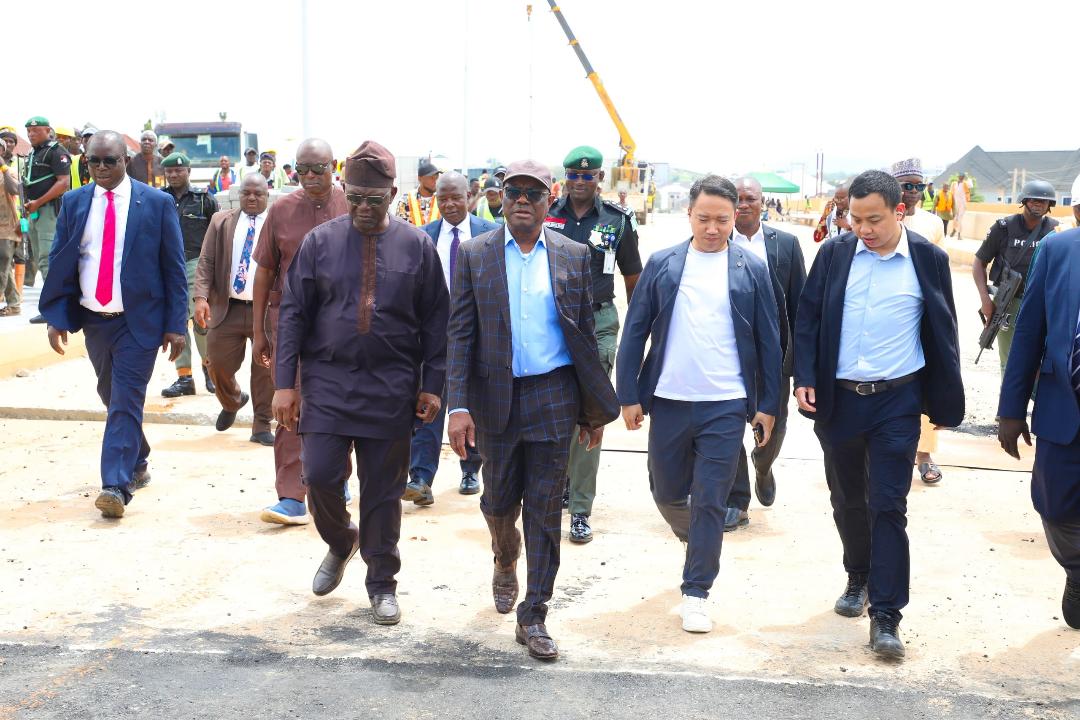
Minister Federal Capital Territory (FCT), Nyesom Wike is expected to commission at least 18 projects during the third anniversary celebration of President Bola Tinubu.
The Minister revealed this on Monday while addressing journalists shortly after an inspection tour of projects and the three-storey building in Gudu area of the FCT, which collapsed over the weekend.
Deputy Director Press in the Minister’s office Rabi Musa in a statement said, during the tour, the Minister had inspected the ongoing construction of the road and a bridge connecting the Central Business District and Wuse District.
He acknowledged the efforts of the contractor, Levant Nigeria Limited, and urged them to finish the project by the first week of June rather than the middle of June.
The Minister also visited the road to the Mabushi bus terminal being carried out by Setraco, as well as the Bridge Interchange connecting Jahi and Gwarimpa being constructed by CBC Global.
He said, “I think we are doing quite a good job…probably towards 28 of May, we should be able to say the total number of projects that are available. But you know with the way we are going, it will not be less than 20, assuming it doesn’t get to 20, it cannot be less than 18 projects”.
The Minister described the projects slated for commissioning as projects that touch the lives of residents of the FCT.
“We believe these projects of course, are projects that touch the lives of residents of Abuja, and they will also have very positive impact on the economy of the FCT”.
Speaking on the collapsed building, which resulted in the death of four persons and nine injured, the Minister lamented the sad situation and ordered the Director of Development Control to set up a panel to look into the cause of the collapse.
He further disclosed that one of the engineers had been arrested, and the developer will soon be apprehended as well, while the premises have been sealed off.
“Well, it’s unfortunate, and from the reports I got, we lost not less than 4 persons and some lives were saved. It’s very pathetic, very pathetic…Developers should also allow government to thoroughly supervise whatever construction that is going on. When you are constructing buildings of this nature, the lives of the people is very, very importan.
“I have told the Director of Development Control to seal up the premises. We are going to set up a panel to really look at what really happened”, he stated.
The Minister reiterated the need for developers to ensure that the Development Control Department is allowed to supervise every stage of construction, especially for projects of such magnitude.
He, however, added that some developers often resort to blackmail whenever government agencies attempt to enforce compliance with building regulations.
“Sometimes when we come to a site like this, the press has not been kind to us. Instead of finding out why government is taking that decision, some people will go to blackmail government officials”, he said.
The Minister stressed that strict compliance with building standards, including soil tests and the use of quality materials, remained critical to preventing future disasters.
“In construction of buildings, we must know the quality. What materials are they using? Are they doing the soil test? What is the result of the soil test? Can it allow for two floors or three floors? All these are very key”, he stressed.
He maintained that government’s primary responsibility was the protection of lives and property, lamenting that the lives lost in the collapse could never be replaced, saying,
“How can you buy back these lives? They are gone! That is the responsibility of government: to protect life and property”.
At the building collapse site, Director, Development Control Department, Dr Tpl Sunusi Bashir Madaki, in his preliminary report, disclosed that the soil at the site was made up from dredged waterways over the years. He also said that there was a local well of two metres depth at the location, which was not visible to officials or the developer.
In his words, “There is a local well at the site which had been filled up with debris and clay, but was not visible to the developer, so column C and D of the collapsed structure were placed on the pit, and the length of the columns was 1.5 metres, the depth of the well was 2 metres, so that shortage created the collapse”.
