

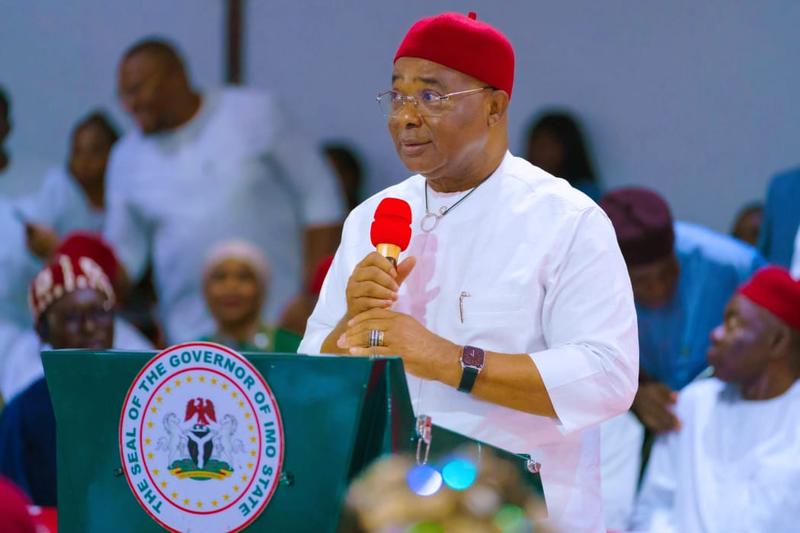
Imo State Governor Hope Uzodimma has urged South-East leaders to stop lamenting marginalisation and instead unite, rethink their political strategy and collectively negotiate the region’s interests with the Federal Government.
Speaking at the South-East Stakeholders’ Convergence at the Banquet Hall of Government House, Owerri, Uzodimma said the region must move beyond internal divisions and opposition politics, and prepare a clear, evidence-based list of its needs to present to President Bola Tinubu for negotiation.
“Unite, rethink your political strategies and collectively negotiate the interests of the Southeast with the Federal Government,” Uzodimma said.
He argued that internal divisions and opposition politics had limited the region’s ability to secure tangible benefits from Abuja.
The Governor, host of the meeting, urged leaders to separate personal political ambitions from collective regional interests and called on South-East Governors, traditional institutions and private-sector figures to back the South-East Development Commission (SEDC) in delivering infrastructure and economic projects.
The communiqué includes several high-stakes requests: restructuring Nigeria into six geopolitical zones, federal approval for a privately developed South-East seaport, and commitments from presidential candidates to regional rail and gas infrastructure.
It also calls for a meeting with President Bola Tinubu and the creation of a permanent secretariat to track implementation.
Supporters of the proposals say improved transport and energy links are essential to unlocking the region’s industrial potential.
Former Imo State Military Governor and former Foreign Affairs Minister Ike Nwachukwu, who chaired the meeting, cited the collaborative effort behind the Sam Mbakwe International Cargo Airport as evidence that unified action can deliver major infrastructure.
Nwachukwu said insecurity, economic hardship, political fragmentation and mutual distrust had weakened the South-East’s position in national affairs.
He urged political leaders to place regional development above party affiliation and to pursue economic integration, industrialisation and youth employment.
Deputy Speaker of the House of Representatives Benjamin Kalu made a similar appeal, saying that Igbo leaders must participate more actively in national decision-making rather than remain outside the political process.
“If we are not in the room, we can’t be part of the decision,” he said.
Former Senate President Anyim Pius Anyim and former Anambra State Governor Jim Nwobodo also pressed for regular consultations across party lines, with Nwobodo proposing rotating stakeholder meetings among the South-East states.
The meeting reflects a broader effort by South-East elites to convert longstanding complaints about political exclusion into a coordinated negotiating position with the Federal Government.
Whether the region’s diverse political and business interests can sustain that unity and translate the communiqué into federal commitments remains the central test.
Chief Ozichukwu Chukwu, a former President-General of Ohanaeze Ndigbo, described the agenda in more assertive terms, calling for collective negotiation and saying, “We are not beggars. We are asking for our rights.”
