

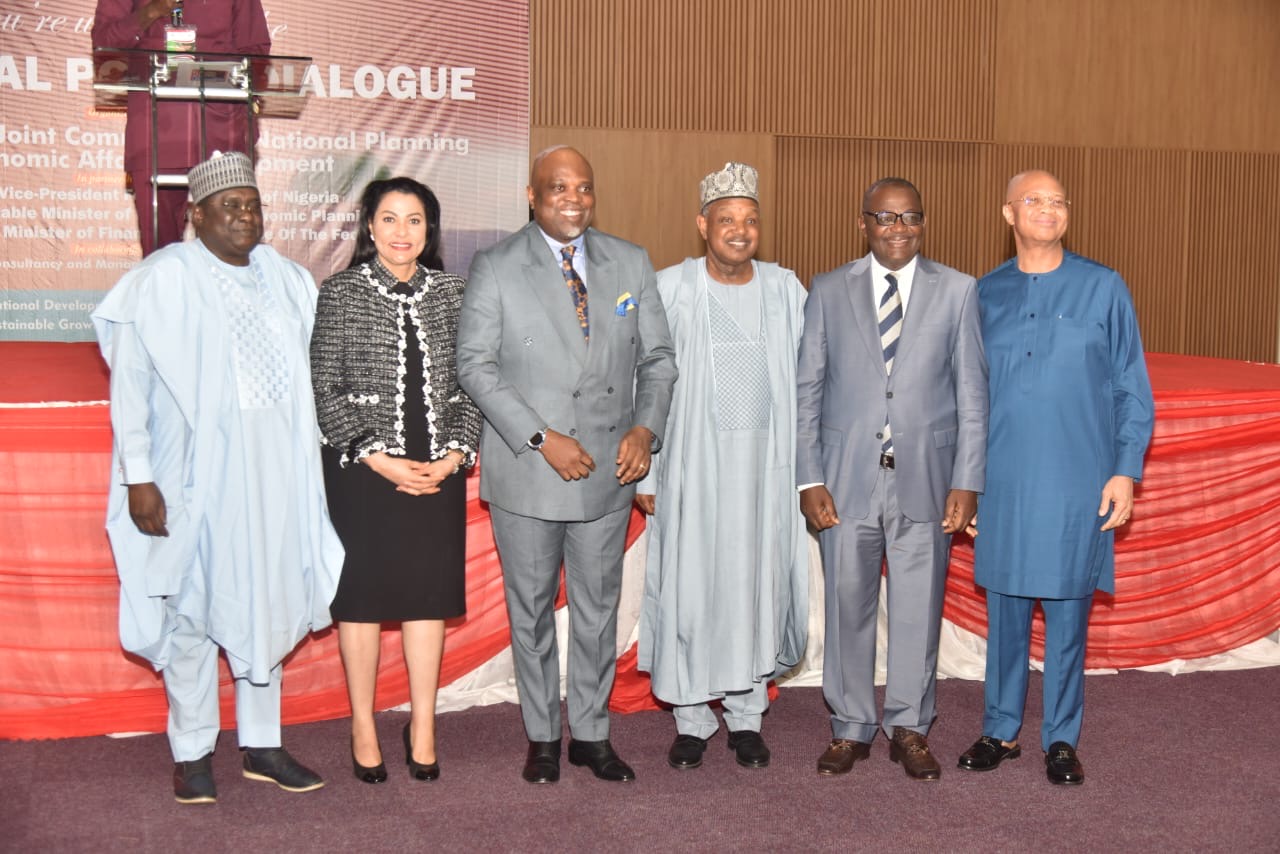
Vice President Kashim Shettima, joined by former Budget Office chief Ben Akabueze and key stakeholders, called Tuesday for urgent reforms to Nigeria’s creaking budgeting framework, aiming to instill realism, long-term sustainability and measurable development gains.
They spoke Tuesday at a two day National Policy Dialogue in Abuja, organised by the National Assembly Joint Committee on National Planning and Economic Development, with a focus on aligning development plans with annual budgets.
Represented by the Special Adviser to the President on Economic Matters, Tope Fasua, the Vice President said the dialogue was timely and critical to Nigeria’s development trajectory.
“This is a very important conversation for the moment and for the future, especially in view of President Tinubu’s vision for Nigeria under the Renewed Hope Agenda,” he said.
He stressed the need to integrate national development plans into annual budgets, noting that such alignment would accelerate growth and improve outcomes for citizens.
“How can our budgets be impacted more positively by these plans, and how do we institute a path towards sustainable growth that improves living standards, reduces poverty, and raises per capita income?” he queried.
Shettima said the administration of Bola Ahmed Tinubu remains committed to expanding the size and impact of the national budget, citing the increase of the 2026 budget to about ₦68 trillion.
“Our budgets should not only be people-focused; they should be larger and more ambitious in reflecting our national aspirations,” he stated.
He dismissed calls for a smaller budget, insisting that “budgeting is not about capitulating to past limitations but about documenting a greater future and challenging ourselves to achieve it.”
The Vice President added that ongoing revenue reforms were already yielding results, noting that “many institutions have been fiscalised and technology is helping to capture revenues that would have otherwise been lost.”
He also highlighted recent fiscal policy measures, saying, “Tariffs on essential raw materials have been reduced and duties on pharmaceuticals, machinery, and manufacturing equipment have been removed to boost productivity.”
Akabueze pointed to a persistent disconnect between development plans and budget implementation, describing it as a major obstacle to national progress.
“One clear symptom is that we have over 56,000 abandoned projects across the country. This is evidence of failure in linking our plans to our budgets,” he said.
He further criticised the structural weakness in Nigeria’s fiscal framework, stating, “Our budget process is not governed by clear laws and rules. The constitution provides only vague provisions, which has led to recurring conflicts and inefficiencies.”
Akabueze called for the passage of a comprehensive budget law, noting that “a clear legal framework will define responsibilities, establish timelines and ensure that budgeting truly drives development outcomes.”
