

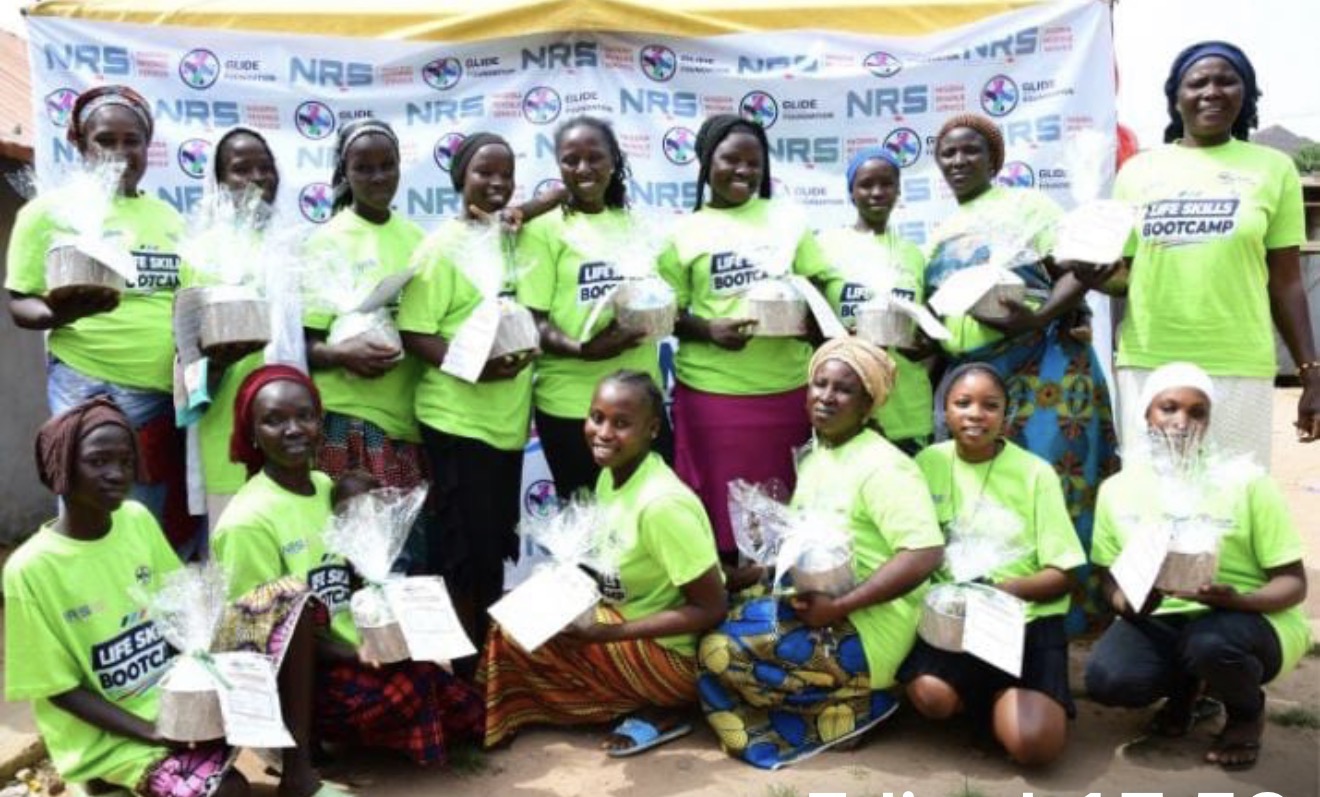
More than 100 women and girls at Abuja’s New Kuchingoro Internally Displaced Persons (IDP) camp have completed a five-day business and vocational programme backed by seed funding.
The effort highlights both the potential of private-led livelihood interventions and the persistent limits of Nigeria’s humanitarian response, and is organized by GLIDE Media Foundation with support from the Nigeria Revenue Service (NRS).
The intervention was concluded on October 24 with hands-on training in baking, soap and petroleum-jelly production, and beaded-slipper making.
Participants also received instruction in packaging, marketing and sales, alongside start-up capital intended to convert the skills into small-scale enterprises.
The programme called the Life Skills Bootcamp, paired technical training with financial-literacy sessions on budgeting, saving, expenditure planning and separating household money from business funds.
Facilitators also introduced participants to digital payment platforms including OPay and Moniepoint, reflecting the growing role of mobile financial services in Nigeria’s informal economy.
Organizers divided participants into three groups for supervised production sessions, while earlier classroom work covered entrepreneurship, personal development, leadership and parenting.
The curriculum also addressed child protection, school attendance and the tension between income generation and caregiving – issues that weigh heavily on women in displacement settings.
The intervention reflects a broader shift among aid organizations away from one-off relief and toward livelihood support. Research on New Kuchingoro has found that displaced women already engage in small-scale trading, food preparation and other informal work, but that insecurity, limited capital and weak institutional support constrain their ability to earn a sustainable living.
For GLIDE Media Foundation, the goal is to reduce dependence on external assistance by helping participants build businesses that can support their families.
The foundation expressed hope that the training and funding would develop into durable income streams rather than short-term relief.
The challenge now is whether the seed capital and newly acquired skills can survive contact with a difficult operating environment.
New Kuchingoro residents, many displaced from the North-East by insurgency, have long relied on nongovernmental organizations, religious groups and philanthropists for basic support, while reporting inadequate government assistance and limited access to markets.
Studies of the camp also point to structural obstacles that training alone cannot resolve: poor coordination among government agencies and NGOs, insecurity outside the camp, and the absence of reliable pathways to resettlement or formal employment.
Still, the programme offers a measurable template: combine marketable skills, financial literacy, digital-payment tools and modest working capital.
NewsQuest reports that its success will depend less on the grand finale than on whether participants can sustain sales, reinvest earnings and eventually reduce their reliance on aid.
