

The Federal Government has approved a ₦70,000 monthly transport allowance for public-sector workers for six months beginning in November, a temporary measure intended to ease the burden of higher living costs amid economic hardship following the removal of fuel subsidy.
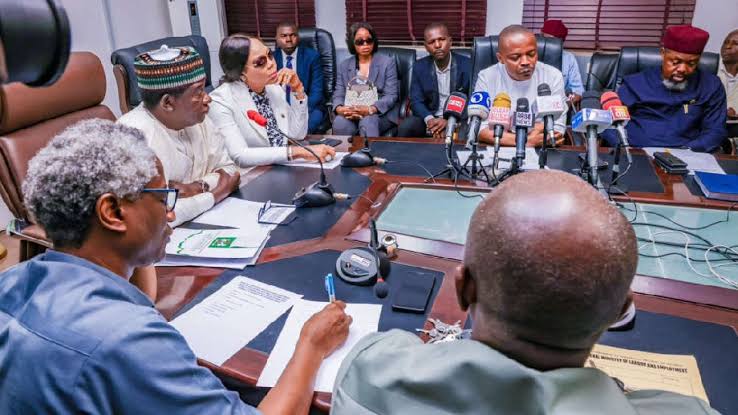
The decision was part of the resolutions from a conciliation meeting between the Federal Government and the Nigeria Labour Congress (NLC) held in Abuja on Tuesday, after organised labour renewed its demands over workers’ welfare, the high cost of living and unfulfilled agreements.
The resolutions were captured in a memorandum of understanding signed after the meeting by the Director-General of Budget, Timi Yakubu; NLC President Joe Ajaero; Permanent Secretary of the Service Welfare Office in the Office of the Head of the Civil Service of the Federation, Dr. Garba Abdul S.U.; and Minister of Labour and Employment, Dr. Muhammad Maigari Dingyadi.
The memorandum, however, did not specify the payment date within each month or detail the administrative arrangements for disbursing the funds.
The government also agreed to pay outstanding “peculiar allowance” arrears, effective from May 1, 2026, in three equal monthly installments beginning in November.
The measures come as workers continue to absorb higher transport, food and energy costs following the May 2023 removal of the fuel subsidy.
Organised labour has pressed for wage increases, lower fuel prices and the fulfilment of earlier welfare agreements.
The two sides agreed to immediately establish a tripartite Minimum Wage Negotiation Committee comprising government, labour and employer representatives.
However, they failed to agree on when any revised minimum wage would take effect, leaving a central issue unresolved.
Titled “Resolutions Reached at a Conciliation Meeting Held at the Federal Ministry of Labour and Employment Between the Federal Government and the Leadership of the Nigeria Labour Congress on Tuesday, 27th October, 2026,” the document detailed agreements covering transport support, outstanding allowances, minimum wage talks, health workers’ pay, tax relief and hazard allowances for agricultural workers.
The government raised the statutory monthly minimum wage from ₦30,000 to ₦70,000 in 2024 through the National Minimum Wage Act.
The latest memorandum refers to fresh discussions but provides no details on the proposal under consideration or a timetable for concluding negotiations.
“We sometimes win some, lose some,” said Chris Onyeka, assistant secretary-general of the NLC, describing the talks as productive but short of labour’s expectations.
On the transport allowance, the memorandum stated: “That transport intervention of Seventy Thousand Naira (₦70,000), commencing from November 2026, would be paid across all levels for a period of six months.”
For health workers, the government committed to clearing 19 months of allowance arrears within three months, starting in December 2026.
The agreement did not state the total amount owed or the specific payment schedule.
The National Salaries, Incomes and Wages Commission (NSIWC) also agreed to complete, within three weeks, an updated assessment of the cost implications of adjusting the Consolidated Health Salary Structure (CONHESS).
That review will inform a decision by the Presidential Committee on Salaries, though no final approval has been announced.
On hazard allowances for agricultural officers, the Ministry of Agriculture has submitted a beneficiary list and cost estimate to the salaries commission for verification, expected within two weeks.
Implementation remains contingent on that review.
Tax relief for workers was referred to the National Executive Council because of its statutory implications, with no measures or timetable specified.
The memorandum also urged state and local governments to adopt similar interventions for their workers.
The government and the NLC agreed to reconvene in one month to assess the implementation of the resolutions.
While the agreement provides immediate financial relief, its overall effect will depend on how well it is implemented and on the outcome of ongoing negotiations over wages and other welfare issues.
