

The Federal Government on Tuesday unveiled a unified national poverty register, alongside plans for a N3.2 trillion ($1.9 billion) humanitarian and poverty reduction fund, in a bid to consolidate fragmented aid programmes and foster sustainable prosperity for millions.
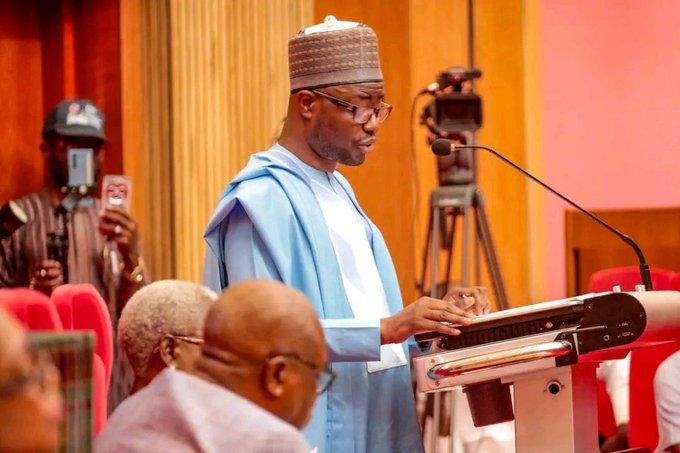
Minister of Humanitarian Affairs and Poverty Reduction Bernard Doro announced this at a workshop on the One Humanitarian One Poverty Response System (OHOPRS).

He described the initiative as a shift from scattered interventions to a cohesive framework.
The Unified National Exits Register, he said, will provide skills training, assets, livelihoods, coaching, and mentoring to help individuals escape poverty, transitioning them to a growth register for ongoing monitoring to prevent relapse.
“We have scattered programs and multiple registers,” Doro told guests. .
“OHOPRS will deliver one national system, real-time digital tracking instead of manual methods, and structured exit strategies.”
He stressed an “all-of-government” approach to tackle poverty’s multidimensional facets — from lacking nearby healthcare despite financial means, to deprivations in housing, sanitation, education, and security — involving ministries, states, partners, and the private sector.
Doro stressed the urgency amid climate shocks, displacement, and economic pressures, warning that disunity risks inefficiency.
Expected outcomes include a real-time poverty dashboard, anticipatory humanitarian responses, and integration of all programs under OHOPRS.
The proposed National Humanitarian and Poverty Reduction Trust Fund targets N1.5 trillion from the federal government, N800 billion from development partners, N600 billion from private sector and impact finance, and N300 billion from climate and global funds, with contributions eyed from the World Bank, European Union, United Nations, and others.
The Minister also described OHOPRS as “Nigeria’s blueprint for lifting our people from poverty to prosperity,” moving the focus from relief to results.
Doro noted the Push for Credible Targeting
Statistician-General Adeyemi Adeniran of the National Bureau of Statistics emphasized reliable data as the cornerstone, citing the 2022 National Multidimensional Poverty Index showing 63 percent of Nigerians — 133 million people — multidimensionally poor.
“These figures represent households and communities whose vulnerabilities demand coordinated, evidence-based responses,” Adeniran said.
The NBS pledged support through data harmonization, quality standards, interoperability via unique identifiers with the National Identity Management Commission, and secure protocols, including a recent pact with the National Data Protection Commission.
“No single institution can address poverty’s complexity alone,” he added.
“We must collaborate with government, partners, civil society, and the private sector for a transparent, inclusive system.”
