

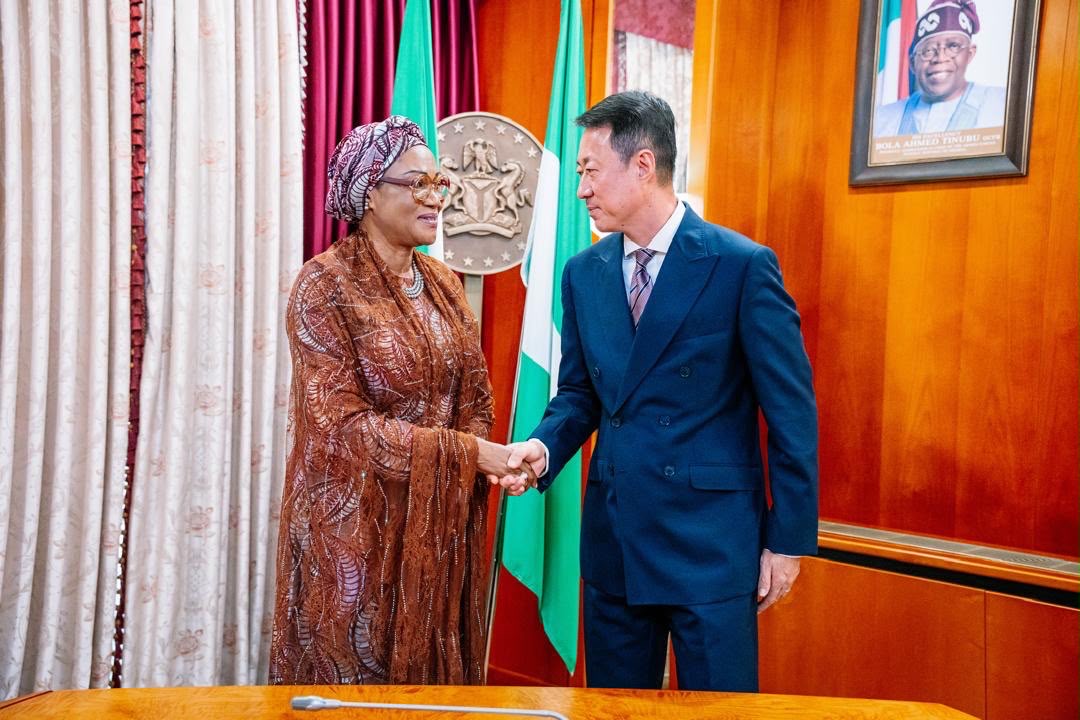
China’s Ambassador to Nigeria, Yu Dunhai, has publicly endorsed the continuation of President Bola Tinubu’s economic reforms beyond 2027, citing a sharp rise in bilateral trade and improving investor sentiment as evidence that the programme is working.
The top diplomat delivered the message during his first courtesy visit to First Lady Oluremi Tinubu at the presidential villa, Abuja on Thursday since taking office in 2024.
Speaking at the First Lady’s office, Mr. Yu said Nigeria had “taken a new shape” over the past three years, with stronger macroeconomic foundations and renewed confidence among foreign investors.
He urged the country to maintain its reform path and consolidate the gains beyond the 2027 election cycle.
The ambassador pointed to bilateral trade reaching $18 billion in the first half of 2026, an increase of 35% year-on-year, while Chinese imports from Nigeria rose 81% to $2.3 billion.
He described the growth in Nigerian exports as “tremendous” and said Beijing would not hesitate to deepen its commercial engagement with Abuja.
Mr. Yu said China would pursue a partnership based on the principle that Africa’s resources belong to Africans, emphasizing high-quality investment and greater use of local human capital.
His remarks align with Beijing’s broader effort to expand access for African exports under a zero-tariff regime that took effect on May 1, 2026.
Nigeria and China elevated their relationship to a comprehensive strategic partnership in 2024 during President Tinubu’s state visit to Beijing.
Mr. Yu arrived in Abuja as ambassador in August 2024, and has since described the relationship as entering a “fast lane.”
First Lady Tinubu welcomed China’s endorsement of the president’s prospective second term, describing it as “cheering” and praising Beijing’s interest in agriculture and technology-driven food security. She pledged to encourage cooperation between the Renewed Hope Initiative and the Federal Ministry of Agriculture and Food Security.
“Nigeria is transforming. And we must embrace the new Nigeria,” she said, according to a statement by her Senior Special Assistant on Media, Busola Kukoyi.
The visit also explored Chinese support in health, education and food security.
NewsQuest reports that the Ambassador’s intervention comes as the Tinubu administration seeks international validation for reforms that have included currency adjustment, subsidy removal and fiscal consolidation.
China’s trade figures provide a concrete data point, though the widening gap between Chinese exports to Nigeria – $24.9 billion in 2025, up from $18.9 billion in 2024, and Nigerian exports to China remains a central test of whether the partnership delivers balanced gains.
