

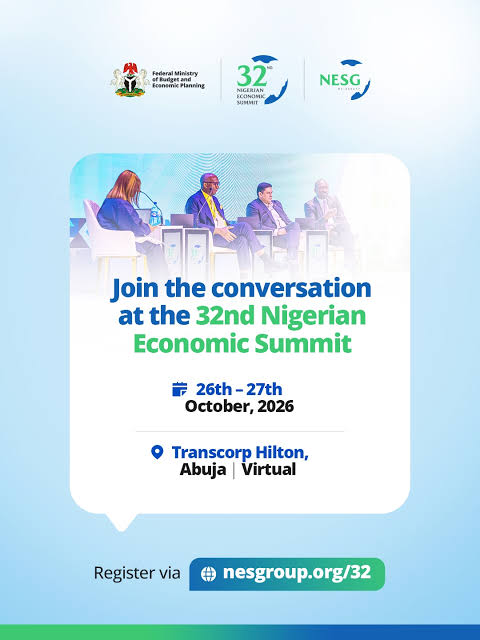
The 32nd Nigerian Economic Summit ( NES) will open in Abuja on Monday, October 26, with policymakers, private-sector leaders and development partners converging to chart strategies for job creation, improved productivity and inclusive growth aimed at delivering shared prosperity for Nigerians.
The two-day event, organised by the Nigerian Economic Summit Group (NESG), will be held at the Transcorp Hilton Hotel under the theme, “Growth that Works: Delivering Jobs, Productivity and Shared Prosperity.”
The meeting will bring together top government officials, business leaders, financial experts, academics and development partners to find practical solutions to Nigeria’s economic challenges.
President Bola Tinubu, Vice President Kashim Shettima, members of the Federal Executive Council, state governors and leading private-sector figures are among those expected to participate.
The summit comes at a crucial point in Nigeria’s economic reforms, as the country works to sustain recent macroeconomic gains and ensure that policy changes lead to real improvements in living standards and business conditions.
Organisers frame the central challenge bluntly: stabilisation is necessary, but not sufficient, unless it produces productive employment, higher incomes and reduced poverty.
Discussions are expected to focus on how Africa’s most populous nation can become more competitive and inclusive—expanding domestic production, attracting long-term capital and strengthening the parts of the economy that create jobs.
The agenda is divided into five areas: Work Nigeria, Produce Nigeria, Invest Nigeria, Scale Nigeria and Secure Nigeria.
Together, they aim to link labour-market reform, industrial productivity, investment mobilisation, state-level development and security to a single growth strategy.
Work Nigeria will examine how to expand productive employment and absorb young labour-market entrants.
Produce Nigeria will address productivity, industrialisation, value addition and the cost constraints facing businesses.
Invest Nigeria on the other hand will focus on mobilising domestic and foreign capital and improving the investment climate.
On its own part, Scale Nigeria will explore how Nigeria’s 36 states and the Federal Capital Territory (FCT) can become stronger engines of growth.
Secure Nigeria will consider how insecurity affects economic resilience and investor confidence.
These themes reflect persistent obstacles: inadequate infrastructure, high production costs, weak productivity and security risks that continue to constrain firms and limit broad-based prosperity.
Scheduled speakers include United Nations ( UN) Deputy Secretary-General Amina Mohammed, BUA Group Chairman Abdul Samad Rabiu and Oxford University economist Stefan Dercon.
According to the organisers, the summit is intended to produce practical policy proposals rather than a broad statement of aspirations.
The gathering will proceed in a modified hybrid format under health protocols agreed with the Nigeria Centre for Disease Control and Prevention (NCDC) and the Federal Ministry of Health and Social Welfare.
The decision follows the confirmation, on October 20, of a single imported case of Ebola caused by the Bundibugyo virus in Abuja.
The patient, a woman who travelled from Uganda, is in isolation and receiving care; authorities have identified 44 contacts for monitoring as investigations continue.
The health measure adds a logistical complication to an event designed to showcase Nigeria’s economic direction to domestic and international investors.
