

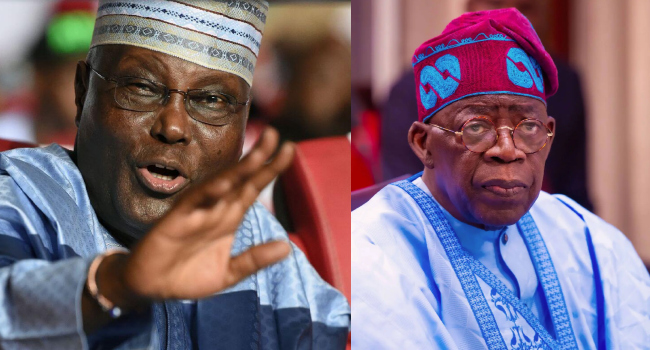
Former Vice President and African Democratic Congress (ADC) presidential candidate, Atiku Abubakar, on Saturday described President Bola Tinubu’s claim that the opposition created hunger and poverty as a delusional and shameless attempt to evade responsibility for the hardship his administration has inflicted on Nigerians.
Tinubu, addressing supporters at the All Progressives Congress (APC) campaign flag-off in Kaduna, said: “I hear my opponents talking about hunger and poverty.
“Who created it? They did!” he said, arguing that his administration was working to eradicate hardship inherited from its predecessors.
In a statement, Director of Strategic Communication for the African Democratic Congress (ADC) Presidential Campaign Council (PCC), Phrank Shaibu called the president’s assertion “either delusion or a staggering case of political amnesia.”
He said the APC had governed for eight years before Tinubu took office and had now held power for another three and a half years.
“A president cannot light the fire of hardship with his own policies, then blame the neighbours for the smoke,” Atiku said, framing the dispute as a question of accountability rather than campaign rhetoric.
The ADC presidential candidate directed a series of challenges at the administration, including its removal of petrol subsidies, the naira’s depreciation from about ₦471 to ₦1,329 per dollar, and what he described as unresolved questions over energy-related spending and external accounts.
Atiku cited a World Bank estimate that 63% of Nigerians would be below the national poverty line in 2026.
The bank’s October 2026 Poverty & Equity Brief says poverty rose from 40.1% in 2019 to 56.2% in 2023 and is projected to remain at 63% in 2026, with food insecurity still elevated.
The former vice president also criticized the president’s decision to commission the unfinished Abuja-Kaduna Expressway from a stadium, saying a road “cannot be completed with a speech or a ribbon-cutting ceremony.”
Atiku said Nigerians would judge the administration by conditions in their homes, markets and communities—not by explanations offered at rallies.
He cast the 2027 presidential vote as “a referendum” on Tinubu’s record.
The president’s allies have countered that opposition figures, including Atiku and Peter Obi of the National Democratic Congress (NDC), are exploiting hardship for political gain while offering few concrete remedies.
Tinubu has defended subsidy removal as a necessary reform and promised prosperity in a second term.
With inflation, insecurity and poverty dominating public concern, both campaigns appear set to make the lived economic experience of Nigerians the defining issue of the 2027 contest.
