

By Chief Adebisi Akande
A call on the Yoruba People at The Centenary Celebration Of Pa Reuben Fasoranti.

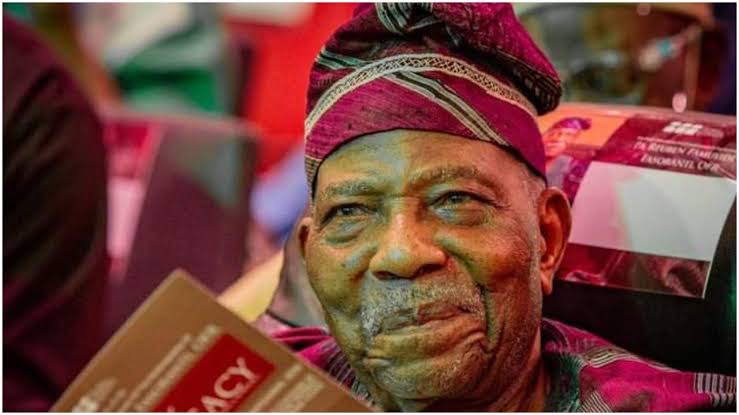
It is with profound deep sense of historical responsibility that I have to share felicitations with my compatriots today on this momentous occasion marking the centenary of Pa Reuben Fasoranti who was born on May 11, 1926 — a man whose life, over the span of a century, has come to embody discipline, moral clarity, and an unwavering commitment to the ideals thatdefine the Yoruba nation.
A hundred years in the life of such a man is not merely a passage of time; it is a living archive of struggle, sacrifice, and steadfast adherence to principle. In celebrating Baba Fasoranti, we are not only honouring longevity but alsoacknowledging a consistency of purpose that has endured through shifting political seasons and changing national circumstances.
His life invites reflection—not of sentiment, but of responsibility. It compels us to look beyond celebration and to confront, with clarity and honesty, the condition of the people and the ideals to which he has devoted himself. It is from that standpoint that I invite us to reflect on a question that has followed the Yoruba nation across generations, shaping its politics, influencing its choices, and, at critical moments, determining its trajectory—the question of unity.
The Burden of History: Unity Tested in Practice
That reflection leads us inevitably to the question of unity—an aspiration that hasendured, but one that has repeatedly been tested in most confusing circumstances.
In the dark days of the 19th century, we lived in constant fears of wars, of invasions and of destabilizations. Even when Oyo Empire collapsed, the Ibadan war mongers resisted the occupation of the Fulani jihadists through Ilorin with the Parapo checkmating the excesses of the Ibadan at the Kiriji battles! The disunity that ensued made the British colonization a walkover.
Even in the era of the sage, Obafemi Awolowo, when the Western Region stood as a model of purposeful governance, unity proved more complex than it appeared. The rupture between Awolowo and Samuel Ladoke Akintola began as a strategic disagreement but, left unmanageable, escalated into a crisis that contributed to the Nigerian instability preceding the military incursion and the Nigerian civil war. It remains a defining reminder that internal fractures rarely remain contained.
By the Second Republic, this pattern had evolved rather than disappeared. During the 1979 and 1983 elections, Awolowo’s presidential bids did not command unanimous Yoruba alignment, as elements within the Yoruba political class found accommodation within alternative national coalitions. What should have been a moment of consolidated regional influence instead reflected a divided strategic posture.
The June 12 experience offered both inspiration and caution. The candidacy of Moshood Abiola drew widespread Yoruba support and national legitimacy, yet following the annulment of theNigerian 1993 presidential election, responseswithin the Yoruba elite were not entirely uniform. While many stood resolutely indefence of that mandate, others adopted more cautious or divergent approaches, revealing once again the difficulty of sustaining unity beyond shared aspiration.
The Fourth Republic presented perhaps the most striking contradiction. In 1999, the Yoruba political mainstream rallied behind Olu Falae, while another Yoruba son, Olusegun Obasanjo, emerged through a different national coalition. By 2003, the
political structure of the South-West was fundamentally altered, as the existing regional leadership was largely displaced. It was a moment that underscored a persistent dilemma: how a people could produce national leadership yet remain regionally fragmented.
These episodes are not distant memories; they are enduring lessons. They demonstrate that the challenge of Yoruba unity has never been theoretical—it has been tested repeatedly at critical moments, and too often, it has faltered where alignment mattered most.
Is Yoruba Unity Under Threat?
It is against this historical background that we must now ask, with clarity and sincerity, whether Yoruba unity is under threat.
For me, the answer is yes—not as a declaration of alarm, but as a sober assessment of present realities. The pressures we face today are less dramatic, but more diffuse. Political divergence has deepened, with partisan affiliations and competitive interests frequently overshadowing shared identity and long-term collective goals.
Yoruba actors increasingly engage one another not as partners in a common project, but as rivals within fragmented political arenas. At the same time, ideological differences regarding the future of Nigeria have become more pronounced. Positions now range from firm commitment to national integration to growing advocacy for autonomy and even secession.
The agitation for a Yoruba nation, while rooted in legitimate grievances, has itself introduced new internal complexities, particularly around questions of feasibility, method, and timing. These tensions are further compounded by a gradual erosion of shared cultural anchors. The ethos that once regulated conduct—discipline, respect, restraint, and communal responsibility —no longer binds with the same consistency.
Trust has become less instinctive, misunderstandings more frequent, and generational differences more pronounced. Even our traditional institutions have not been entirely insulated. Moments of public strain involving revered stools, including the Ooni of Ife and the Alaafin of Oyo, have at times mirrored broader societal tensions.
Taken individually, these issues are manageable. Taken together, they suggest adeeper structural weakening of cohesion.
A Defining Moment: History, Power, and the Opportunity for Alignment
If history teaches us anything: it teaches that moments of political advantage do notautomatically translate into collective progress. They must be recognized, properly interpreted, and deliberately utilized.
We have, in the past, found ourselves at the centre of national power without corresponding regional cohesion. The experience of 1999, and even more pointedly the political realignments of 2003, demonstrated that the presence of aYoruba leader at the helm of the Nigerian state does not, in itself, guarantee the alignment of Yoruba interests or the preservation of Yoruba political structures.
Leadership at the centre, where it is not complemented by coherence at home, can exist alongside fragmentation—and in some cases, even accelerate it. Some of us who were active participants in that period do not speak of it from abstraction, but from lived experience. We saw, first-hand, how quickly a region can lose strategic ground when internal alignment is weak, and how difficult it is to rebuild once that cohesion is disrupted.
It is precisely in the light of that experience that the present moment must be approached with greater clarity.
In the leadership of President Bola Ahmed Tinubu, we are not simply confronted with another instance of Yoruba representation at the national level. What distinguishes this moment is the character of the political process that produced it. This is a leadership forged within the complexities of Yoruba political evolution itself—one that has, over time, navigated internal differences, built coalitions, and sustained relevance across changing national contexts.
This distinction is not merely historical; it is strategic.
For perhaps the first time in a long while, there exists a realistic possibility that alignment at the centre can be matched by coherence within the region. But that possibility will remain unrealized unless it is supported by a deliberate shift in conduct among Yoruba political actors—away from zero-sum competition and toward coordinated purpose.
It must therefore be said, with a sense of responsibility, that the opportunity before us will not implement itself. It will require restraint in moments of rivalry, maturity in the face ofdisagreement, and a conscious willingness to subordinate immediate advantage to longer-term collective interest.
What is at stake extends beyond the fortunes of any administration. It is, more fundamentally, a test of whether the Yoruba nation can align its internal dynamics with its external influence at a time when both appear, for once, to be within reach.
History, as always, will be unsentimental in its judgment. It will record not the opportunities we were given, but the choices we made in response to them.
The Fasoranti Example: Unity Through Principle
In reflecting on this moment, the life of Pa Reuben Fasoranti provides both context and guidance. His role in the post–June 12 period, particularly within Afenifere, was defined not by the absence of disagreement, but by the insistence that disagreement must not be allowed to destroy the collective.
He represents a tradition of leadership rooted in steadfastness, discipline, and moral clarity —one that places the long-term interest of the people above transient advantage. That example is neither nostalgic nor abstract. It is directly relevant to the choices before us.
Beyond Politics: From Sentiment to Lived Reality
If unity is to endure, it must move beyond sentiment to reality. It must find expression in deliberate and sustained collaboration across economic, political, and institutional spheres.
Efforts at regional coordination, including the work of the Development Agenda for Western Nigeria Commission, demonstrate that cooperation, when institutionalized, can provide a foundation for broader cohesion. However, such frameworks must be strengthened, deepened, and supported by a renewed commitment to shared cultural values.
Without a revival of those values – respect, responsibility, and a sense of collective destiny—even the most well-designed institutions will struggle to endure.
A Call to Responsibility. The responsibility, ultimately, lies with us.
History has shown that the Yoruba are capable of unity, but often in response to crisis. The greater challenge, and indeed the more enduring test, is whether unity can be sustained in moments when the pressures are less visible but no less significant.
If we fail under such conditions, then we must accept that our divisions have become habitual. But if we succeed, then this moment may well be remembered as the point at which the Yoruba nation moved from episodic cohesion to deliberate alignment.
Conclusion: Unity as a Deliberate Choice
In reflecting on the journey, we have traced—from the early fractures of the dark ages, the First Republic, through the contested alignments of later years, to the hard lessons ofmore recent political transitions—we are confronted with a pattern that is both instructive and cautionary.
The Yoruba nation has never been short of leadership, intellect, or vision. At every critical point in our history, we have produced men and women of capacity, courage, and influence. Yet, time and again, the full weight of that capacity has been diminished by an inability to sustain alignment at decisive moments. That is the lesson history leaves with us—not as condemnation, but as responsibility.
In the life of Pa Reuben Fasoranti, we see the continuation of a tradition shaped in no small measure by the discipline and philosophical clarity of Obafemi Awolowo – a tradition that recognizes disagreement but refusesdisintegration. It reminds us that unity is not convenience; it is discipline.
The present moment offers us a rare convergence of opportunity and experience.But, as history has shown, such moments do not endure indefinitely. They pass, and in passing, they leave behind either consolidation or regret.
If we choose alignment—deliberately and consistently—then this period may yet be remembered as the point at which the Yoruba nation reconciled its potential with the discipline required to realize it.
If we do not, then we will have added yet another chapter to a familiar story. The responsibility, in the final analysis, is ours. And history, as always, will remember.
Chief Adebisi Akande, CFR. Asiwaju of Ila Orangun, is former Governor of Osun state and founding National Chairman of the ruling All Progressives Congress (APC).
