

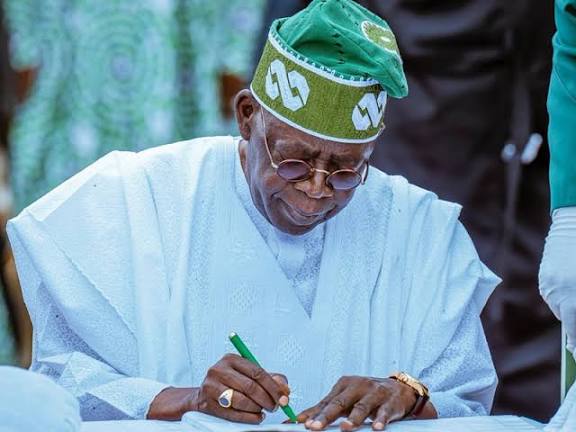
President Bola Tinubu has ordered a suspension of the cashless toll system at major airports across the country.
The President’s directive comes just days after its rollout caused widespread gridlock and stranded passengers.

Minister of Aviation and Aerospace Festus Keyamo disposed this whole briefing State House Correspondents at the Presidential Villa after the Federal Executive Council (FEC) meeting.
NewsQuest reports that the policy will be reconsidered after refining that would involve private firms to make it more efficient.
The system, introduced by the Federal Airports Authority of Nigeria (FAAN) to curb corruption and boost revenue after decades of cash collections, backfired spectacularly at Lagos and Abuja airports, with motorists facing long delays and missing flights.
“Mr President was very concerned about the welfare of Nigerians… out of empathy, [he] directed that we should suspend the present system,” Minister Keyamo told reporters.
The Minister explained that a hybrid approach will return temporarily, allowing cash payments alongside FAAN cards already purchased, while private operators are sought to develop a smoother electronic alternative – even if it means paying commissions.
Minister Keyamo also said that President approve the revival of a stalled second runway project at the Nnamdi Azikiwe International Airport Abuja.
He explained setbacks including foreign exchange fluctuations since the contract’s award under the previous administration, compensation for site clearances, and additional works like extended taxiways and airfield lighting.
Keyamo said, “There was actually a memo before council today which Mr. President approved on the second runway. And you remember that the construction of the second runway started before, but four issues actually affected the projects. And those four issues that affected the projects were, one, the foreign exchange volatility that came up between when it was originally awarded by the previous government and of course this government.
“So the foreign exchange volatility affected the pricing of the projects. The other one that affected it was the compensation that we had to pay for economic trees and other encumbrances at the project sites. And so that is why we had to augment and re-scope that project.
“The third one is additional works identified by the ministry and consultants, notably the extension of the runway, additional taxiways and apron works that were not captured in the original design that we inherited as a government. And so in the process of doing all of this we needed to completely re-scope that project again and of course re-award it. There were four components of the project that we had to re-award, which is one, the construction of the runway, the taxiways, the links, the fencing with gates, internal perimeter and certain roads, and crash road services around the airports.
“And the second aspect of that project is the procurement and installation of the airfield lighting, navigational aids, communication and metrological equipment. Because after the normal runway, you know all of this technical equipment will have to come in to aid the use of the runway.”
The Aviation Miniater continued, “The third aspect of that project that was approved today is the provision of power supply, including construction of power station and switch room, irrespective of the project.
“Then of course the fourth one is the provision of vehicles, complementary agents and spare parts for the construction of the second runway. So graciously the President approved these four aspects of the project today”.
