

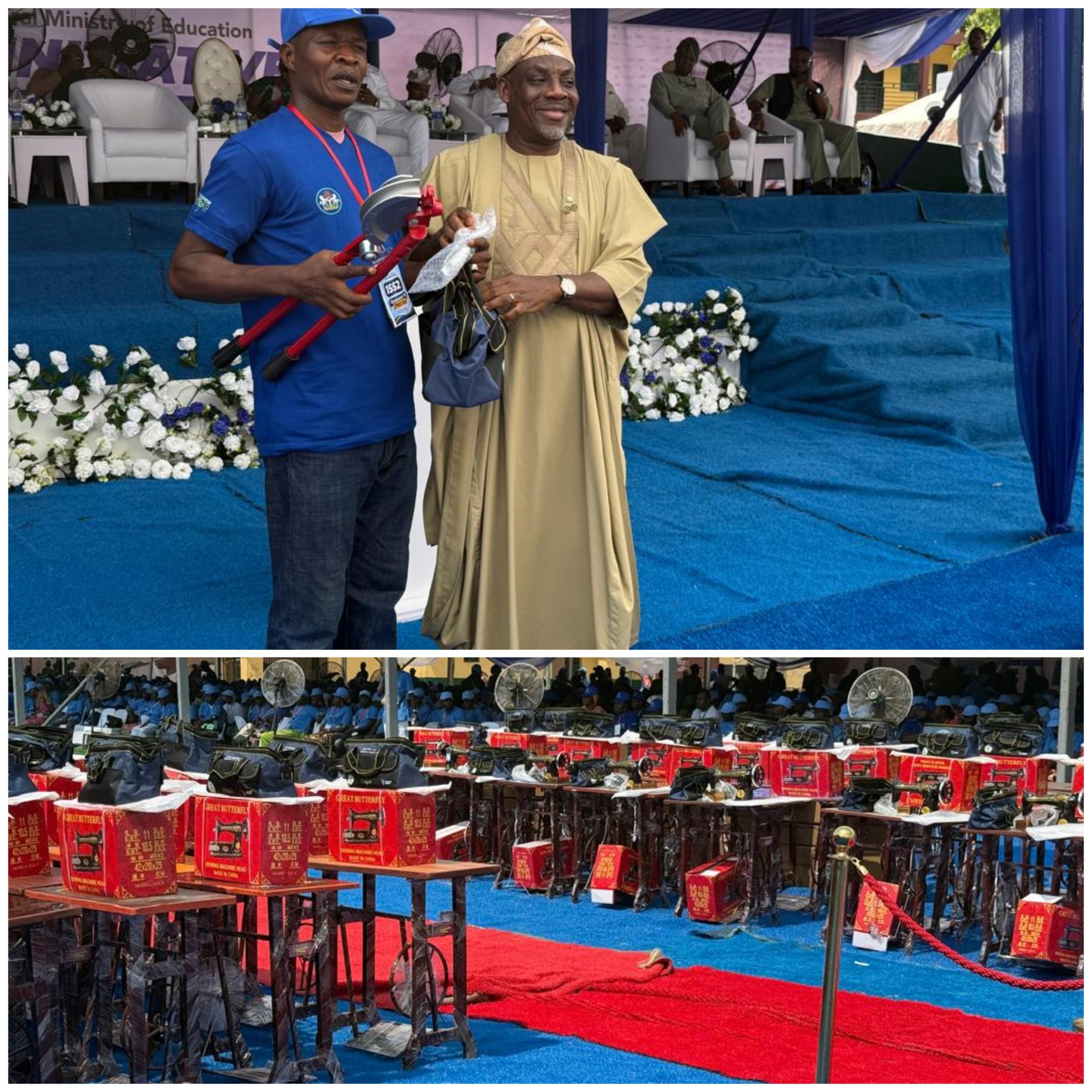
The Honourable Minister of Education, Dr. Tunji Alausa, has said that the starter kits distributed to Technical and Vocational Education and Training (TVET) graduates will equip them to become job creators and self-reliant, rather than job seekers.
The Minister said no fewer than 7,000 graduates in Lagos had received starter kits under the TVET programme, while 87,701 beneficiaries completed the first cohort nationwide.
In a statement issued, the Special Adviser on Media and Communications to the Honourable Minister, Ikharo Attah, the initiative was described as a means of job creation that would enable graduates to become self-reliant and employers of labour.
The statement said a second cohort had enrolled 150,000 learners into accredited training centres across the country after receiving 1.49 million applications.
The programme spans trades including welding, electrical installation, automobile mechanics, solar installation, fashion design, hospitality, information technology, agriculture, leatherwork and beauty therapy, among others.
Speaking at the Lagos phase of the nationwide distribution of equipment to graduates at the Federal Technical College, Yaba, on Friday, the Minister said the exercise was part of an effort to convert classroom instruction into employment and small-business creation amid persistent youth unemployment.
Alausa said the starter kits were intended to address a familiar gap in vocational education: graduates who acquire skills but lack the capital or equipment to practise them.
He described the initiative as a practical test of whether vocational training can produce measurable economic outcomes.
Officials said the kits would enable beneficiaries to offer services, earn income, establish businesses and eventually employ others.
Alausa said distribution would proceed in phases, subject to assessment, verification and documentation.
He distinguished between training completion, certification and eligibility for equipment support, acknowledging that not all graduates would receive kits immediately.
He added that, for agricultural and livestock-related trades where conventional tool kits may be impractical, beneficiaries would receive cash support instead.
The initiative is a centrepiece of President Bola Tinubu’s Renewed Hope Agenda, which emphasises youth empowerment.
“Vocational training must translate into tangible economic outcomes,” Alausa said, urging graduates to treat the equipment as the foundation for businesses rather than personal possessions.
Alausa restated the Ministry’s commitment to strengthening technical and vocational education through quality training, competency-based assessment, recognised certification, industry partnerships, entrepreneurship support and employment tracking.
The Minister commended the National Board for Technical Education (NBTE), the National Business and Technical Examinations Board (NABTEB), the Nigerian Education Loan Fund (NELFUND), training centres and development partners, including GIZ and UNESCO.
He also called on state governments, community leaders and private companies to provide mentorship, hiring opportunities and enterprise support.
In her remarks, the Director Office of the Permanent Secretary, Dr. Folake Olatunji-David, represented by the Director of Technology and Science Education, P.O. Ogungbemi, described the ceremony as a major milestone in repositioning TVET as a driver of skills development, youth empowerment, entrepreneurship and national economic growth.
She said the programme’s ultimate measure would not be graduation ceremonies but employment rates, business formation, earnings growth and job creation.
The statement further noted that, for some beneficiaries, the programme represented a route out of economic precarity.
Feyisayo Onafowokan, a leatherwork and shoemaking trainee and single mother, said the initiative had renewed her hope of achieving financial independence.
Femi White, founder of Femi White Welding and Fabrication, praised the programme as timely and called for sustained investment in technical education.
