

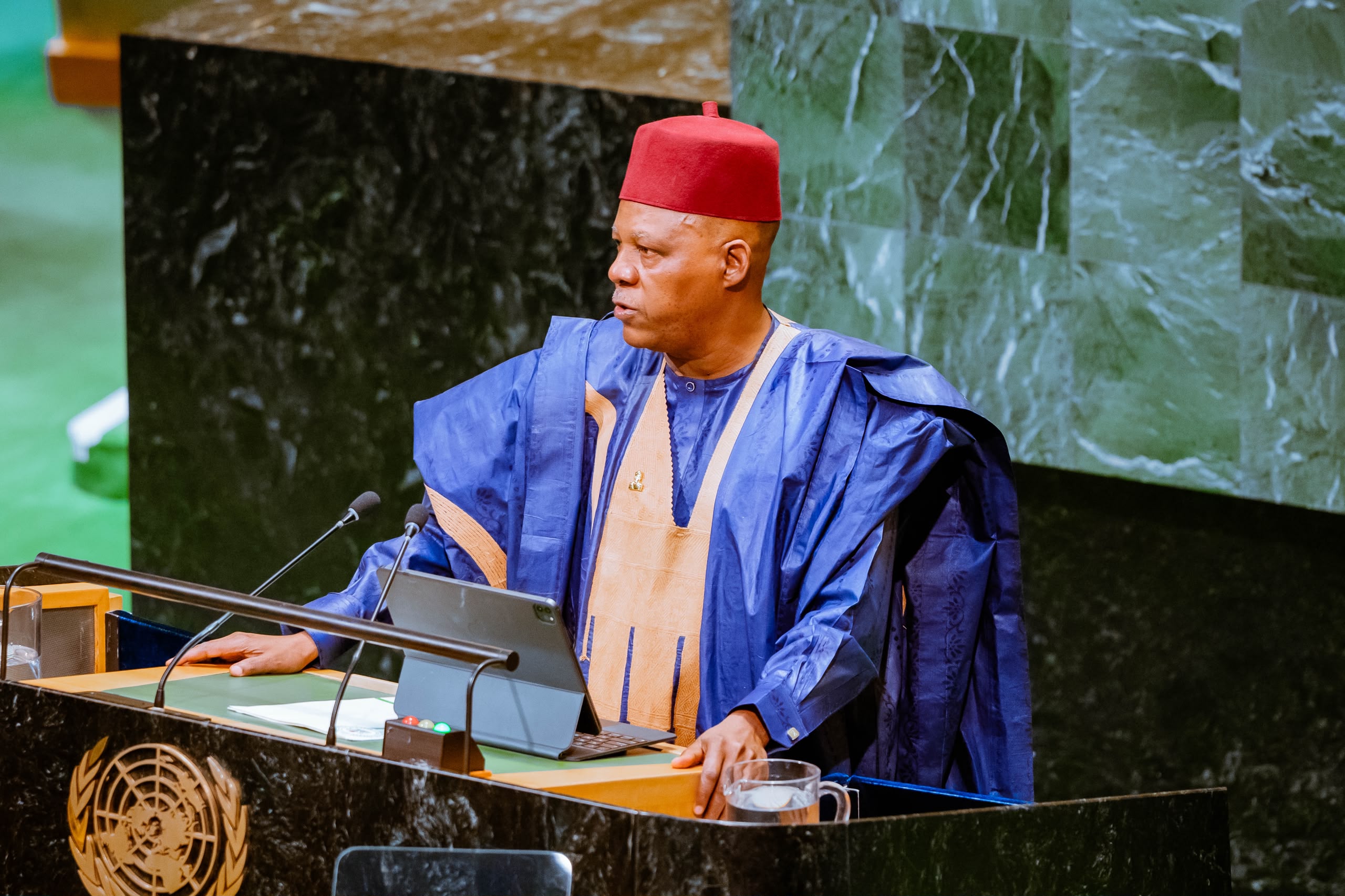
President Bola Tinubu on Thursday called for a sweeping reform of the United Nations (UN) arguing that the global body cannot continue to reflect the power structure of 1945 while confronting the political, security and economic realities of 2026.
In an address delivered by Vice President Kashim Shettima at the United Nations General Assembly (UNGA 81), President Tinubu said reform should begin with the Security Council, where Africa has no permanent representation despite accounting for a large share of the body’s agenda.
“The world of 2026 cannot remain captive to the distribution of power in 1945,” Tinubu said.
“Africa cannot continue to fill the Council’s agenda while remaining absent from its permanent membership.”
The Nigeria leader called for at least two permanent African seats on the Security Council, with full rights and responsibilities – including veto powers as long as they remain available to existing permanent members, and a total of five nonpermanent seats for the continent.
NewsQuest reports that Nigeria’s demand reflects the African Union’s Ezulwini Consensus and Sirte Declaration on UN reform.
President Tinubu also urged world leaders to halt conflicts and recommit to the principles of the UN Charter, saying diplomacy, international law and multilateral cooperation were under growing pressure from war, nationalism and unilateral action.
“The persistence of conflict across the world recalls the purpose for which the United Nations was founded: to spare succeeding generations the devastation of war,” he said.
“We must therefore return to the founding principles of dialogue, mutual respect and collective responsibility.”
The President said Nigeria supported a world in which “diplomacy prevails over coercion, cooperation over isolation and international law over the arbitrary exercise of power.”
Tinubu said Nigeria was prepared to assume greater responsibility for peace and security in Africa, citing its past deployments and financial commitments in Liberia, Sierra Leone, Darfur, Mali and The Gambia.
Through the Economic Community of West African States (ECOWAS), the African Union (AU), and Gulf of Guinea partnerships, Nigeria is pursuing mediation, democratic governance, counterterrorism and maritime-security efforts, he said.
Drawing on Nigeria’s long campaign against Boko Haram, Islamic State West Africa Province and other armed groups, President Tinubu said no country could fully protect itself from threats sustained beyond its borders.
“Terrorism and cyberattacks exploit gaps in global action,” he said, adding that military operations alone could not secure lasting peace without education, economic opportunity, accountable governance and protection of human rights.
Nigeria, a founding member of ECOWAS, remains committed to regional solidarity and African-led responses to security crises, backed by what Tinubu described as principled international partnerships.
He also called for urgent diplomacy to address the humanitarian, economic and geopolitical consequences of conflicts in Sudan and other war-affected countries.
“We should all be afraid of a world in which we can no longer tell the victim from the aggressor,” Tinubu said.
“When our investment in propaganda shields perpetrators from justice to the point that telling the truth becomes a crime, the promise of this institution stands betrayed.”
President Tinubu also renewed Nigeria’s call for reforms to the international financial architecture, including broader access to concessional funding and debt-sustainability arrangements that take account of developing countries’ growth needs.
He said inadequate financing remained a major obstacle to sustainable development, as many developing countries devote substantial portions of public revenues to debt service rather than education, health care and infrastructure.
Nigeria, he said, is pursuing its sustainable-development goals through macroeconomic management, stronger institutions, private-sector-led growth and targeted public investment.
“Government trust is earned only when decisions improve lives,” he said, linking domestic reform efforts to wider African development and the need for a more stable international order.
Tinubu rejected what he described as a false choice between economic development and climate action.
Developing countries, he said, must be able to industrialize, reduce poverty and widen energy access through lower-carbon development paths supported by technology transfers and climate finance.
He reaffirmed Nigeria’s commitment to the Paris climate agreement and said Africa deserves fairer access to climate financing, noting that the continent produces less than 4% of global emissions but faces disproportionate climate impacts.
Nigeria’s Energy Transition Plan targets net-zero emissions by 2060 while expanding access to reliable and affordable energy, he said.
President Tinubu also said Nigeria would pursue technological development, including artificial intelligence, as part of its growth agenda.
The government is expanding digital public infrastructure, accelerating broadband deployment and supporting technology entrepreneurship, he said.
“Humanity is our oldest citizenship, and peace is the inheritance we owe every child,” Tinubu said, calling for what he described as a reformed, inclusive and effective United Nations.
