

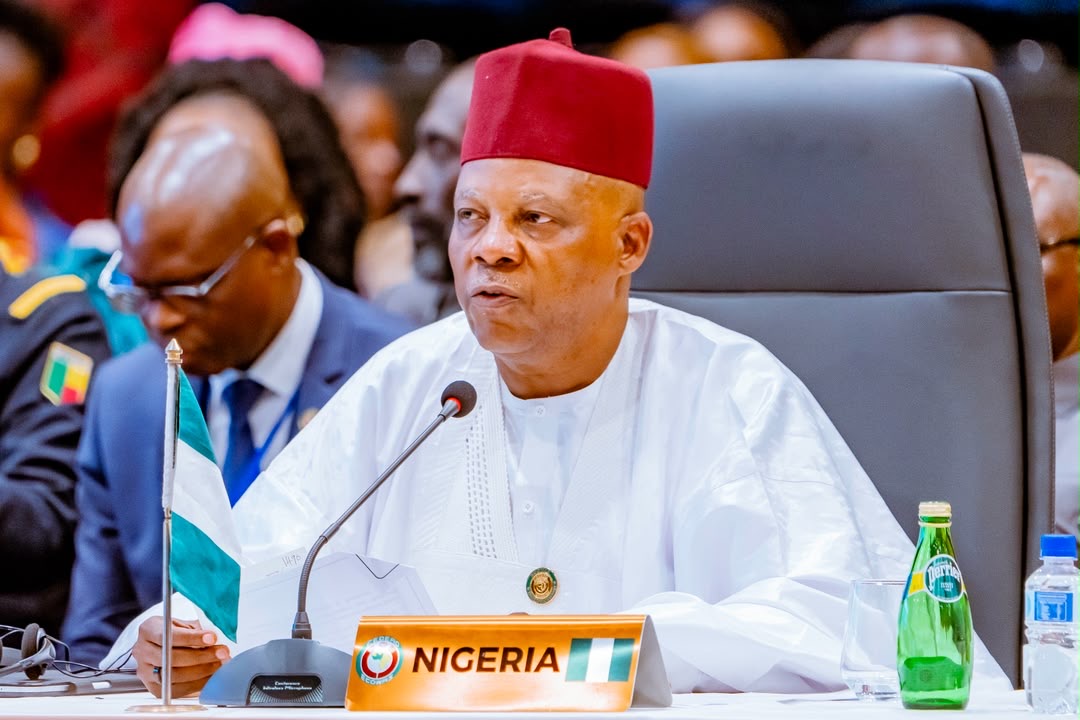
President Bola Tinubu on Sunday pressed fellow West African leaders to unite in condemning a recent wave of xenophobic attacks in South Africa, while pledging support for a new ECOWAS framework aimed at deepening regional integration.
Tinubu, speaking at the 69th Ordinary Session of the Economic Community of West African States and represented by Vice President Kashim Shettima, said Nigeria had evacuated more than 1,490 citizens from South Africa and called on ECOWAS members to raise a single voice against what he described as “Afro-phobic” violence.
“Nigeria condemns, in the strongest terms, the recent attacks on its citizens and other Africans in the Republic of South Africa,” Tinubu said, urging the regional bloc to bring the matter before the African Union.
“This would send a clear message that this type of intolerance is totally unacceptable under any guise.”
In a statement by the Senior Special Assistant on Media and Public Communication Stanley Nkwocha, the President Tinubu described the appeal within a broader drive to implement the newly adopted ECOWAS Compact for the Future of Regional Integration, a document he said renews member states’ commitment to rebuilding trust between citizens and public institutions.
He also described the Compact as a milestone that will “strengthen regional solidarity, and build a more resilient, prosperous, peaceful, and people-centred Community capable of meeting the aspirations of its over 400 million citizens.”
The President used the platform to press for intensified regional cooperation on security, trade and technology.
He urged ECOWAS to step up efforts against terrorism and unconstitutional changes of government, and reiterated Nigeria’s support for creation of a Counter Terrorism Force and a strengthened ECOWAS Standby Force to facilitate intelligence sharing and joint operations.
On economic matters, President Tinubu endorsed measures to remove trade barriers, improve cross-border infrastructure and facilitate freer movement of people and goods.
He also highlighted the Compact’s emphasis on science and technology, calling for a Digital Single Market and regional frameworks on artificial intelligence and cybersecurity to spur entrepreneurship and job creation.
The President reiterated commitments to gender equality, youth empowerment and education, and said Nigeria — the region’s largest economy and a founding member of ECOWAS — would take a leading role in implementing the Compact’s six strategic pillars.
Sierra Leone’s President Julius Maada Bio, who chairs ECOWAS, said the summit was intended to take stock of the bloc’s progress and chart a course toward an “ECOWAS Vision 2050” of a peaceful, integrated and prosperous West Africa.
Bio warned that accelerating global change requires the community to reassess assumptions and adapt strategies to preserve sovereignty and expand opportunities.
United Nations Deputy Secretary-General Amina Mohammed expressed UN support for ECOWAS initiatives, particularly efforts to counter terrorism in the Sahel and across West Africa, and urged the U.N. Security Council to back African-led solutions.
Omar Alieu Touray, president of the ECOWAS Commission, said the commission would deepen policy coordination, bolster governance and renew electoral-support mechanisms while strengthening regional responses to security and humanitarian threats.
The meeting’s notable development was the signing of an intergovernmental agreement for the African Atlantic Gas Pipeline project, a flagship energy scheme intended to expand regional energy supplies.
