

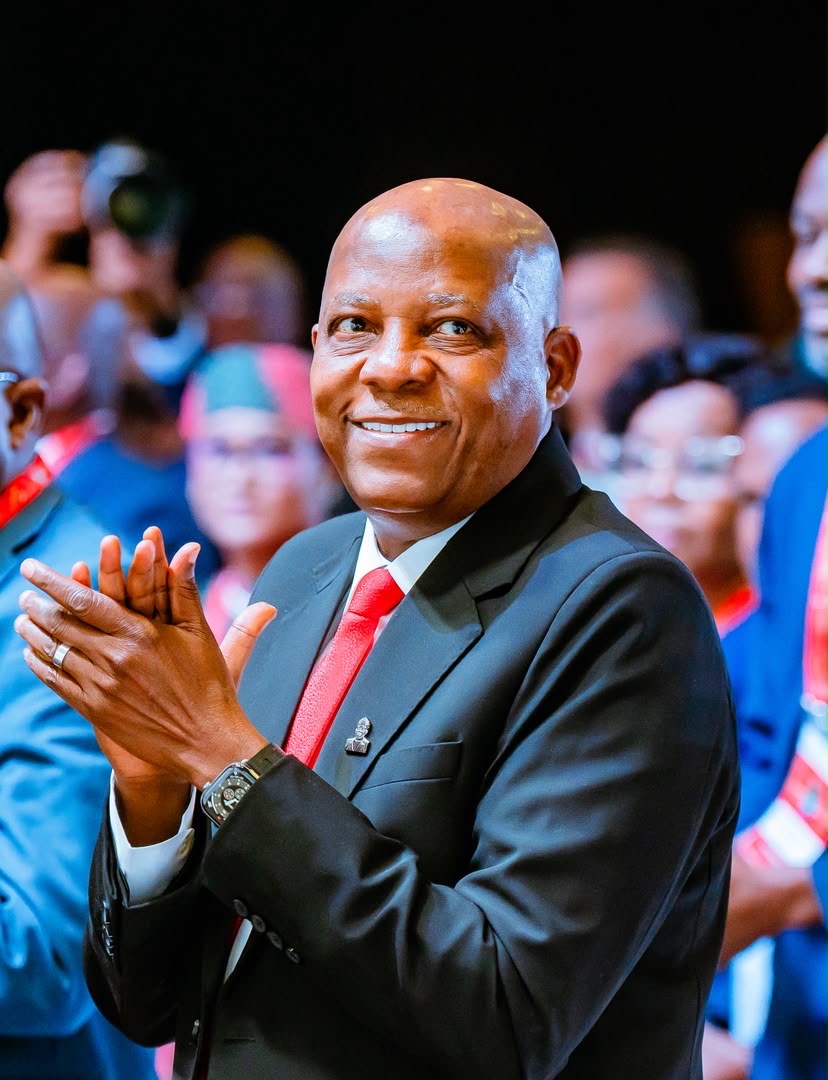
President Bola Tinubu on Monday said his administration is working to reverse decades of economic underperformance, assuring business and policy leaders that difficult reforms are restoring confidence and creating the foundation for jobs, investment and broader prosperity.
Represented by Vice President Kashim Shettima at the opening of the 32nd Nigerian Economic Summit in Abuja, Tinubu described the government’s programmes as a “difficult reset” rather than a quick fix.
The two-day summit, organized by the Nigerian Economic Summit Group, is themed “Growth That Works: Delivering Jobs, Productivity and Shared Prosperity.”
In a statement by the Senior Special Assistant on Media and Communication to the Vice President Stanley Nkwocha, President Tinubu said, “We came to rewrite the story of a nation that has performed below its potential for far too long. But there is no shortcut to economic growth.”
He argued that Nigeria cannot exploit its large, young population without first stabilizing the economy and creating conditions in which both public and private investors can expand and hire.
The administration, according to him, is dismantling structural barriers that have prevented the country’s human and natural resources from generating prosperity.
The President said the reforms were already yielding measurable gains. Nigeria’s inflation-adjusted gross domestic product expanded 3.89% year-on-year in the first quarter of 2026, up from 3.13% a year earlier, according to the National Bureau of Statistics.
Non-oil activity accounted for 96.08% of output, while manufacturing grew 3.29% and the oil sector 2.57%.
Capital importation reached $10.37 billion in the first quarter, an 83.83% increase from the year-earlier period, President Tinubu said, citing figures that include both portfolio and foreign-direct investment.
He said the government plans to reduce regulatory burdens, strengthen transparency and policy predictability, and broaden access to finance.
According to him, the administration is also pursuing tax changes intended to create a more modern and equitable revenue system, while reforming the electricity market to attract investment across generation, transmission, distribution and alternative energy.
In agriculture, President Tinubu said the administration is linking farms to storage, processing and markets while expanding irrigation, mechanization, credit and rural infrastructure.
In solid minerals, he noted that the government wants to shift from raw extraction toward domestic processing, industrial production and exports.
The statement added that President Tinubu acknowledged that headline growth alone would not be enough.
He said Nigeria must improve the quality of work, reduce underemployment and make better use of an underutilized workforce.
“We must judge infrastructure by the economic activity it generates and education by the skills and productivity it delivers,” he said.
“We must judge industrial policy by the competitiveness of our firms and investment incentives by the capital, technology, exports and jobs they attract.”
The summit’s emphasis on converting reform into employment reflects a central challenge for the administration: recent inflows have been dominated by short-term portfolio capital rather than factories, equipment and long-term productive investment.
United Nations Deputy Secretary-General Amina Mohammed welcomed the reforms but urged the government to consolidate and stabilize them while managing citizens’ expectations.
She also praised the African Development Bank’s new development-financing architecture and its focus on high-impact programs.
Minister of Finance and Coordinating Minister of the Economy Taiwo Oyedele presented a draft Nigerian Economic Policy Framework, describing it as a national economic doctrine for decision-making and measuring progress.
He invited the private sector and NESG experts to critique the proposal, saying its principles include enterprise, open but fair markets and whole-of-government coherence.
The NESG Chairman Olaniyi Yusuf said the task was not to reverse the reforms but to stabilize them and translate policy consensus into practical solutions.
In his remarks, BUA Group founder Abdul Samad Rabiu, while acknowledging hardship among ordinary Nigerians, said improved access to foreign exchange had made the operating environment more predictable for businesses.
Among those attending were Anambra State Governor Chukwuma Soludo, Lagos State Governor Babajide Sanwo-Olu, Budget and Economic Planning Minister Abubakar Bagudu, Industry Minister Jumoke Oduwole and senior business leaders.
