

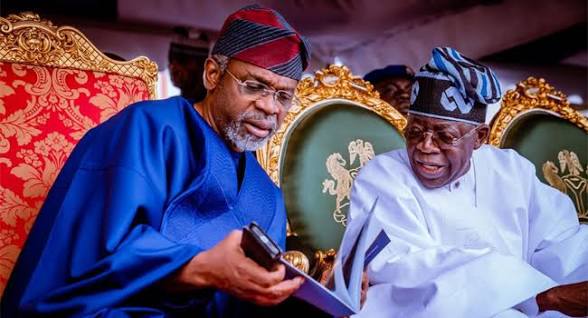
President Bola Tinubu wants to build an economy in which Nigerians can earn a decent living through hard work rather than political connections, his Chief of Staff, Femi Gbajabiamila, said Tuesday.
Speaking at the unveiling of “From Reforms to Prosperity Agenda,” the administration’s 2027–2031 electoral campaign roadmap and manifesto, Gbajabiamila said the President’s ambition was to give every Nigerian a fair opportunity to succeed.
The Chief of Staff acknowledged the gap between that promise and the financial pressures many households now face following President Tinubu’s bold and sweeping reforms that are aimed at resetting the economy.
“Now, those decisions have placed real pressure on households. We must speak honestly about that experience because the people living through it deserve to be heard. And nobody should have to pretend that life is easy at the moment,” he said.
Gbajabiamila’s remarks described the administration’s case for another term around a central challenge: turning economic restructuring into tangible gains for ordinary Nigerians.
The senior presidential aide defended the removal of the petrol subsidy and the unification of the foreign-exchange market as necessary responses to longstanding structural weaknesses.
He argued that preserving the old policies would have spared the government an immediate political backlash while weakening the country’s longer-term prospects.
President Tinubu, he said, had chosen the harder course.
“If he came in as a politician and decided to govern as a politician, he would have continued on the cruise, on the path that we were taking.
“But instead, knowing full well the immediate consequences, he decided he would govern as a leader,” Gbajabiamila said.
The Chief of Staff said the reforms would ultimately have to translate into better living conditions.
He described the new roadmap as a contract with voters, linking the administration’s economic programme to its promise of wider opportunity.
That vision, he said, included an environment in which young Nigerians could pursue their ambitions without relying on patronage or access to influential politicians.
Gbajabiamila pointed to the student loan scheme as an effort to expand opportunity and ease financial burdens.
He also cited tax reforms intended to reduce pressure on low-income earners and qualifying small businesses, alongside electricity legislation allowing states to establish and regulate their own power markets.
Those measures, in his account, form part of a broader effort to make education more accessible, encourage investment and improve the conditions for earning a livelihood.
But the political task, he told members and stakeholders of the APC, would require more than defending difficult decisions.
NewsQuest reports that the governing party is already demonstrating results in campaign rallies across the country to persuade Nigerians that its programme deserves to continue for another four years.
“The party asking to continue in government must be prepared to answer the people whose mandate it seeks,” he said.
“We must earn support through the quality of work, through the quality of our case and the seriousness of our conduct,” Gbajabiamila said.
