

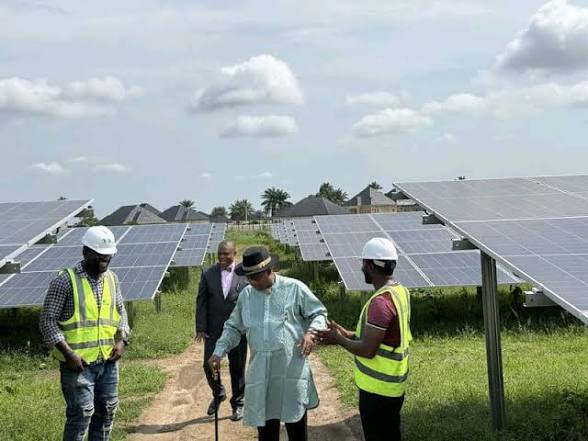
The Rural Electrification Agency (REA) has completed renewable-energy installations at 15 Federal tertiary institutions across the country, deploying nearly 100 megawatts of hybrid solar mini‑grid capacity and equipping each campus with renewable‑energy training centres, the agency said.
In a post on his X handle (former Twitter) on Saturday Special Assistant to President Bola Tinubu on Social Media Olusegun Dada said projects, are intended to bolster power reliability on campuses that have long relied on unstable grid supply and expensive diesel generators.
The REA said the hybrid mini‑grids will power student hostels, lecture theatres, administrative buildings, laboratories, teaching hospitals and staff quarters—reducing fuel costs and curbing carbon emissions while providing steady electricity for research and clinical services.
“These are not just power plants; they are learning hubs,” the agency said.
Each beneficiary institution also received a world‑class renewable‑energy training facility to support skills development and applied research in clean energy technologies, the agency added.
The institutions completed in the first phase include the University of Abuja, the Nigerian Defence Academy, the University of Maiduguri, the University of Port Harcourt, the Federal University of Technology, Owerri, Federal University, Lafia, Federal University, Lokoja, Federal University Oye‑Ekiti, and the University of Calabar Teaching Hospital, among others.
READ ALSO: ‘Tinubu’s support helping us to deliver in Benue’
REA officials said the combined capacity of the projects close to 100 megawatts represents one of the largest coordinated deployments of campus‑scale solar hybrid systems in the country to date.
The systems pair solar photovoltaic arrays with battery storage and, where necessary, auxiliary generation to deliver uninterrupted power during periods of low sunlight or peak demand.
The installations come as the country seeks to expand access to reliable electricity and accelerate private‑sector investment in renewables.
Frequent outages and the high cost of diesel have long disrupted academic schedules and clinical services at teaching hospitals, prompting university administrators to seek alternative energy solutions.
Following completion of the first phase, the REA has begun preparations for a second rollout covering eight additional federal universities, the agency said.
The next phase will target the University of Nigeria, Nsukka; Obafemi Awolowo University; University of Lagos; University of Ibadan; Ahmadu Bello University; Federal University Dutse; Federal University Wukari; and the University of Benin.
“Engineering designs are complete and we are now moving toward procurement and implementation,” the REA said.
NewsQuest reports that REA is yet to provide a timeline for construction or final commissioning of the next tranche.
The campus mini‑grid programme is expected to serve as a model for decentralized power in other public institutions, provided the projects secure sustainable operations and maintenance funding.
“Technical installation is the easier piece; long‑term management, tariff structures, and institutional capacity to run these systems will determine whether they deliver value,” said an energy consultant who advises Universities on off‑grid projects.
