

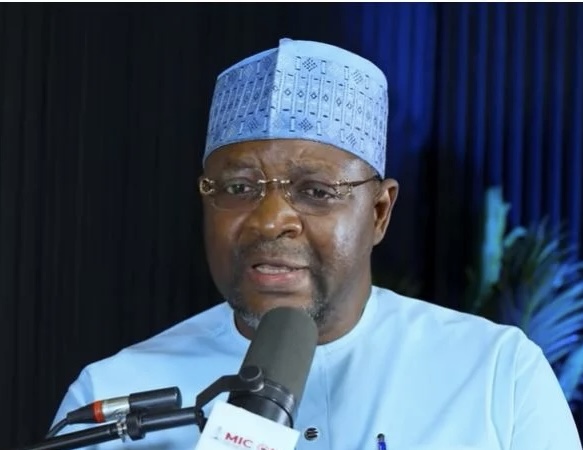
President Bola Tinubu’s Special Adviser on Media and Public Communications Sunday Dare has defended First Lady Oluremi Tinubu’s suggestion that Nigerians consider low‑capital, informal businesses.
The First Lady’s comments touched off a wave of online criticism this week.
Dare, in a podcast interview however, described the First Lady’s advice as a call to micro‑enterprise and self‑reliance rather than a prescription to consign young people to menial work.
Speaking, Dare invoked his own upbringing in a petty‑trading household to argue the informal sector’s continued economic importance.
“At wherever I am today, my mother sold akara,” he said.
“I carried bananas in a tray on my head to markets in Jos. My mother sold oranges, and through that, they were able to train me.”
He warned against looking down on small trades, noting they have “historically lifted families out of poverty” and remain “predominantly” present across the country.
The controversy began Wednesday at a Renewed Hope Initiative event in Abuja, when First Lady Tinubu urged beneficiaries of Federal Government support schemes to consider ventures such as selling akara, roasting corn or making kuli‑kuli, saying those businesses “don’t take a lot of money.”
She also said her initiative- the Renewed Hope Initiative (RHI), have been offering direct grants—rather than loans—to help beneficiaries get started.
Critics seized on the comments as out of touch, pointing to soaring food and fuel costs and high inflation that have eroded household purchasing power.
Social‑media users argued that recommending small, informal businesses ignored structural obstacles—access to credit, rising input prices and constrained markets—facing Nigerian entrepreneurs today.
But, presidential aide Dare rejected that reading.
“When you look at the informal sector of our country, its resilience continues to lift this economy,” he said, adding that the model had worked for earlier generations.
“If that was right 60 years ago, what is wrong with that now?” he asked.
He said First Lady Tinubu’s intent was to promote entrepreneurial thinking, not to consign young people to petty trading.
“You must not miss her point,” he said.
“Whatever it is, try and do something, have some level of entrepreneurial skill…be engaged in some kind of enterprise,” the presidential spokesman added.
