

The Federal Government on Tuesday called for increased international investment in skills programmes for millions of Nigerian youths, describing it as essential to unlocking the nation’s demographic dividend.
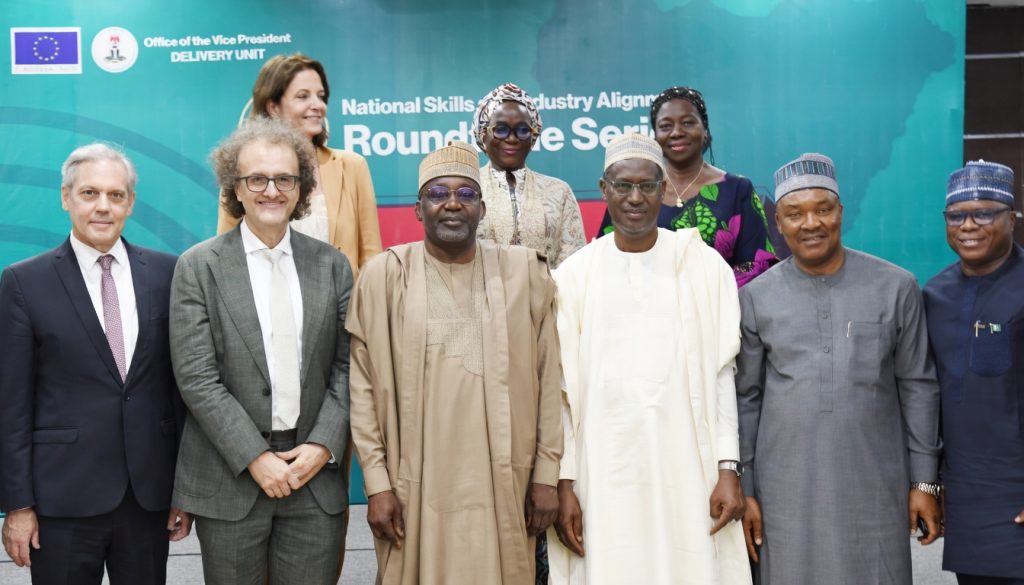
Vice President Kashim Shettima kicked off a National Skills and Industry Alignment Roundtable Series in Abuja, an event organized by his office with European Union backing.
Themed “Bridging Skills Supply and Labour Market Demand,” the gathering drew policymakers, private sector executives, and development agencies to align training programs with job needs.
Represented by Deputy Chief of Staff Ibrahim Hadejia, Vice President Shettima emphasized Nigeria’s lack of a “talent problem” but a mismatch between skills and industry demands.
“Until skills meet industry demand, job creation will remain below its full potential,” he said.
He noted that millions of ambitious youths flood the labor market yearly, mostly into low-productivity informal jobs.
The President BolanTinubu administration, he added, is consolidating scattered initiatives into a unified national framework.
“We’re moving away from fragmented programs … toward a more coherent national system—one where skills lead to jobs, jobs lead to enterprise, and enterprise drives economic growth.”
Vice President Shettima noted the 2025 milestones, like mapping the job ecosystem and policy dialogues, which stressed private sector leadership alongside government support.
“Job creation cannot be outsourced to government alone—industry must take its place at the table, not just as employers but as co-creators of the workforce Nigeria needs.”
In his remarks, the Minister of Housing Ahmed Dangiwa tied the discussion to his sector’s acute shortage of skilled workers, from Architects to bricklayers, as the nation scrambles with a national housing crunch.
European Union Head of Cooperation Massimo De Luca lauded collaborations with the Vice President’s office and groups like the Tony Elumelu Foundation, focusing on programes such as the 3 Million Technical Talent initiative.
“We grow skills where they matter, where they are required, and where they are defined,” he said.
Other dignitaries at the event included representatives from the organized private sector, GIZ (Germany’s development agency), the Tony Elumelu Foundation, and the Aliko Dangote Foundation.
NewsQuest reports that the series seeks to convert talks into action, linking training to jobs and policies to tangible outcomes.
