

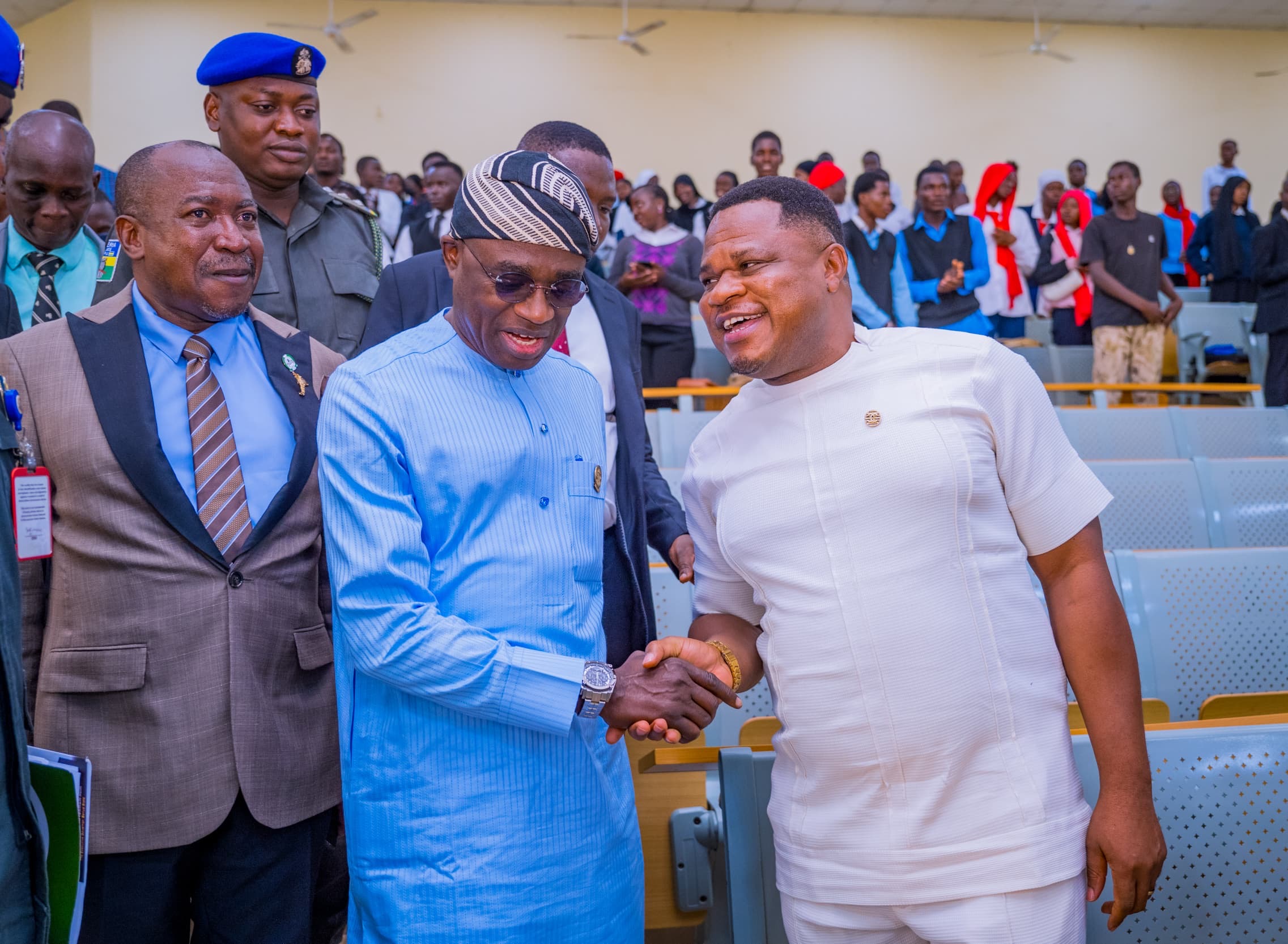
Governor Hyacinth Alia of Benue State on Friday declared that education remains central to Nigeria’s strategy for combating insecurity.
The Governor stated this at the inaugural lecture of the University of Abuja’s new Quarterly Guest Lecture Series in Abuja.
Speaking to a hall of academics, students and officials, Governor Alia described the problem as both immediate and structural: while security operations remain necessary, sustainable peace requires long-term investments in education, human capital and institutions.
“Education is Nigeria’s most sustainable weapon against insecurity,” he said, a line that depicts the seriousness with which his administration views the proposal.
The Governor laid out what he called the “Benue Model,” a policy package that prioritizes free and compulsory basic education, rapid expansion of school infrastructure, large-scale teacher recruitment and the founding of the Benue State University of Agriculture, Science and Technology in Ihugh.
He said those measures have helped channel youths into productive activity and reduced their susceptibility to crime and violent extremism.
Delivering the address in person, the Governor presented the lecture as more than an academic exercise: it was a tested state-level policy that he urged Federal and State actors to consider.
NewsQuest reports that Governor Alia’s presence at the event signaled an intent to follow rhetoric with action and reinforced the idea that elected officials must lead long-term social investments that underpin security.
Among the audience was Dr. Solomon Akeprekpe, a prominent backer of Governor Alia, who publicly endorsed the Governor’s education-first approach.
His attendance lent visible political support to efforts to replicate Benue’s model nationwide.
Governor Alia also reiterated his advocacy for State Police, arguing that locally structured law enforcement would complement social investments by strengthening community-level security frameworks.
A question-and-answer session after the lecture focused on financing, curriculum relevance and the adaptability of Benue’s policies to other states.
Academics and civil-society participants generally welcomed the practical emphasis of the presentation, while urging clearer implementation timelines and accountability mechanisms to ensure measurable reductions in insecurity.
Governor Alia thanked the University leadership and community for hosting the lecture.
University officials said the Quarterly Guest Lecture Series aims to convene policymakers, scholars and practitioners to address national challenges; they said details of the next session will be released later.
Meanwhile, guests left the event hopeful that the Governor’s appearance would broaden debate and spur policy shifts toward preventive, education-centered approaches to Nigeria’s security problems.
