









By Anule Emmanuel
As Britain’s top diplomat in Nigeria prepared to leave, he offered an unusually candid endorsement of President Bola Tinubu’s sweeping economic reforms, calling the measures painful in the present but vital for long-term stability.
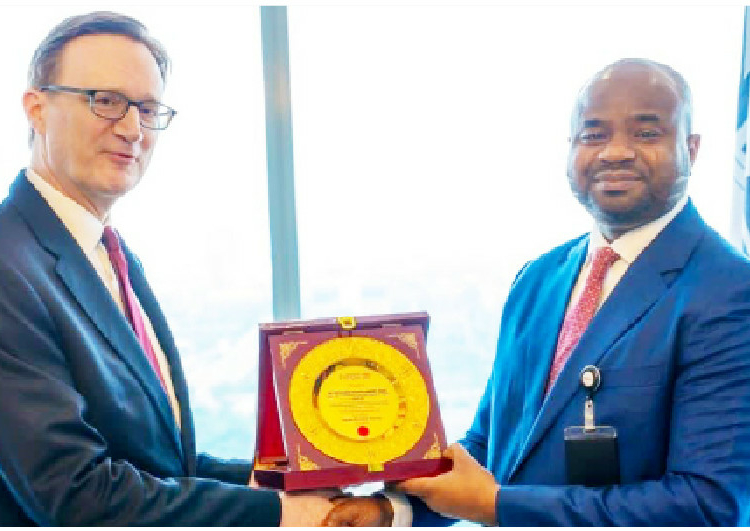
Dr. Richard Montgomery, the outgoing British High Commissioner, made the remarks during a farewell call at the Nigeria Revenue Service (NRS) corporate headquarters in Abuja, where he met Dr. Zacch Adedeji, the agency’s Executive Chairman.
Dr. Montgomery, CMG, who arrived in Nigeria on May 18, 2023, in succession to Ms. Catriona Laing, CB, described the NRS as a central ally in the effort to reset Africa’s largest economy. His diplomatic opinion recognizes the Tinubu administration’s ambitious plan to grow Nigeria’s economy to $1 trillion by 2030, a target that is part of a broader agenda built on industrialization, infrastructure investment and private-sector participation.
The British envoy’s visit to the NRS Chief Executive before leaving the country is further evidence of a quietly intensive relationship between the United Kingdom mission and Nigerian fiscal managers as the current administration confronts a legacy of subsidy distortions, foreign-exchange strain and an arrears-laden public purse.
“The reforms are tough, and they can cause short-term pain for ordinary people—devaluation, inflation, and so forth,” Montgomery told Dr. Adedeji during his visit.
According to a statement from Dare Adekanmbi, Special Adviser special on media to the NRS chairman, the British envoy did not hesitate to add that President Tinubu’s reform measures remain “fundamental to restoring vitality to the economy,” a judgment he said he was briefing back in London as Britain’s new prime minister, Andy Burnham, prepared for outreach to Tinubu.
It must be understood that Montgomery’s remarks straddle diplomacy and frank appraisal. They recognize the immediate social costs of market-driven policies while signaling a broader, strategic confidence that disciplined fiscal policies and strengthened institutions can attract private capital and stabilize public finances over time.
This position, voiced publicly by a senior Western diplomat departing after three years in post, also gives imprimatur to reformers in the Tinubu administration, who face an uphill political calculus: tightening today to secure growth tomorrow.
What is notable about Montgomery’s farewell visit and remarks is that Dr. Adedeji, whose agency is charged with expanding revenue mobilization to finance government business without overreliance on oil and borrowing, was the subject of particular praise. Montgomery described the NRS as “one of the best partners of the British High Commission” and lauded Dr. Adedeji’s “tough but good work.”
For President Tinubu and his administration, the compliment also highlights the centrality of tax and customs modernization in any credible economic reset.
The praise was reciprocated. Dr. Adedeji acknowledged Montgomery’s technical support and personal engagement, which he said helped “changed the story,” crediting the British mission with helping shape aspects of the NRS’s reform agenda.
The exchange between Nigeria and the United Kingdom is not unusual; it illustrates a pattern common in fragile and emerging-market transitions: external partners providing both technical assistance and political cover as domestic authorities implement politically costly measures.
British officials argued that the reforms being pursued by the Tinubu administration could help restore growth, increase government revenue and make Nigeria more investable over time.
What is not to be missed is that Nigeria’s economy is juggling inflationary pressures, currency volatility and a National Assembly that, as Montgomery noted, complicates budget and fiscal management.
Those institutional frictions can blunt reform momentum, erode public confidence and raise the political price of austerity—especially where subsidy removals and currency adjustments hit households directly.
For international investors and aid partners, the envoy’s endorsement signals that parts of Nigeria’s economic team are gaining credibility abroad.
For ordinary Nigerians confronting rising prices, however, the long-term gains Montgomery predicts will hinge on the government’s ability to translate higher revenue and tighter policy into visible improvements in services and jobs.
Until then, the “short-term pain” Montgomery acknowledged will remain the most salient measure of the reforms for many.
Even before his departure, Montgomery is on record to have repeatedly praised the reforms as “big and bold,” singling out the removal of fuel subsidy and exchange-rate unification for particular laudation and saying they are already showing signs of impact.


