




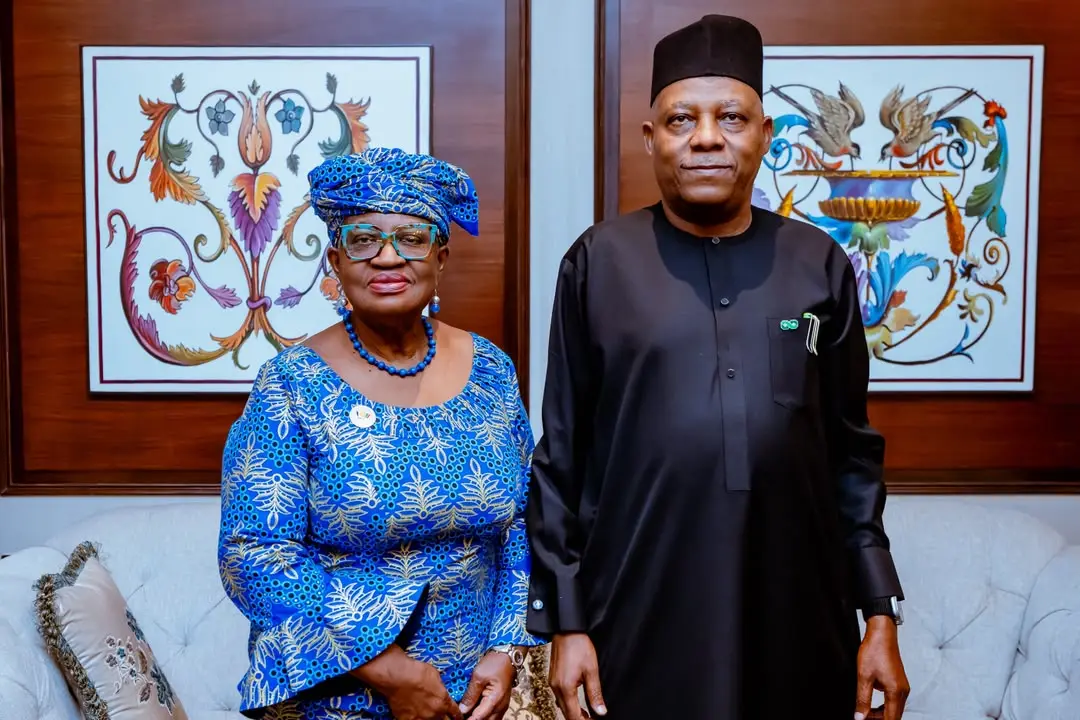


Vice President Kashim Shettima, told World Trade Organization chief Ngozi Okonjo‑Iweala on Saturday that Nigeria will continue to back the WTO’s role in preserving multilateral trade rules and resisting protectionist pressures.
Speaking on the sidelines of the BRICS leaders’ summit in New Delhi, Shettima described multilateral institutions as essential to global stability and prosperity.
“The world is greater than one nation. We will continue to support the WTO in championing the cause of multilateralism,” he said, adding that nations remain interdependent and cannot “divorce” themselves from the global community.
Vice President Shettima used the meeting to highlight migration’s contributions to economic growth and innovation, arguing that immigrants have long been central to the development of cities and nations.
He pointed to the nation’s diaspora as a case in point, citing a recent Pew analysis of 2024 U.S. Census Bureau data showing that 67% of Nigerian‑born Black immigrants age 25 and older in the United States hold at least a bachelor’s degree—the highest share among major Black immigrant groups examined.
The Vice President also praised Okonjo‑Iweala’s stewardship of the WTO and urged her to continue deploying her experience to advance global development.
Okonjo‑Iweala, the first woman and first African to lead the WTO, began a second four‑year term as director‑general in September 2025.
A statement by Senior Special Assistant to the President on Media and Communication Stanley Nkwocha said Shettima is scheduled to address BRICS leaders on Sunday to outline Nigeria’s partnership and foreign‑investment opportunities, part of a broader pitch tied to President Bola Tinubu’s Renewed Hope Agenda.
He is expected to reiterate the administration’s focus on reforms, infrastructure expansion and private‑sector‑led growth as routes to sustainable opportunity.
The BRICS meeting, whose theme this year is “Building for Resilience, Innovation, Cooperation and Sustainability,” has drawn attention as emerging‑market governments press for a more inclusive international economic order.