

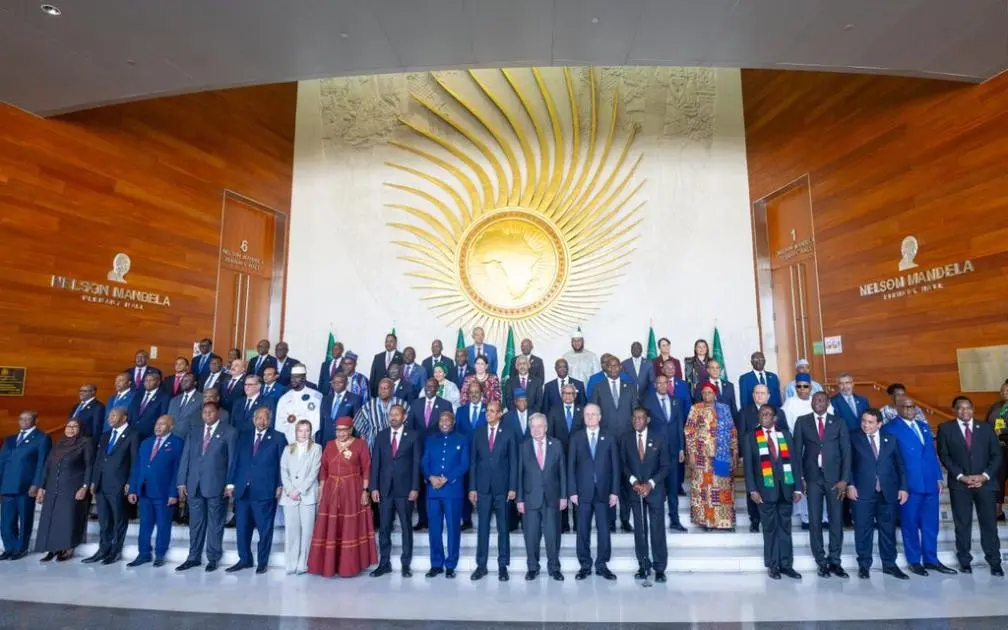
The African Union has elected Burundi’s president Évariste Ndayishimiye as its chairperson for 2026, with the bloc pledging to make water security a cornerstone of its agenda as climate pressures and conflict threaten the continent’s future.
The decision came at the 39th ordinary session of the AU Assembly of Heads of State and Government in Ethiopia’s capital, under the theme: “Assuring sustainable water availability and safe sanitation systems to achieve the goals of Agenda 2063”.
This is contained in a statement issued via the AU website on Sunday on the margins of the 39th Ordinary Session of the Assembly of Heads of State and Government in Addis Ababa, Ethiopia.
The summit, which opened on Saturday, underscored urgent calls for African solidarity, financial self-reliance, and a bolder voice on the world stage.
Ndayishimiye takes the rotating one-year post from Angola’s outgoing president João Lourenço, heading a new bureau that includes Ghana as first vice-chair (west Africa), Tanzania as second vice-chair (east), an as-yet unconfirmed third vice from north Africa, and Angola as rapporteur (south).
In his address, AU Commission chair Mahmoud Youssouf painted a sobering picture of the continent’s challenges: resurgent coups, fragility in institutions, and geopolitical storms eroding multilateralism.
“Institutional reform and financial self-reliance are now imperative as external funding declines,” he said, urging faster domestic resource mobilisation and flagship projects in industry, agriculture, energy, and infrastructure.
Youssouf expressed solidarity with conflict zones including Sudan, the Sahel, eastern Democratic Republic of Congo, Somalia, and Palestinians, while reaffirming commitment to international law.
“We call for determined, collective action to secure a stronger, more autonomous and prosperous Africa,” he added.
Lourenço, reflecting on Angola’s tenure, hailed advances in Agenda 2063—the AU’s blueprint for a united, prosperous Africa by mid-century—including infrastructure investment, the African Continental Free Trade Area (AfCFTA), and bureaucratic reforms.
He framed water access as a “political, moral and strategic priority” for health, food security, and stability, while demanding an end to guns in Sudan and DR Congo, and rejection of post-coup elections.
Ethiopia’s prime minister Abiy Ahmed pushed for Africa to “shift from reacting to global events to actively shaping the global agenda”, spotlighting his country’s new AI institute and plans for an AI university as steps toward narrative and technological sovereignty ahead of the AU’s 25th anniversary.
UN secretary-general António Guterres, while addressing the gathering, called for a deeper UN-AU partnership, UN Security Council reform to boost African seats, and fairer financing for industrialisation.
NewsQuest reports that deliberations continue on water security, peace, and security amid mounting crises.
