







By Anule Emmanuel
Beneath the cavernous ceilings of Tate Modern’s Turbine Hall, where the hum of conversation mingled with the bold strokes of midcentury Nigerian canvases, President Bola Tinubu stood before a glittering crowd on Thursday evening and invoked a defiant creed: Nigerians, he declared, have always refused to be defined by others.


The occasion was a reception hosted by the British government at the Tate’s exhibition “Nigeria’s Modernism,” a showcase of works by artists like Ben Enwonwu and Bruce Onobrakpeya, who in the turbulent mid-20th century fused ancestral motifs with modernist passion.
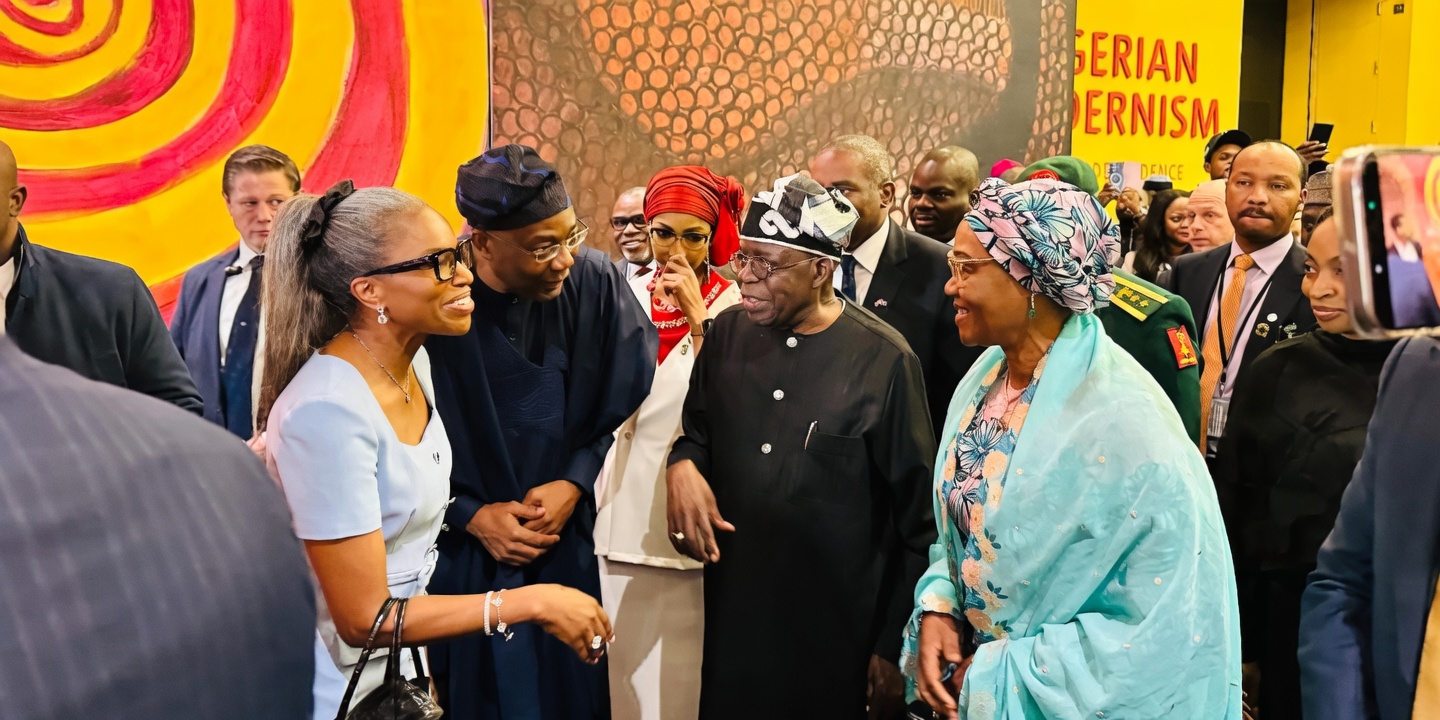
What began as a state visit celebration unfolded into a vivid tableau of Nigeria’s cultural might—politicians in crisp agbadas rubbing shoulders with diaspora leaders, British officials, and art patrons, all bathed in the glow of projections casting Yoruba masks alongside abstract geometries.
“It’s more than just a title for an art show,” President Tinubu said, his voice steady against the backdrop of Uli patterns and Nok terracotta echoes.
“It is a testament to revolution. It tells the story of a generation of Nigerian giants who refused to be despised but chose to define themselves.”
He praised their “creative ingenuity,” a fusion of ancient lore and contemporary edge that, in his view, mirrors Nigeria’s broader reinvention.
Tinubu, on a state visit to the United Kingdom, seized the moment to pivot from palette to policy. Dismissing “negative indices bandied about by naysayers,” he assured the gathering that Nigeria’s economy had emerged from “the dark tunnel of uncertainty and hopelessness” into a brighter horizon.
“Trust in the capacity of Nigerians to excel anywhere,” he urged, a nod to the unyielding spirit animating both the artworks and his administration’s ambitions.
President Tinubu also emphasised that Nigeria’s creative industry continuous to remain a strategic driver of economic growth and global competitiveness, calling for stronger investment and collaboration to unlock its full potential.
What is important in the words of President Tinubu is for the sector to sustain partnerships between government, the private sector and international stakeholders to expand access to funding, strengthening market structures and enhance global visibility for Nigerian creatives.
“What we see here is a people who have taken the best of global techniques and infused them with the enduring rhythms of our heritage,” the President stressed at the colourful ceremony.
It is however not in doubt that Nigeria’s
creative industries, art, music, film and literature, are among the greatest exports, representing the nation’s soft power in an interconnected world.
Thursday event at Tate Modern’s Turbine Hall, moderated by Abike Dabiri-Erewa, chair of the Nigerians in Diaspora Commission, brimmed with testimonials to that global reach.
Dabiri-Erewa spotlighted compatriots in high UK posts, from judges to executives.
United Kingdom Deputy Prime Minister David Lammy welcomed President Tinubu and his wife First Lady Oluremi alongside a Nigerian delegation that read like a who’s-who of power: Lagos Governor Babajide Sanwo-Olu, Ogun State Governor Dapo Abiodun, ministers like Hannatu Musawa of Arts, Culture, and Creative Economy, Minister of Finance and Coordinating Minister of the Exonomy Wale Edun, and General Christopher Musa (rtd) Minister of Defence.
Lammy, who organized the reception, underscored the stakes.
Trade between the nations has hit £8.1 billion annually, he noted, powered by over half a million Nigerians enriching Britain’s cultural and economic fabric—from Nollywood’s global pulse to Afrobeats anthems topping charts.
“Nigeria’s vibrant cultural influence is everywhere,” he said, describing the UK-Nigeria ties as a “strategic partnership” of mutual respect, now deepened by ongoing trade dialogues.
As guests sipped wine amid the exhibit’s electric blues and fiery reds, the evening transcended diplomacy.
It evoked Nigeria’s modernism not just as history on canvas, but as a living force—resilient artists who, decades ago, alchemized colonial shadows into self-possessed light, much like the nation President Tinubu envisions today.


