

By Anule Emmanuel
President Bola Tinubu on Saturday positioned his prospective re-election not as a personal prize but as a pledge to millions of young Nigerians: better schools, greater welfare and a future in which opportunity is no longer rationed by circumstance.
Speaking at the All Progressives Congress (APC) presidential campaign rally in Port Harcourt, the Rivers State capital, President Tinubu told his supporters that “prosperity is here”, while acknowledging that the bold reforms required to deliver it had initially been tough.
Yet the President’s message was deliberately forward-looking. He argued that his administration had inherited a fiscal emergency in which 27 of the country’s 36 states could not meet salary obligations, and that difficult decisions were therefore unavoidable.
Whatever one thinks of the medicine, the political argument is clear: Tinubu is asking Nigerians to judge him by the recovery he says is now under way, rather than by the discomfort of the transition.
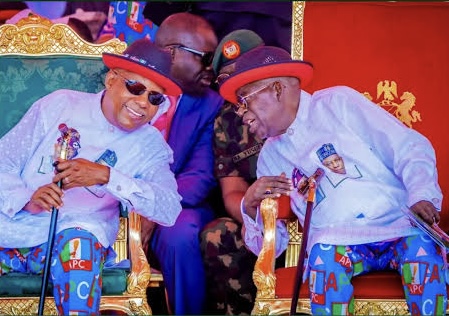
The Port Harcourt rally was itself a demonstration of political strength. As presented by Nyesom Wike, the Minister of the Federal Capital Territory (FCT) and former governor of Rivers State, the crowd filled the 40,000-capacity Adokiye Amiesimaka Stadium. The arena came alive with colourful displays and jubilant supporters chanting political slogans backing the Tinubu-Shettima ticket.
President Tinubu described the turnout as “unprecedented”. The gathering brought together the government’s national leadership, APC stakeholders in Rivers State and allies from across the political spectrum.
The coalition coordinated by Minister Wike, which fused with party contingents on display at the sports ground, was a signal of unity ahead of the 2027 elections, as the President seeks a second term.
At the centre of Saturday’s rally stood Minister Wike, whom President Tinubu singled out as “a development partner” in his administration. The President did not mince words in crediting Wike with playing an instrumental role in his 2023 victory, at a moment when, by his own account, he had felt the campaign was losing hope.
It was an unusually personal tribute – and a pointed reminder that political alliances in Nigeria are built as much on delivery and loyalty as on party labels.
For Wike, his beliefs align closely with the ideals of the Rainbow Coalition, a cross-party political movement in Rivers State designed to mobilise support for Tinubu’s 2027 re-election while presenting agreed candidates for state and federal offices.
Although not a registered political party, the Rainbow Coalition has operated as a coordinating platform, bringing the APC, the Peoples Democratic Party (PDP) and smaller parties behind a common electoral objective: securing President Tinubu’s victory. The coalition was publicly unveiled in Port Harcourt on October 27, 2026.
On stage, Minister Wike rallied supporters behind an expansive endorsement of President Tinubu as Nigeria’s best option at the next election. He described the President as a “brother” to the people of Rivers State, arguing that political brotherhood transcends blood ties when a leader has demonstrably acted in a state’s interest.
Wike’s evidence was practical rather than rhetorical: the establishment of a Federal Ministry of Environment presence in Ogoniland, the newly commissioned Bodo-Bonny Road and more than 47 appointments given to Rivers indigenes in the Tinubu administration.
As far as Wike is concerned, these are not merely federal projects; they are proof that Rivers has been brought into the centre of national decision-making.
The rally was not without edge. Minister Wike quickly took aim at opposition figures who claim to be too popular to campaign, warning that they should not later allege rigging if they decline to make their case to voters.
His remark was as much a challenge as a taunt: if a candidate believes popularity alone will carry the day, let him test it before the electorate rather than after the count. Specifically, Minister in his bold and eloquent speech – was making reference to Rotimi Amaechi a former governor of Rivers State and Vice Presidential Candidate of the African Democratic Congress (ADC) in the 2027 general election.
Wike alleged that Amaechi had boasted publicly that he was popular enough not to campaign in Rivers State, challenging the former governor to test his popularity at the polls.
Rivers Governor Siminalayi Fubara also struck a conciliatory note, praising the President for helping to preserve peace during what he described as the state’s most difficult period. Tinubu’s response — that Fubara “will not regret” heeding the counsel of elders — was both reassurance and a public affirmation of the political settlement now underpinning Rivers.
Senate President Godswill Akpabio made the connection explicit: peace, he said, would help deliver Tinubu’s re-election. In a state long accustomed to political turbulence, the message was that stability is not simply good governance; it is also the foundation on which electoral coalitions are built.
Vice-President Kashim Shettima praised Rivers voters as among the country’s most educated and independent-minded, while defending the President’s economic decisions as necessary rescue measures rather than optional experiments.
Kingsley Chinda, the APC governorship candidate, also addressed the crowd. He promised that Rivers people would repay Tinubu’s “good deeds” with mass support in 2027.
Tinubu’s Port Harcourt message rests on a simple proposition: that the hardship of reform will be justified by a more secure and prosperous future, especially for young Nigerians.
His praise of Wike shows that he understands the political value of allies who can point to roads, appointments and a federal presence in their own communities.
The President has now made youth welfare, education and prosperity the central promises of his re-election campaign.
Rivers people must now heed the President’s call to obtain their Permanent Voter Cards (PVCs). Tinubu described the PVC as a “weapon” — a viable instrument through which citizens can fight poverty at the ballot box.
“It is left for you to use the weapon you have, and that weapon is the PVC. If you have not collected yours, please go ahead and collect it. Please, I beg you, I take God beg. The weapon you have against poverty is to elect progressive development of our economy. That is what I am pursuing,” Tinubu said.
The question before Nigerians is no longer whether Tinubu and his government are rhetorically ambitious, but whether the administration can convert its early fiscal repairs into visible, lasting improvements in ordinary lives.
Tinubu’s outing in Rivers on Saturday, following his visit to Akwa Ibom on Friday, depicted a leader who strongly believes that his actions, policies, programmes and reforms represent clear progress, with no place for a “reverse gear”, if Nigeria truly desires meaningful and sustainable development that guarantees the future.
“To the youths of Nigeria, I am looking at you. This election is about you, it’s not on me. Your future depends on this election,” Tinubu told the youths of Rivers State before returning to Aso Rock in Abuja.
