

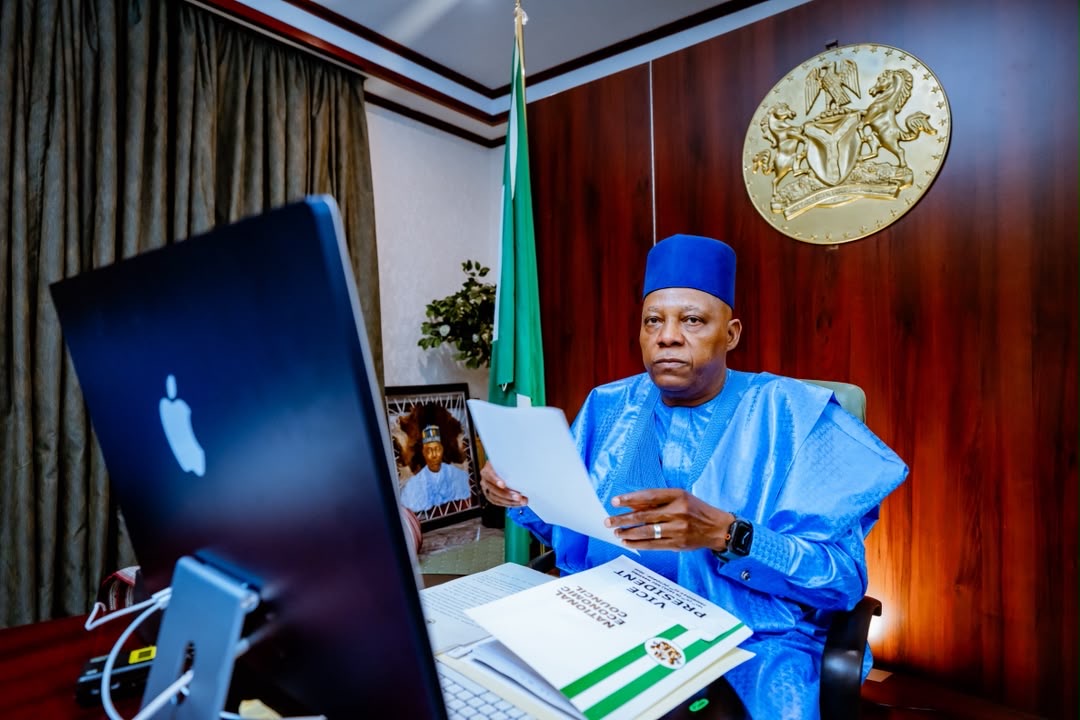
Vice President Kashim Shettima on Thursday urged governors to turn macroeconomic reforms into jobs, cheaper transport and better healthcare, as the council also weighs Ebola preparedness and a joint financing framework for CNG and electric vehicles.
The National Economic Council on Thursday endorsed a 90-day economic action plan designed to convert the gains from President Bola Tinubu’s reform programme into more immediate relief for households confronting high food, transport and living costs.
The plan, presented by Finance Minister and Coordinating Minister of the Economy Taiwo Oyedele at the council’s meeting, focuses on five priorities: food affordability, tax harmonisation, completion of high-impact projects, removal of investment bottlenecks and regulated household support.
According to a statement by the Senior Special Assistant on Media and Communication to Vice President Stanley Nkwocha, the council, chaired virtually by Shettima also approved a national dashboard to track projects across the federation.
The statement said the platform is intended to improve transparency and accountability, including in the use of savings from the removal of petrol subsidies.
Speaking at the event, Shettima pressed State Governors state and federal agencies to ensure that the administration’s stabilisation agenda produces visible improvements in daily life, including employment, affordable transportation, healthcare and financial security.
“The first dividend of prosperity should be the confidence to plan a life,” he said, arguing that the success of economic policy should be judged by its effect on citizens rather than by policy announcements alone.
In his remarks, the Minister of Finance Oyedele said the government’s medium-term objectives include reducing headline inflation and interest rates to single digits by 2027.
He said the next phase of reform would depend on coordinated execution by federal and state institutions.
In a separate resolution, the council agreed to create a joint federal-state financing framework to accelerate the deployment of compressed natural gas and electric vehicles.
It directed authorities to work with transport unions and operators to ensure that fuel savings are passed to commuters through lower fares.
Vice President Shettima had earlier said the National CNG Bus Initiative should be measured by affordability and access, not by the number of buses purchased.
“The cost of reaching a livelihood should never consume the livelihood itself,” he said.
A committee is to be constituted to coordinate the financing arrangement, engage stakeholders and develop measures to make public transportation more affordable and sustainable.
The council also received an update on the reported Ebola case in the Federal Capital Territory. Health Minister Muhammad Ali Pate sought to allay concerns, saying Nigeria has the institutional capacity to contain the outbreak through surveillance, laboratory testing, logistics and public communication.
He said 21 states had updated their preparedness plans and urged the remaining 15 to accelerate theirs.
On polio, the council directed states to conduct post-campaign reviews in areas where children were missed during immunisation exercises, release counterpart funds promptly and strengthen cooperation with security agencies and traditional leaders.
The council further endorsed stronger federal-state collaboration in the livestock sector, which officials view as a potential source of jobs, rural income and economic growth. All states indicated support for the federal government’s livestock-development initiatives.
NewsQuest reports that NEC’s decisions reflect a growing political imperative for the Tinubu administration: after more than two years of bold fiscal and monetary adjustments, it must demonstrate that improved macroeconomic indicators are translating into lower prices, better services and greater purchasing power for ordinary Nigerians.
