

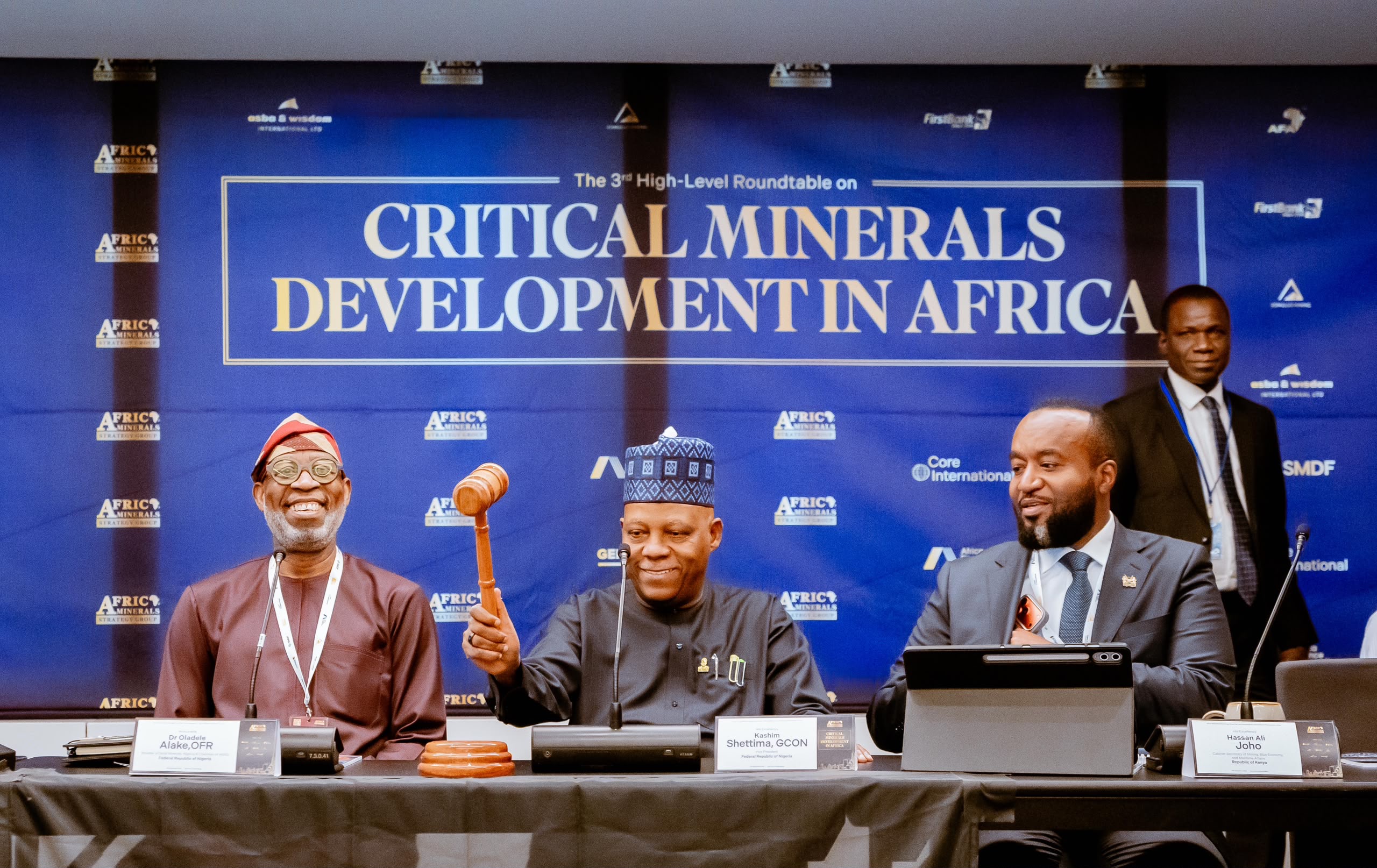
President Bola Tinubu has urged African governments to form a more assertive alliance around critical minerals, arguing that the continent must move beyond exporting unprocessed resources and secure a greater share of the value created from cobalt, lithium, copper and rare earths.
Tinubu, speaking at a high-level Africa Minerals Strategy Group roundtable on the sidelines of the United Nations General Assembly (UNGA 81), said Africa’s growing importance to clean-energy technologies, artificial intelligence and advanced manufacturing should translate into jobs, industrial capacity and broader prosperity at home.
He said “For generations, Africa has furnished the materials of prosperity elsewhere”.
Senior Special Assistant to the President Stanley Nkwocha in a statement said Tinubu stated this in remarks delivered by Vice President Kashim Shettima.
“Our duty is to ensure that the future being fashioned from African minerals has room for African ambition,” the statement added.
The gathering, chaired by President Tinubu and attended by officials from several African countries, focused on mineral processing, access to geological data, financing and security of supply chains.
Nigeria’s Minister of Solid Minerals Development Dele Alake, who chairs the Africa Minerals Strategy Group, proposed a Continental Integration and Economic Assurance Declaration intended to create a common framework for African mineral value chains.
President Tinubu said mineral-rich African communities often remain poor despite supplying inputs central to the global economy.
He called for more refining, battery production, component manufacturing, technology transfer and skills development across the continent.
“The worth of a mine must be counted in the lives it improves,” he said, citing employment, infrastructure, local enterprise participation and long-term prosperity as measures of success.
The President warned that individual African countries could weaken their bargaining power by competing for investment through lower royalties, looser local-content rules and broad concessions.
“Fragmentation leaves us exporting raw materials and buying finished goods at a premium,” he said.
“Cooperation gives our markets scale, our industries integration, our financing reach and our negotiations authority.”
The proposal reflects a wider effort by resource-rich countries to capture more economic benefits from the global scramble for minerals used in electric vehicles, renewable-energy equipment, data centers and defense technologies.
NewsQuest reports that African governments have increasingly sought to encourage processing and manufacturing within their borders, rather than permitting the export of ore and concentrates for refining abroad.
President Tinubu said such a strategy would require African nations to align policies, develop shared infrastructure, mobilize regional capital and negotiate jointly where their interests overlap.
He said the proposed continental declaration should not become another ceremonial document. Instead, he called for a program with implementation deadlines, financing arrangements and public accountability mechanisms.
African governments should identify their national and regional commitments, while development-finance institutions and sovereign investors should establish financing platforms, he said.
President Tinubu said Nigeria was seeking to expand its own mining industry through policies requiring local value addition for new licenses, better geological data, improved access for investors, formalization of artisanal miners and stronger enforcement against illegal mining.
He said federal mining revenue rose from about ₦6 billion in 2023 to more than ₦38 billion in 2024, and reached between ₦68.1 billion and ₦70 billion in 2025.
He also pointed to foreign investment commitments and lithium-processing capacity developed in Nasarawa State as evidence that more stringent terms for investors could still attract capital.
Nigeria’s policy, he said, is that minerals extracted in the country should support Nigerian industry, workers, skills development and host communities.
“Firm terms can attract serious capital,” he said.
Alake said the proposed Continental Integration and Economic Assurance Declaration would establish a unified framework for Africa’s critical-mineral and solid-mineral value chains.
He urged African countries that have not joined the Africa Minerals Strategy Group to participate, arguing that the continent would need coordinated policy, financing and infrastructure to fulfill its mining ambitions.
Kenya’s minister of blue economy and maritime affairs, Hassan Ali Joho, called domestic-resource mobilization central to mineral development.
He also urged members of the group to promote transparency, competitiveness and greater alignment in licensing procedures while respecting national sovereignty.
Representatives of Liberia, Chad and Tanzania also participated in the discussion.
President Tinubu described the effort as a test of whether African governments could convert natural-resource endowments into durable economic gains.
“Africa’s power resides in its people, markets and ingenuity,” he said.
“No outsider will organise our continent or place our industrial interests above their own.”
