

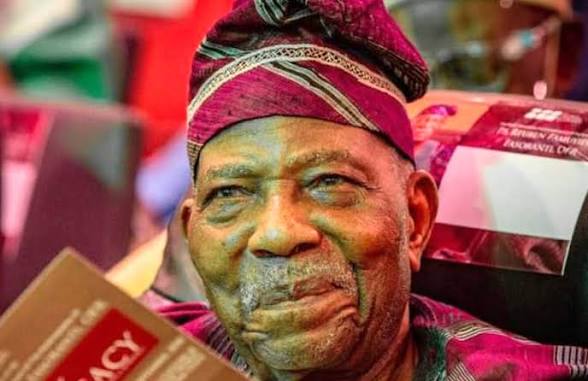
Leaders of Afenifere and prominent Yoruba figures used a centenary lecture to press for greater unity among South‑West states and renewed momentum for restructuring Nigeria under “true federalism”.
The leaders described the appeals around the life and ideals of Pa Reuben Fasoranti, who turned 100 in May.
The Pa Reuben Fasoranti Centenary Lecture at Onikan drew traditional rulers, politicians, academics, religious figures and Afenifere representatives from across the country.
The programme, organised by the Yoruba socio‑political organization, featured lectures by Arch Ayo Ladigbolu and Professor Ropo Sekoni and was chaired by former Ogun State governor Olusegun Osoba.
Oba Olu Falae, a former finance minister and ex‑managing director of Nigerian Merchant Bank, opened the event by casting the celebration as recognition of Fasoranti’s lifelong impact rather than mere longevity.
“We are not here to celebrate longevity. We are here to celebrate impacts,” Mr. Falae said, describing Fasoranti as “respected with love,” a listener and a leader who embodied the political philosophy of the late Chief Obafemi Awolowo.
Mr. Osoba, welcoming delegates who had travelled from across Nigeria, said Afenifere’s ideals — which he described as egalitarian and rooted, in Awolowo’s thought – extended beyond the Yoruba to the nation as a whole.
Tracing the lineage of the progressive movement from the Alliance for Democracy through the Action Congress and the All Progressives Congress, he argued that current federal initiatives championed by President Bola Tinubu, such as state policing and deeper fiscal federalism, reflect long‑standing progressive aims.
“We can see that since President Bola Ahmed Tinubu came to power, no state is owing salaries, their allocations have doubled and tripled,” Mr. Osoba said, urging governors to channel higher federal allocations “to benefit the people.”
In a lecture that drew on poetry, proverbs and traditional songs, Arch Ladigbolu emphasised Yoruba ethical concepts — particularly iwa rere (good character) and otito (truth) — as essential to repairing leadership deficits and curbing corruption.
Speaking largely in Yoruba, he said allegiances to character over wealth underpinned the stature of both Awolowo and Fasoranti, and argued that moral leadership would be critical in a multi‑ethnic, multi‑religious Nigeria.
The event opened with multi‑faith prayers and included remarks highlighting Fasoranti’s decades of activism and public service.
Speakers also referenced the role of pro‑democracy movements, such as the National Democratic Coalition, during Nigeria’s military era, described Fasoranti’s centenary as an occasion to revive the movement’s drive for constitutional and institutional reforms.
