

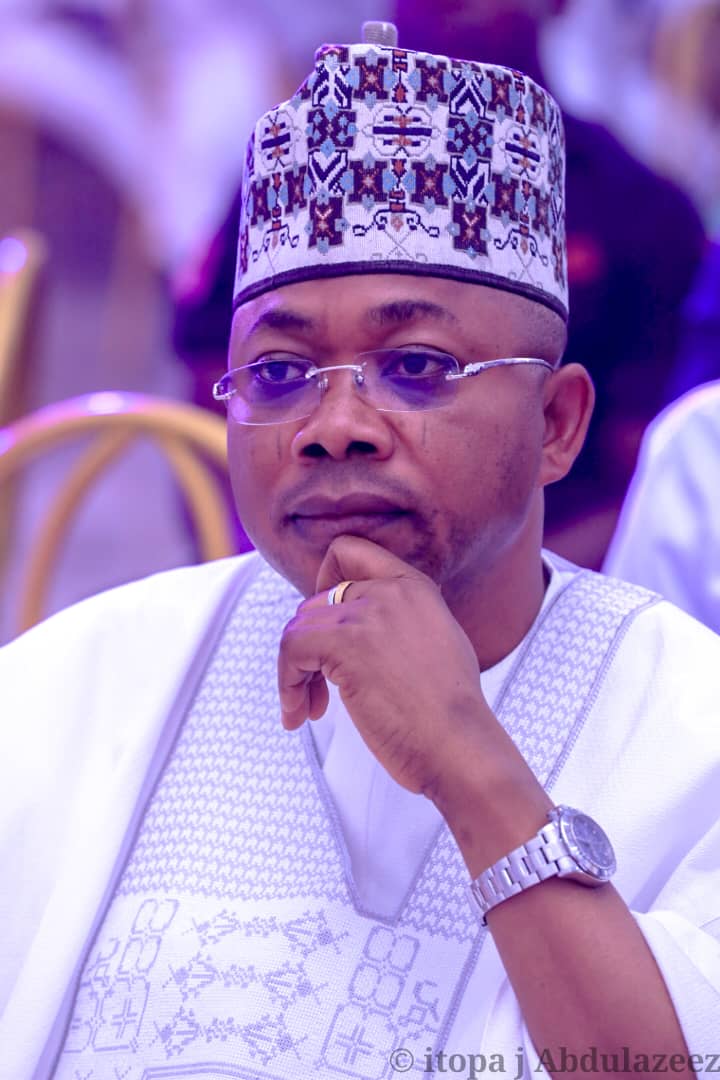
By Jacob EDI
There are governments that merely occupy time, and there are governments that attempt to bend time towards a destination.

The distinction is subtle, but profound. One manages the present, putting out fires as they arise, patching holes and hoping the next day will be kinder. The other looks beyond immediate turbulence and asks the more difficult question: what should this place become, and what must we begin doing today to fit into the inevitable tomorrow? That, to my mind, is the more interesting way to read the third year of Governor Ahmed Usman Ododo’s administration in Kogi State.
Ododo inherited a state of immense possibilities and equally enormous deficits. Kogi has never been short of promise. Its strategic location, agricultural potential, mineral resources, human capital and geographical advantage have always suggested a state capable of considerably more than it has sometimes managed to achieve.
The difficulty has never been the absence of possibility. Kogi itself is a confluence of opportunities.
The challenge has been converting possibility into reality.
Perhaps that is where the Ododo story begins to acquire philosophical weight. Governance, properly understood, is not merely the administration of what exists. It is the deliberate construction of what does not yet exist.
Ododo’s experience within government appears to have informed this approach. Before becoming governor, he had the unusual advantage of observing the machinery of government from within, learning its mechanisms and, perhaps unconsciously, understudying governance itself. His choices today bear the imprint of that experience.
That is the audacity of tomorrow.
The first two years were largely years of intervention, repair and consolidation: infrastructure, healthcare, agriculture, education and security. In its third year, however, the question becomes more consequential: what kind of Kogi is being prepared by Ododo, Kogi’s Flower Boy? There is something profoundly consequential about fixing what appears mundane.
A rural health centre may not make spectacular political theatre, but for a woman in labour, a functional facility nearby can mean the difference between anxiety and assurance, perhaps even between life and death.
The administration’s investment in primary healthcare therefore means more than statistics. More than ₦7 billion was approved in 2024 for the rehabilitation of 88 additional primary healthcare centres, alongside facilities already undergoing renovation, with the wider programme targeting more than 150 facilities across the state’s 21 local government areas. Government becomes meaningful when it travels beyond the capital and arrives at the doorstep of the citizen.
The same logic applies to roads.
A road is never merely asphalt. It is a line connecting one possibility to another. It carries the farmer’s produce to market, the child to school, the patient to hospital and the trader to opportunity.
Across the three senatorial districts, the administration has pursued major road construction and rehabilitation, including urban and rural roads and projects under KOGROMA. But the larger question is not how many kilometres have been constructed.
It is what those roads make possible. Kogi sits at a remarkable geographical intersection. It should not merely be the state people drive through on their way somewhere else. It should become a place people deliberately come to: for commerce, industry, investment, tourism and opportunity. In this regard, the government has constituted a powerful team of experts to review the abundant tourism potentials of the state with a view to totally overhaul these potentials and open up the state to the outside world.
The state is, unquestionably, a confluence of possibilities. The challenge is transforming the possession of geography into the exploitation of geography.
This what Ododo is doing. Agriculture presents perhaps the clearest opportunity. Kogi does not need to invent its comparative advantage. Much of it is already beneath the feet of its people. The land is there. The farmers are there. The challenge over the years has been how to move from subsistence to productivity, productivity to processing, and processing to value chains capable of generating employment and wealth.
The Ododo administration’s wet-season farming programme, deployment of more than 150 tractors and partnerships involving IFAD, ACReSAL and L-PRES point in that direction.
But the ambition must be bigger than farming.
The BassaNge farmer producing cassava or rice is important. The farmer connected to a processing plant, packaging facility, logistics network and national market becomes part of an economic ecosystem.
That is when agriculture becomes industry. Education belongs in the same bracket. There is perhaps no more expensive mistake a government can make than building physical infrastructure while neglecting the human beings who will inherit it. Roads wear out. Buildings require renovation. Educated citizens reproduce value across generations.
The provision of WAEC fees for more than 18,000 public-school students, continued investment in tertiary institutions and the development of engineering and medical facilities at the Confluence University of Science and Technology are investments in the human architecture of tomorrow. So too is the effort towards the revival and accreditation of the MBBS programme at Prince Abubakar Audu University, Anyigba.
A modern Kogi cannot build its future with yesterday’s skills. This is Governor Ododo’s thinking, invariably.
But there can be no meaningful tomorrow where people are afraid of today.
Security becomes foundational.
Governor Ododo has left little ambiguity about his position on insecurity. His refusal to negotiate with bandits and terrorists, coupled with support for security agencies and community-based security initiatives, has defined his security philosophy.
The rescue of abducted students, including the 20 students of the Confluence University of Science and Technology, remains a painful reminder both of the brutality of insecurity and the state’s unequivocal resolve to protect its citizens.
A farmer cannot confidently cultivate land he fears reaching. A trader cannot expand commerce along dangerous corridors. Parents cannot confidently send children to school where safety remains uncertain.
Security restores something development cannot do without: confidence. And confidence is an economic asset.
Then comes the larger economic question. The governor’s interest in exploiting Kogi’s solid mineral resources, including its coal deposits, suggests an attempt to move beyond identifying what the state possesses, as it has being in times past, towards asking what those resources can produce. A state can be rich beneath the ground and poor on the surface. The challenge is closing that gap.
Coal-to-power will understandably invite questions about financing, technology, environmental safeguards and the changing global energy landscape. Those questions should be asked. But the larger proposition deserves attention: minerals should not merely leave Kogi as raw materials. They should become inputs into an industrial economy. The governor has repeatedly espoused this view.
A mineral underground is mere potential but transformed into electricity, industrial production, employment and revenue, it becomes real development. The same ambition is visible in the proposed Zariagi International Airport.
Critics will ask whether an airport is justified given Kogi’s proximity to Abuja. That is a legitimate question. So are questions about cost, management, passenger volumes and economic viability. But infrastructure of this magnitude must be understood within a larger economic architecture.
An airport is not merely a runway. Properly conceived and efficiently managed, it can stimulate logistics, hospitality, investment, commerce and mobility. Combined with the Abuja-Lokoja-Okene-Benin corridor, the Ajaokuta economic ambitions, agriculture, mining and industrial development, it could help alter Kogi’s economic calculus.
Imagine a Kogi where agricultural produce moves efficiently from farm to processing centre and from processing centre to national and international markets; where minerals feed industries within the state; where reliable power supports production; where an airport expands connectivity; and where young people find opportunities not only in government offices but in factories, technology firms, logistics companies and enterprises.
Tomorrow…
Yet the Ododo story is not only about infrastructure. It is also about the character with which he has approached power. Politics is often mistaken for a contest in which victory belongs to whoever can deploy the greatest force. But power has another language: character.
Ododo’s willingness to consult stakeholders, including those outside his political party, reflects an understanding that political opponents remain citizens of the same state. The ability to consult is not surrender. Accommodation is not cowardice. Disagreement need not become permanent warfare, he believes.
No state can develop at the speed of its divisions rather, Ododo’s Kogi sees industry, its minerals and power and roads and commerce and human capital development and abundant opportunity for the people. The Ododo administration is not under the illusion that it can construct a mythology of perfection but it’s working hard converting potential into capacity and productivity and prosperity.
History is rarely kind to governments that merely celebrate what they inherited. It remembers those that did something with it. Kogi has never lacked possibility. What it has needed is the courage to act upon it.
The road remains long. The questions remain many. But work is ongoing. And sometimes, before a people can fly, someone must first have the audacity to build the runway.
