

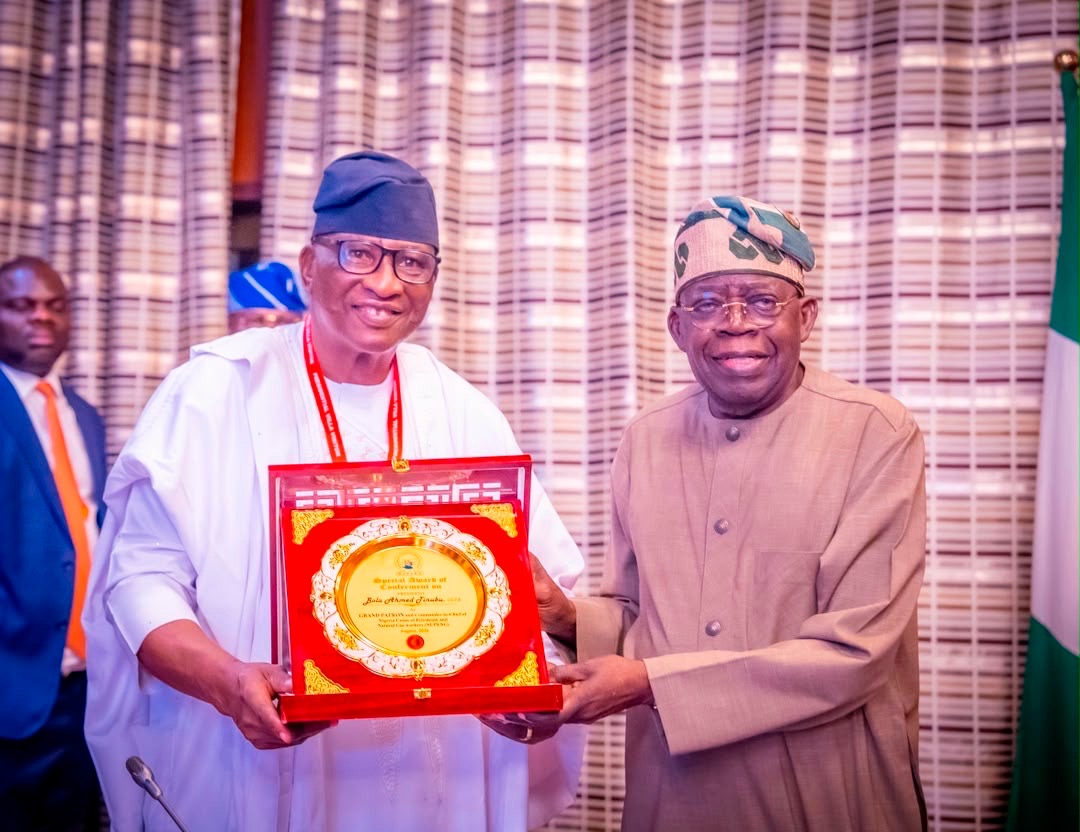
President Bola Tinubu has pledged a structured, research-driven effort to return Nigeria’s long-idled refineries to operation.
The President said the government will pursue a technical, financial and managerial reset rather than quick fixes.
Speaking at Presidential Villa, Abuja after receiving the national leadership of the Nigerian Union of Petroleum and Natural Gas Workers, or NUPENG, President Tinubu said the government would commission detailed assessments to identify the structural and operational weaknesses that have kept the facilities offline for years.
In a statement by the Special Adviser on Information and Strategy to the President Bayo Onanuga, Tinubu said “The refineries that you mentioned are going to come back to work,” he said.
“We’re building a very firm, resetting, and structural reworking of the economy of it. Ordinary flame and smoke of a refinery doesn’t mean that it’s working until it’s profitable and yields the value for which it is built.”
The President described the effort as part of a broader responsibility to rectify inherited problems.
“No matter what has happened in the years past, it’s now my responsibility as president to fix it and make it work for the greatest common good of our population,” he said, adding that the approach would be evidence-based and long-term.
President Tinubu also touched on two politically sensitive areas: local government autonomy and the Presidential Initiative on Compressed Natural Gas.
He said constitutional questions around local-government autonomy are under review and appealed for stakeholder patience.
The President offered NUPENG a larger role in the CNG initiative but urged union leaders to ensure its benefits reach ordinary commuters.
Minister of Information and National Orientation Mohammed Idris, noted that NUPENG’s acknowledgement of President Tinubu’s reforms had eased friction between unions and the administration.
“It is not common that you find trade unions come back to the President and say, ‘Thank you for what you have done,’” Idris said, pointing to past instances when labour leaders publicly praised recent wage adjustments and other measures.
NUPENG President Salimon Akanni Oladiti praised the administration’s decision to remove the fuel subsidy—one of President Tinubu’s most consequential economic moves—saying the policy had halted persistent fiscal drains and freed resources for infrastructure.
Mr. Oladiti cited ongoing projects he said were already improving working conditions for members, including the 750-kilometre Lagos–Calabar coastal highway and the 1,068-kilometre Sokoto–Badagry superhighway.
“For our members, a good road is the difference between arriving home safely and never arriving at all,” Mr. Oladiti said, noting that safer highways reduce accidents and spillage for tanker drivers.
The union urged the President to sustain efforts to rehabilitate the refineries, arguing that functioning domestic refining capacity would bolster energy security, cut import dependence and create jobs.
In a symbolic gesture, NUPENG named President Tinubu Grand Patron of the union.
The President also paid tribute to the late Frank Kokori, a former NUPENG leader and ally in pro-democracy struggles, saying he and Kokori had “struggled for this democratic dispensation together.”
NewsQuest reports that reviving Nigeria’s refineries entails complex technical work and substantial capital, and success will hinge on rigorous diagnostics, transparent procurement and viable commercial plans—areas President Tinubu signaled the administration intends to prioritize.
