

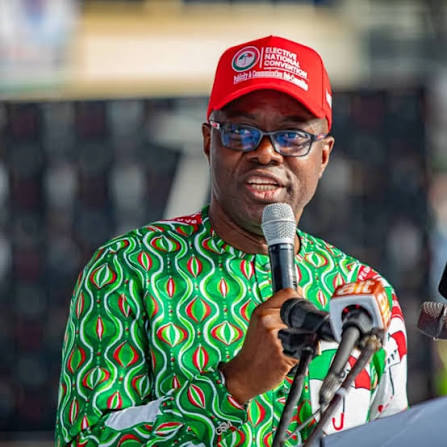
Presidential candidate of the Allied Peoples Movement (APM) in the 2027 general election and Governor of Oyo State Engineer Seyi Makinde has said that he would pursue a restructuring of Nigeria’s mineral-resources governance if elected.
Governor Makinde said he will give states and host communities a larger role in decisions over solid minerals while preserving federal authority over national economic stability.
In a statement by his Director of Strategic Communication Richard Ihediwa, the APM hopeful outlined his proposal in the Makinde-Daura “RESET Nigeria” manifesto, where he argued that the current arrangement leaves too much decision-making with the federal government even as states and communities absorb much of the cost of mining activity.
He said those costs include environmental degradation, unsafe storage of hazardous materials, damaged roads, community conflict and emergency response.
“Nigeria must examine how greater responsibility for natural resources can be transferred to states, how communities that bear the consequences of resource exploitation can receive a fairer share of the benefits, and how such changes can be implemented without undermining national economic stability,” the manifesto said.
Under the plan, a Makinde administration would launch a national conversation on restructuring and resource control in its first year in office.
Ihediwa explained that a Makinde presidency would complete a Federal Responsibility Review intended to determine which functions should remain exclusively federal, which should be delivered by states under national standards, which should be principally state or local, and which require formal intergovernmental agreements.
The review is expected to also produce constitutional amendments, legislation, fiscal changes and transition arrangements, rather than serve as an open-ended constitutional conference.
According to the statement, the objective is to align authority more closely with responsibility: states and communities would gain greater influence over mineral exploitation in their territories, while the federal government would retain a role in safeguarding national economic stability.
Makinde in his manifesto proposes that the federal government continue issuing mining licences under the existing constitutional framework, but that state governments be formally involved in the process.
States he said would be able to review applications and raise concerns relating to land use, environmental protection, community interests and public safety.
The plan also called for closer cooperation between federal and state regulators, public registers of mining licences and beneficial owners, and clearer compliance-monitoring mechanisms.
The APM campaign described the measures as a response to illegal mining, indiscriminate exploitation, youth restiveness and clashes between communities and government authorities.
It argued that greater local participation could reduce conflict while improving accountability in the sector.
Governor Makinde’s proposal is part of a broader “Federation that Works” agenda, which seeks to give states more responsibility for developing their economic potential and to direct more resource benefits to communities near extraction sites.
“The Makinde objective is a federation in which states have greater responsibility for developing their economic potentials, communities benefit more directly from the resources around them and national institutions continue to protect the interests of all Nigerians,” the campaign said.
The Makinde-Daura Presidential Campaign Organization urged Nigerians to vote for the APM on January 16, 2027, saying the proposal would create opportunities, generate jobs and improve living conditions.
