

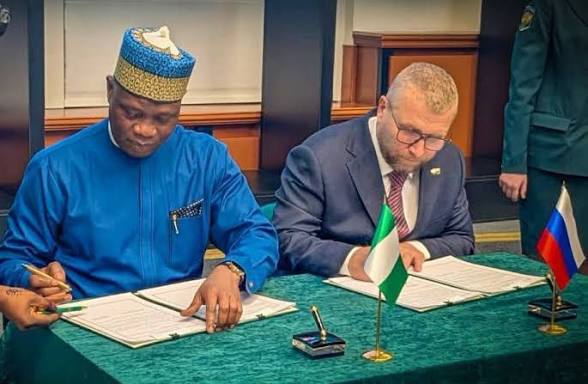
Nigeria and Russia have signed a customs-cooperation agreement intended to streamline trade, expand intelligence sharing and strengthen enforcement, as both countries seek to improve border administration and reduce friction in bilateral commerce.
The Agreement on Cooperation and Mutual Assistance in Customs Matters, signed in Moscow by Nigeria Customs Service (NCS) Comptroller-General Adewale Adeniyi and Federal Customs Service of Russia Head Valery Pikalyov, creates a structure for cooperation on trade facilitation, data exchange, customs enforcement, financial integrity and staff training.
The pact is designed to help legitimate cargo move more efficiently while giving customs authorities better tools to detect illicit trade, tax evasion, counterfeit goods, narcotics and other prohibited or hazardous shipments.
It also provides for direct operational assistance and professional exchanges between the two services.
Adeniyi described the agreement as a strategic instrument for protecting economic integrity, securing supply chains and improving trade governance.
He said it followed months of technical consultations and legal reviews between the two administrations.
Adeniyi said the agreement builds on a broader effort to modernise customs operations.
Declarations, payments and supporting documentation are increasingly processed electronically, reducing paperwork and improving the speed and transparency of clearance procedures.
Adeniyi argued that revenue collection and trade facilitation are complementary rather than competing objectives.
He linked the service’s approach to the World Customs Organization’s SAFE Framework of Standards, which seeks to balance secure supply chains with efficient legitimate trade.
A central longer-term objective is cooperation between Nigeria’s and Russia’s Authorised Economic Operator programmes—schemes that grant vetted, compliant traders expedited treatment at the border.
The two administrations plan structured exchanges on programme design, procedures and implementation experience.
Mutual recognition, if ultimately achieved, could allow certified companies in one country to receive comparable benefits in the other, potentially reducing inspections and accelerating cargo movement.
The agreement itself does not establish that recognition; it opens the path for negotiations.
The two sides also discussed sharing customs statistics and trade data for analysis.
Adeniyi said reliable data exchange would support comparative analysis, improve understanding of bilateral trade patterns and strengthen evidence-based administration.
The Russian Customs Service is legally authorised to collect, process and provide customs statistics derived from declarations, and already exchanges such data with foreign counterparts.
He said Moscow was prepared to explore a dedicated data-sharing arrangement with Nigeria, subject to the applicable legal and procedural framework.
The agreement, signed on the sidelines of the third Russia-Africa Summit, marks the first such customs accord between the two countries, according to Russian trade authorities.
