

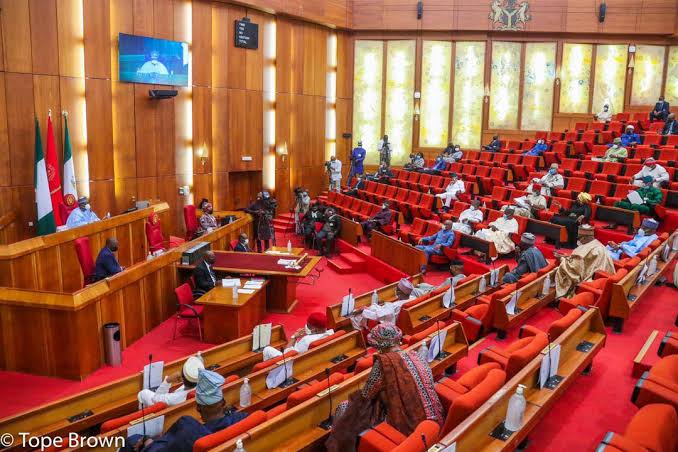
The Senate has called on the Federal Government to renegotiate the Bilateral Air Services Agreement (BASA) between Nigeria and China to allow Nigerian airlines to operate direct flights to China, in a move aimed at reducing travel costs and strengthening bilateral trade and connectivity.
Arguing that the pact has failed to deliver reciprocal access for Nigerian airlines and has left travelers dependent on connections through third-country hubs, the Senate urges the Ministry of Aviation and Aerospace Development to revise the commercial terms and flight schedules under the agreement.
The resolution, adopted Tuesday, also directed the Ministry of Foreign Affairs to open talks with Beijing on easier business visas for Nigerian traders and landing slots for Nigerian carriers at Chinese airports.
Although Nigeria and China signed the agreement under former President Muhammadu Buhari to establish direct commercial air service, no Nigerian airline currently flies directly to China.
Chinese carriers, by contrast, operate direct flights into Nigeria, according to senators.
Nigerian travelers typically reach Chinese cities through Addis Ababa, Cairo, Dubai, Istanbul, London or Frankfurt.
Senate President Godswill Akpabio said the imbalance was commercially untenable.
“If it’s only China that can fly directly to Nigeria and Nigerians can’t, then it’s something we need to rejig,” Akpabio said.
Sen. Mohammed Monguno, the Senate Chief Whip who sponsored the motion, said the agreement was intended to make Lagos’s Murtala Muhammed International Airport and Abuja’s Nnamdi Azikiwe International Airport gateways linking West and Central Africa with East Asia.
Lawmakers argued that direct service would shorten travel times, improve supply-chain efficiency, reduce foreign-exchange outflows, lift airport revenue and support non-oil exports, including perishable goods.
They also cited growing commercial ties between Africa’s most populous country and China as a reason to secure reciprocal aviation rights.
The Senate said enforcement would require coordinated action by the Ministry of Aviation and Aerospace Development, the Nigerian Civil Aviation Authority, the Central Bank of Nigeria (CBN) and the Nigeria Customs Service (NCS).
The Senate also recommended measures including strict reciprocity, code-sharing arrangements, temporary airport-fee waivers and naira-yuan settlement under the countries’ existing currency-swap plan.
The Senate directed its aviation and foreign-affairs committees to monitor compliance and report back within four weeks.
It also signaled that Nigeria could review the agreement if China does not grant Nigerian airlines equivalent access.
