

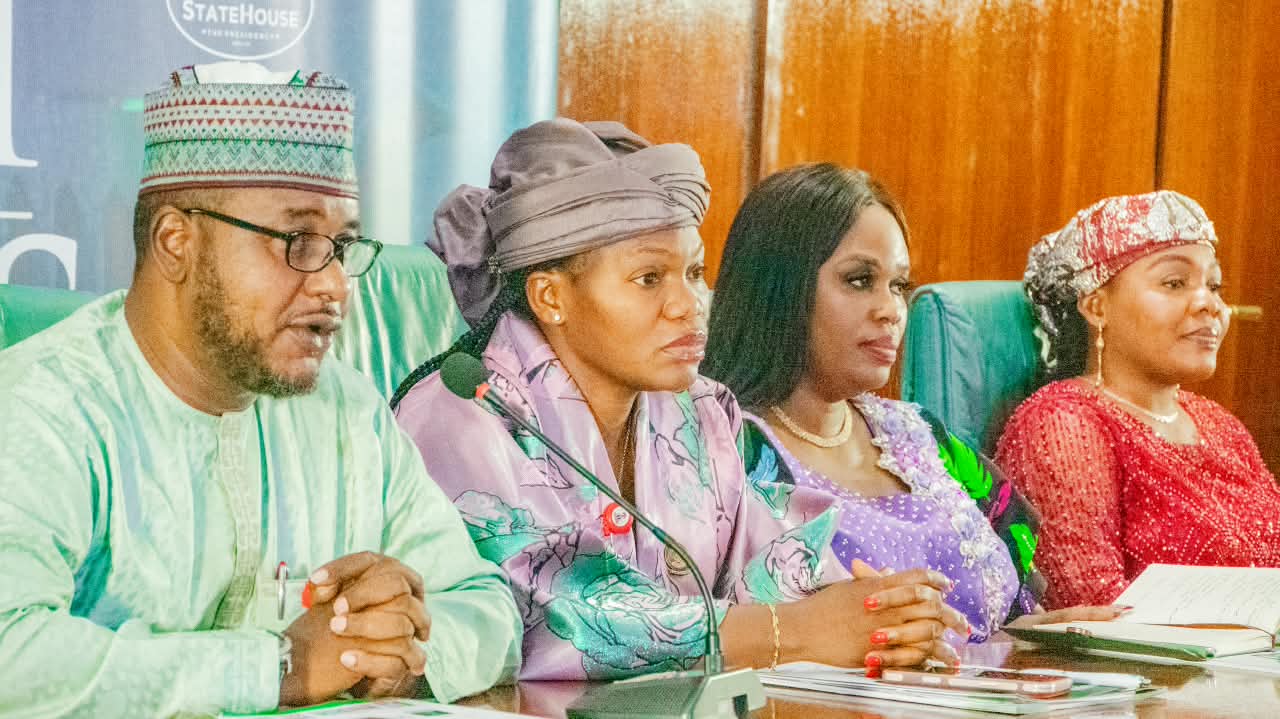
Senior aides to President Bola Tinubu on Tuesday mounted a coordinated defense of the administration’s infrastructure record, presenting road, rail and energy projects across the nation’s six geopolitical zones as evidence that the government is delivering development.
The aides said that President Tinubu deserves a re-election to consolidate many of the bold driven reforms that are fast impacting millions of lives.
Speaking to State House correspondents at the Presidential Villa, the aides—zonal directors under the Infrastructure Mobilisation and Sensitisation Directorate of the Presidential Campaign Council—argued that investments in transport, power, agriculture and education were beginning to ease long-standing constraints on commerce and daily life.
NewsQuest reports that their messages blended policy advocacy with political mobilization, urging Nigerians to back the president’s bid for a second term.
Dr. Abiodun Essiet, Senior Special Assistant to the President on Community Engagement for North-Central, said more than 167 kilometers of roads had been completed in the region, with over 1,207 kilometers under construction.
She cited the Shendam Bridge, Lafia Bypass, Makurdi–Otukpo–9th Mile Road and Abuja–Lokoja highway as priority projects.
Dr. Essiet said the administration remained responsive to cost-of-living pressures through regular community engagement and briefings from officials. “Some of the reality of what our people are facing is what we are communicating to Mr. President,” she said.
“You think Mr. President doesn’t know the price of eggs or bread in the market? He does, because we brief him regularly.”
She pointed to the Mokwa–Bida Road in Niger State as an example of the administration’s approach, saying the road had last been contracted 46 years ago.
President Tinubu, she added, directed that it be rebuilt with reinforced concrete rather than asphalt to improve durability.
She also highlighted fertilizer distribution, tractors, rural markets, solar electrification and loans through the Nigerian Education Loan Fund, alongside the Lagos–Calabar Coastal Highway and the Akwanga–Bauchi–Gombe–Biu–Maiduguri corridor.
In the North-West, Abdullahi Tanko Yakassai emphasized the reconstruction of the Abuja–Kaduna–Zaria–Kano highway using concrete pavement, along with solar streetlights and planned security installations.
The project has become a centerpiece of the administration’s northern infrastructure agenda; President Tinubu recently inaugurated an 81-kilometer section during a campaign event in Kaduna.
Yakassai also cited the Sokoto–Badagry Superhighway, the Kaduna–Kano railway and approved monorail projects in Kaduna and Kano as investments intended to improve transportation, expand agricultural trade and stimulate economic activity.
The Sokoto–Badagry corridor is designed to link northern agricultural states with Lagos and the country’s southwestern commercial hub.
In her remarks, Barrister Chioma Nweze said roughly 1,000 kilometers of road projects were under way in the South-East, including the Enugu–Onitsha and Enugu–Port Harcourt highways, as well as work around the First and Second Niger bridges to relieve congestion and improve regional connectivity.
She also cited the South-East Development Commission and proposed expansion of household gas distribution as measures aimed at lowering energy costs and supporting industrial growth—initiatives she said could strengthen political support for the president ahead of 2027.
In the South-South, Gift Johnbull highlighted the Lagos–Calabar Coastal Highway, East–West Road reconstruction, Benin–Agbor road work and the Kaa–Ataba Bridge in Rivers State. She argued that better roads would help farmers reach markets, expand commerce and reduce communities’ dependence on the oil-and-gas economy.
Abdulhameed Abba, the North-East engagement aide, pointed to federal investments in roads, education, health care and water resources, particularly links among Akwanga, Jos, Gombe and Biu that he said would improve regional mobility and commerce.
In the South-West, Moremi Ojudu focused on infrastructure and local-government reforms, arguing that greater financial autonomy for councils would strengthen grassroots development, support small businesses and improve revenue generation.
The aides reaffirmed their support for President Tinubu’s development agenda—and for its continuation beyond 2027.
The administration has often explained that more than 2,700 kilometers of highways and major roads are under construction, rehabilitation or reconstruction nationwide, including several flagship corridors intended to knit together the country’s regions.
