

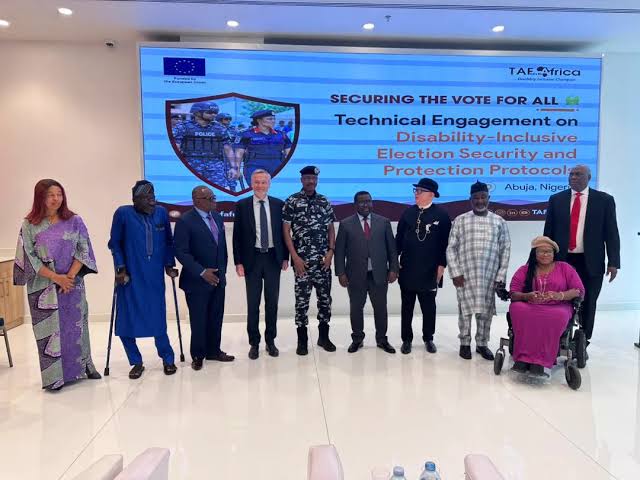
The Independent National Electoral Commission (INEC) has called for enhanced security measures to protect persons with disabilities ahead of the 2027 general elections as part of efforts to ensure inclusive participation.
Speaking at a technical meeting on disability-inclusive election security in Abuja, INEC Chairman Professor Joash Amupitan urged the police and other security agencies to prioritise the protection of voters with disabilities in their preparations for the polls.
He called for coordinated measures to prevent intimidation and remove barriers to participation.
He said credible elections depended not only on an efficient voting process but also on whether eligible citizens could cast their ballots safely, freely and without discrimination.
Amupitan appealed to security agencies to incorporate disability considerations into personnel training, deployment plans and incident-response procedures well before election day.
His appeal placed security alongside physical access and voting assistance as a requirement for electoral inclusion.
Voters with disabilities, he said, must be protected from harassment, intimidation and other obstacles that could prevent them from exercising their rights.
Amupitan called for security assessments to identify inaccessible polling units, overcrowding, potential flashpoints and communication barriers that could hinder voters with disabilities.
He urged police officers and other security personnel to act professionally and impartially, with sensitivity to the needs of people with different disabilities.
Any assistance provided to voters, he said, must preserve their dignity, independence, privacy and freedom of choice.
The approach would require agencies to account for disability-related needs when planning deployments, communicating with voters and developing incident-response procedures, rather than addressing those needs only when problems arise at polling stations.
The meeting, held at the Abuja Inter-Continental Hotel, brought together representatives of the police and other security agencies, the European Union (EU), TAF Africa and organisations representing persons with disabilities.
Amupitan cited the 1999 Constitution, as amended, the Electoral Act 2026, the Discrimination Against Persons with Disabilities (Prohibition) Act 2018 and Nigeria’s commitments under the United Nations Convention on the Rights of Persons with Disabilities as the legal foundations for inclusive elections.
He also pointed to Clauses 19, 21, 27 and 28 of INEC’s 2026 election regulations and guidelines, which he said provide for priority access, appropriate assistance and assistive voting materials for voters with disabilities.
The police, he said, have a responsibility to maintain public order, protect lives and property, prevent electoral violence and provide a safe environment for voting.
Those duties must be carried out in ways that enable, rather than obstruct, participation.
Amupitan urged the police and other security agencies to strengthen cooperation through the Inter-Agency Consultative Committee on Election Security (ICCES).
He identified information-sharing, clearly assigned responsibilities and timely responses to emerging threats as essential to protecting voters.
The task ahead, he said, is to embed disability inclusion in election security arrangements before voting begins, ensuring that protections set out in law are reflected in how personnel prepare, deploy and interact with the public.
