








Nigeria and the United States have signed an agreement aimed at attracting greater American investment into the country’s $700billion mining sector.
The agreement comes as the Federal Government seeks to expand local mineral processing, create jobs and reduce dependence on raw-material exports.
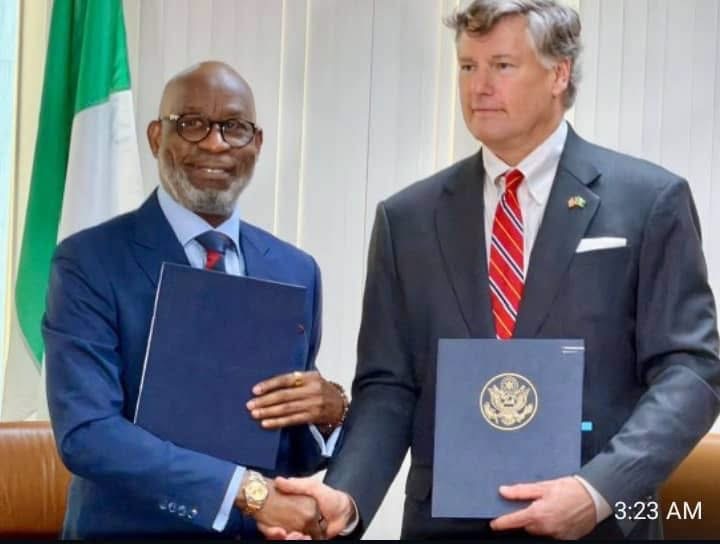
Minister of Solid Minerals Development Dele Alake, signed the agreement Wednesday with the US Deputy Secretary of State Christopher Landau at Nigeria Mission House in New York.
Minister Alake on his official Facebook page said the framework was designed to deepen cooperation in geological data acquisition, exploration, mineral development and processing, supporting infrastructure, and technical capacity building.
“Nigeria cannot remain a source of raw materials while others capture most of the value,” Alake said.
“We want more local processing, quality jobs, stronger skills and greater opportunities for Nigerian businesses.”
NewsQuest reports that the agreement also comes as Nigeria tries to position its solid-minerals industry as a more consequential contributor to national output, exports and foreign investment.
The country’s mineral resources are estimated by the government to be worth about $700 billion, though much of the sector remains underdeveloped and is affected by inadequate geological information, weak infrastructure, illegal mining and limited processing capacity.
For years, Nigeria’s economy has depended heavily on oil revenues, leaving it exposed to swings in crude prices and production disruptions.
The Tinubu administration has identified mining, agriculture, manufacturing and services as areas central to efforts to diversify the economy under President Bola Tinubu’s Renewed Hope Agenda.
Minister Alake said the new US – Nigeria framework would be translated into specific investments and commercial projects in the coming months.
“We will identify viable projects and build partnerships that create value for Nigerians and our U.S. partners,” he said.
The planned cooperation signals an effort by Nigeria to secure investment not only for extraction but also for the higher-value stages of the minerals supply chain, including beneficiation, refining and processing.
Such an approach could allow Nigeria to retain a larger share of the economic value generated from its deposits, while giving American companies access to new investment opportunities in a country with significant untapped reserves of lithium, gold, limestone, bitumen, lead-zinc and other minerals.
Alake said the agreement represented an important step in strengthening Nigeria-U.S. economic cooperation around the country’s mineral endowment.
“This is how we turn our mineral wealth into lasting economic growth,” he said, “and advance the diversification goals of President Bola Ahmed Tinubu’s Renewed Hope Agenda.”


