





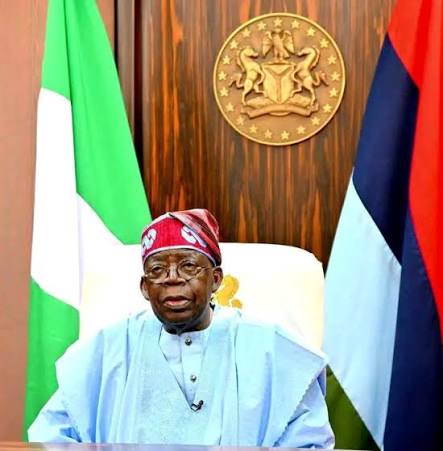


President Bola Tinubu on Thursday said Nigeria has moved beyond the most painful phase of his economic reforms and would now focus on lowering living costs, creating jobs and spreading the gains of recovery more widely across the country.
In a 66th Independence Day address which described his administration’s policies as an unavoidable treatment for a deeply damaged economy, Tinubu said Nigeria has since begun to emerge from years of weak growth, distorted subsidies, unstable foreign exchange markets and declining public confidence.
“The age of reform has done its work. Now begins the age of prosperity,” the President noted.
President Tinubu used unusually stark language to defend his policies comparing the country’s pre-2023 economic condition to a cancer patient facing a choice between painful treatment and temporary relief.
“For too long, Nigeria’s leaders chose morphine while praying for a miracle that never came,” he said, arguing that past governments had deferred difficult decisions while allowing structural problems to deepen.
The President’s administration has ended the long-running petrol subsidy regime and moved to liberalise the foreign-exchange market, policies intended to reduce fiscal pressure, attract investment and restore price signals across the economy.
President Tinubu said the reforms did not create Nigeria’s economic weaknesses but instead confronted them.
He urged Nigerians not to return to what he described as the “abuse of addictive subsidies,” a clear defence of his government’s decision to abandon policies that had kept fuel prices artificially low for years.
The President said Nigeria’s economy has expanded by more than 4% this year, with oil and non-oil activity contributing to what he described as a more stable period of growth.
He also pointed to lower oil theft, easing inflation, rebuilt foreign reserves and a more stable foreign-exchange market as evidence that the government’s economic strategy was working.
Nigeria’s non-oil export earnings exceeded $6 billion in 2025, he said, calling it the highest such revenue in the country’s history.
“These are not idle claims,” Tinubu said, adding that international institutions, investors, journalists and civil-society organisations had concluded that Nigeria’s reforms had improved the country’s economic resilience.
NewsQuest reports that the speech marked an effort by the President to present a new political and economic narrative after more than three years of reforms.
Rather than focusing primarily on macroeconomic stabilisation, President Tinubu said his government would now seek to ensure that improvement in national indicators translated into tangible gains for families.
“For three years, our overriding purpose was to correct our nation’s course. Now, our purpose is simple: shared and widespread prosperity.”
President Tinubu also said his administration’s immediate priority would be reducing the cost of living by cutting the cost of producing, transporting and selling goods.
The government plans to expand mechanised irrigation, dry-season farming, access to seeds and fertiliser, agricultural mechanisation, storage facilities and transport links, he said.
It would also continue investments in roads, railways and ports to reduce losses between farms and markets and help manufacturers lower their operating costs. The administration’s theory is that lower logistics, energy and production costs will eventually lead to lower market prices.
“When a farmer produces more cheaply, when fewer crops are lost between the farm and the market, when a manufacturer spends less on electricity, when a truck reaches its destination faster,” Tinubu said, “all those savings will ultimately find their way into the price of goods in the market.”
He also placed industrial development and employment at the centre of the next stage of his economic programme.
The President said Nigeria would use its natural-gas reserves to power industries, support manufacturers, expand digital connectivity and invest in skills and financing for businesses.
“I want to see more Nigerians making things. I want to see more Nigerian farms feeding our cities and supplying our factories. I want to see Nigerian businesses selling Nigerian goods to the whole world.”
Tinubu said he wanted young Nigerians to build high-growth technology companies and create opportunities at home, rather than see the country’s youthful population become “a source of despair.”
The President acknowledged that many Nigerians remain unable to wait for the promised long-term benefits of economic recovery, with families struggling to pay for food, transport, education and health care.
He said the government would strengthen direct assistance to poor households and improve the National Social Register to ensure that welfare support reaches people who genuinely need it.
President Tinubu also cited the Nigerian Education Loan Fund, known as NELFUND, as a tool to help students from low-income families pursue higher education.
He said the Consumer Credit Corporation, or CREDICORP, would expand access to consumer financing for vehicles, solar systems, digital devices and other assets.
The government would continue working with state and local authorities to improve primary health care, basic education and essential services, he said.
“These programmes are not substitutes for prosperity. They are a bridge to aid our nation’s citizens on their path towards it,” he added.
His government’s goal, he added, was not merely “to manage poverty more efficiently” but to defeat it through sustained economic growth and millions of productive jobs.
President Tinubu also struck a patriotic and religious note toward the end of his address, saying Nigeria had “passed through our own Red Sea” and should not reverse course despite the hardship associated with the reforms.
“This is not the time to look back. Let us go forward together, with faith in ourselves, faith in our country, and faith that the sacrifices we have made will yield their reward,” be stressed.
Tinubu said Nigeria’s future depended on whether the government could convert recent economic stabilisation into broad-based opportunity, affordable food and transport, reliable power, productive employment and improved public services.
“The Promised Land before us is a Nigeria of abundance and opportunity. A nation where prosperity is broadly shared, where every child can dream beyond the circumstances of his birth, and where our country’s immense promise is finally reflected in the lives of our people,” President said.


