

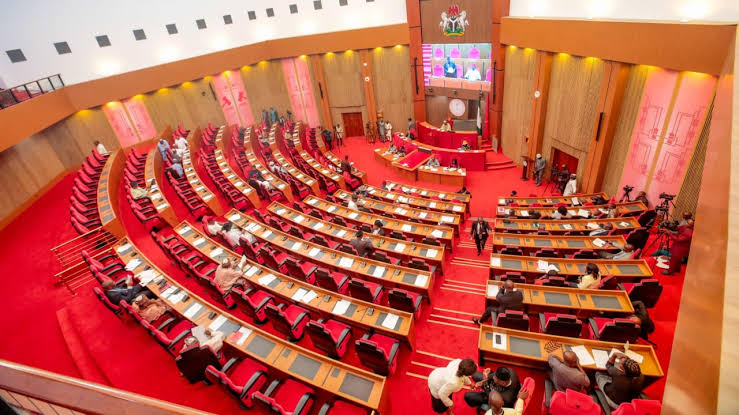
The Senate has vowed to pass the State Police Bill before the end of the year, saying the creation of state police has become necessary to address the country’s worsening security challenges, including banditry, kidnapping and killings.
The proposed constitutional amendment has secured approval from the minimum of 24 state legislatures required to proceed, according to lawmakers.
Ondo State’s assembly endorsed the measure on Monday, adding its support to that of the 24 states already listed as having approved it.
The amendment would change Section 214 of the Constitution, replacing the existing Nigeria Police Force with a Federal Police Service and separate State Police Services.
Supporters say the arrangement
would improve intelligence gathering and speed up responses to threats by giving officers greater familiarity with the communities they serve.
Yemi Adaramodu, chairman of the Senate Committee on Media and Public Affairs, told reporters that lawmakers intended to finish work before their year-end recess.
“Before we even leave for Christmas, it would have been done,” he said.
To meet that timetable, lawmakers must receive executive proposals that are still undergoing review, while state legislatures’ submissions must return to the National Assembly for verification and consideration.
A presidential working group chaired by President Bola Tinubu’s chief of staff, Femi Gbajabiamila, has submitted a draft National Policing Bill, 2026, and 29 consequential amendment bills to the Ministry of Justice for legislative drafting review and validation.
The ministry is expected to return the drafts by October 30.
The working group will then give them final consideration before presenting them to Tinubu for approval and transmission to the National Assembly.
That sequence differs from an earlier timetable outlined by Gbajabiamila, who had said the legislation was 90% ready and would reach lawmakers on October 29.
Adaramodu, however, declined to endorse the executive’s schedule.
“We cannot pass comments on what the executive said until we receive correspondence from them,” he said.
He nevertheless described state policing as a priority in the constitutional review and said lawmakers would move quickly once the necessary proposals arrived.
The Senate passed the constitutional amendment on June 24, followed by the House of Representatives.
The National Assembly sent it to the country’s 36 state assemblies on September 16.
Senator Victor Umeh, who represents Anambra Central, said approval by 24 state assemblies satisfied the constitutional threshold.
The submissions would now return to federal lawmakers for verification, he said.
Adaramodu said a 30-day deadline associated with the process applied to the submission of input by the states, rather than to the completion of the National Assembly’s work.
Lawmakers would consider those submissions and hold a conference to address them, he said.
In Ondo, the amendment passed its second and third readings on Monday with the support of every member present.
Speaker Olamide Oladiji directed the assembly’s clerk to transmit the approved document and the legislature’s observations to the National Assembly.
Supporters frame the overhaul as an effort to address the limits of a centrally run force operating across a large and diverse country.
“We cannot continue to have one central police force to provide security to Kebbi, Calabar, Sabon Gari, Ikot Abasi and all the far ends of this country,” Umeh said.
He argued that officers with local knowledge would be better positioned to gather intelligence, identify threats and respond before violence escalated.
Adaramodu similarly identified enforcement—not simply the passage of additional criminal laws—as the challenge lawmakers hoped to address.
“We have enacted a lot of laws in the National Assembly to deter them,” he said of armed groups.
“The only thing we need now is the enforcement.”
He said lawmakers would seek input from stakeholders before completing the framework, citing its implications for communities throughout Nigeria.
However, the plan to pass it before the end of the year is just a target for now.
The executive has not yet sent its draft to the National Assembly, and lawmakers still have to review what the states submitted, NewsQuest gathered.
