

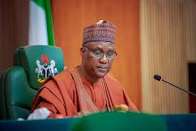
The House of Representatives has approved President Bola Tinubu’s requests to borrow $28.2 billion and €1.04 billion externally, giving the government legislative backing to fund infrastructure and development programs amid a widening financing gap.
The approvals, passed on Tuesday, cover two proposals: a 2026–2027 supplementary external borrowing plan totaling $20.52 billion and €1.05 billion, and authorization to raise ₦10.79 trillion, equivalent to $7.71 billion at the budget exchange rate of ₦1,400 per dollar, for projects outlined in the 2026 Appropriation Act.
The measures cleared second reading before being referred to the House Committee on Aids, Loans and Debt Management.
After the committee presented its reports, lawmakers considered and approved both requests in the Committee of Supply, chaired by Deputy Speaker Benjamin Kalu.
In his letter to lawmakers, Tinubu said the additional borrowing was necessary to advance his administration’s reform agenda and accelerate economic growth.
He said the projects were selected following technical and economic assessments based on their expected contribution to the nation’s socioeconomic development.
The President said the programs are intended to create jobs, expand skills training, support entrepreneurship, reduce poverty and improve food security.
Most initiatives would be implemented across all 36 states and the Federal Capital Territory (FCT).
Tinubu argued that Nigeria’s infrastructure deficit requires resources beyond domestic financing.
“In light of the need for significant infrastructure investment in the country and the vast financial resources needed to address this gap, it has become essential to pursue prudent external borrowing to close the financial shortfall,” he said.
The funds are earmarked for projects in power, transportation, health care and other strategic sectors, with the administration emphasizing timely disbursement and implementation.
For the ₦10.79 trillion request, the government plans to use a mix of financing channels, including Eurobonds, concessional and commercial loans from multilateral and bilateral lenders, International Monetary Fund (IMF) facilities, bridge financing, loan syndications and direct borrowing from international financial institutions.
Tinubu said Eurobond issuance would receive particular emphasis because it can be completed relatively quickly.
The government intends to pursue the options in parallel, weighing costs, benefits and the time required to secure each form of financing.
Proceeds are designated for capital projects spanning infrastructure, defense and security, agriculture, health care, power, transportation and education.
Lawmakers attached conditions to the approval, directing the federal government to maintain transparency and accountability throughout the borrowing program.
The House authorized the government to raise the approved amount through one or more of the financing channels listed in Tinubu’s letter.
It also instructed the government to seek the most favorable terms available.
Under the resolution, the Debt Management Office (DMO) must periodically report to the National Assembly on completed financing arrangements, including amounts raised, sources of funds, interest rates, repayment periods, fees and other terms.
The House Committee on Local and Foreign Debts is charged with ongoing oversight, monitoring financing arrangements, actual drawdowns, use of proceeds and compliance with the legislature’s approved conditions.
