

The Federal Government’s Renewed Hope Cities initiative has attracted more than 100,000 expressions of interest from Nigerians, with traders, small-business owners and public-sector workers in Abuja, Kano and Lagos among the earliest subscribers.
Conceived as a public–private partnership under President Bola Tinubu, the programme pairs the Federal Ministry of Housing and Urban Development with private developers including Continental Civil and General Construction, Ceezali Limited and Citec International Limited.
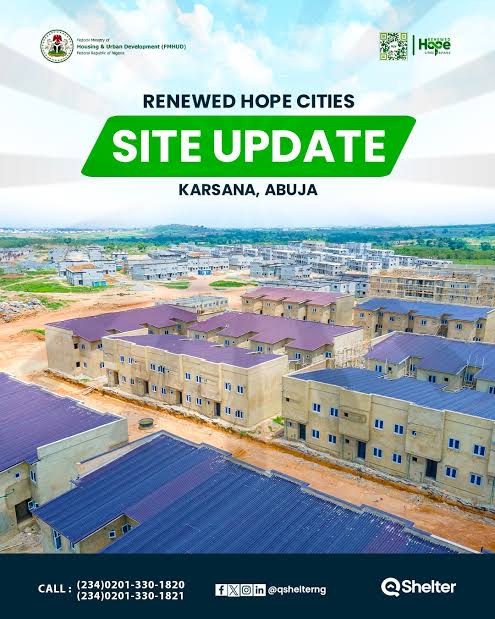
President Tinubu personally broke ground on the flagship Renewed Hope City in Karsana, Abuja, where 2,400 housing units are nearing completion.
Infrastructure support has followed: at the President’s directive, the Minister of the Federal Capital Territory, Nyesom Wike, ensured government-funded access roads to project sites, with the first phase of the Karsana access road already completed.
A central pillar of the programme is the President’s directive to the Federal Mortgage Bank of Nigeria (FMBN) to extend mortgages to contributors of the National Housing Fund.
More than 2,000 Nigerians have already benefited from the scheme, with over 10,000 additional applications currently being processed.
The FMBN has committed more than ₦100 billion in off-taker guarantees and construction financing to de-risk projects and unlock private investment in Renewed Hope Cities nationwide.
The housing loan available to NHF( National Housing Fund) contributors carries a single-digit interest rate of 6% and a maximum tenor of 30 years, markedly below commercial-bank rates of 18–23%.
The project has moved beyond Abuja. In Janguza, Kano, more than 350 units are complete, with another 650 under construction ahead of a March 2027 delivery date.
In Lagos, the Lagos–Calabar Coastal Highway has opened up the Lekki–Epe corridor, prompting developers to begin work on 2,004 units along Monastery Road, with the first 550 expected by April 2027.
New sites are also underway in Jibi by Kubwa on the outskirts of Abuja (2,000 units planned) and in Kagini, Abuja (1,200 units, as phase two), with construction plans in the pipeline for Asaba, Ibadan, Katsina, Enugu, the Sagamu–Papalanto Road corridor and Port Harcourt.
The government has pledged to eventually extend the scheme to every state, with an ambition of housing 100 million Nigerians.
Financing for the Renewed Hope Cities project has come from a mix of private equity from developers, construction and mortgage finance from the FMBN, financing support from the Family Homes Funds and the Nigeria Sovereign Investment Authority, and banking support from Keystone Bank Plc, the scheme’s sole commercial bank partner.
The wider Renewed Hope housing framework provides different acquisition options, including mortgage, rent-to-own and outright purchase, creating multiple pathways through which eligible Nigerians can pursue homeownership.
Cooperative societies and institutional buy-in
Momentum has also been built through cooperative societies across diverse sectors.
Staff associations from Nigeria Midstream and Downstream Petroleum Regulatory Authority(NMDPRA), Nigeria Upstream Petroleum RegulatoryCommission (NUPRC),(National Deposit Insurance Scheme(NDIC)and Securities and Exchange Commission(SEC), SEPLAT, MTN, NLNG(Nigeria Liquefied Natural Gas(NLNG) and PENGASSAN Benin, along with the Banex Traders Association, cooperatives within the Federal Ministries of Finance and Foreign Affairs, and trader groups in Kano, have all joined the scheme.
Some organisations, including NMDPRA, NUPRC, SEC and NRS, have gone further, covering staff equity contributions outright to remove financial barriers to entry.
NMDPRA alone recorded more than 1,000 subscribers, with hundreds more from NUPRC and NRS.
On September 23, 2026, the Federal Ministry of Housing and Urban Development, in collaboration with Renewed Hope Cities developers, handed over 430 housing units to the staff and cooperative members of NMDPRA in a ceremony attended by NMDPRA Chief Executive Rabiu Umar, the Minister of Housing, the CEOs of the FMBN and Family Homes Funds, NMDPRA executive directors and Renewed Hope Cities officials.
Minister of Housing Muttaqha Darma praised President Tinubu for his consistent backing of housing reforms, noting that every proposal brought to the President for reform has received full support.
He commended NMDPRA for being the first organisation to fund a 30% equity contribution on behalf of its 430 beneficiaries, and urged the Authority to extend the same benefit to its remaining staff.
In his remarks, NMDPRA Chief Executive Umar congratulated the President on the initiative, describing it as an example of policy meeting diligent execution with great success.
He noted that NMDPRA’s role in regulating Nigeria’s midstream and downstream petroleum sector makes it central to national development, and said the equity support is a critical investment in employee welfare, providing staff an opportunity to build long-term household assets through structured homeownership.
Under the NMDPRA management arrangement, participating staff have been supported toward meeting their equity obligations, while the balance of the property cost can be financed through applicable mortgage arrangements and other installment payment plans for eligible beneficiaries.
FMBN officials disclosed that NMDPRA staff had subscribed to 359 housing units in Karsana, Abuja, and 14 units at Janguza, Kano, while 197 NHF mortgage applications valued at approximately ₦8.3 billion were being packaged for submission to FMBN.
The NMDPRA cooperative’s president, speaking on behalf of the 430 beneficiaries, thanked the President, the Minister and the developers, and praised NMDPRA’s leadership for funding the equity contributions.
He appealed for additional funding so that the more than 1,000 staff who have expressed interest in the scheme can receive the same support extended to the first batch of 430 beneficiaries who have secured allocations across the Renewed Hope developments in Abuja, Kano and Lagos.
By and large, the NMDPRA experience presents a potentially replicable model for other ministries, departments and agencies (MDAs), government-owned institutions, corporations and organised cooperatives seeking practical ways to support their employees in achieving home ownership.
Following the good example of NMDPRA management, the executive managements of Nigerian Upstream Petroleum Regulatory Commission (NUPRC) and National Revenue Service (NRS) are also doubly committed to providing financial support for their staff and cooperatives members to ensure they participate fully in securing their homes in the President Bola Tinubu’s Renewed Hope Cities projects in different parts of the country.
As more public institutions lift their staff to own a piece of the Renewed Hope Cities projects, the initiative demonstrates how MDAs can complement the Federal Government’s housing agenda by supporting their employees to meet the initial equity requirements associated with home acquisition.
Rather than leaving employees to independently bear the full burden of the initial equity requirements, institutions can explore structured employee-support arrangements that enable qualified staff to access housing while spreading the financial obligations over an agreed period.
This type of institutional participation can significantly strengthen the ability of organised workers to access housing finance and participate in large-scale government housing initiatives.
