

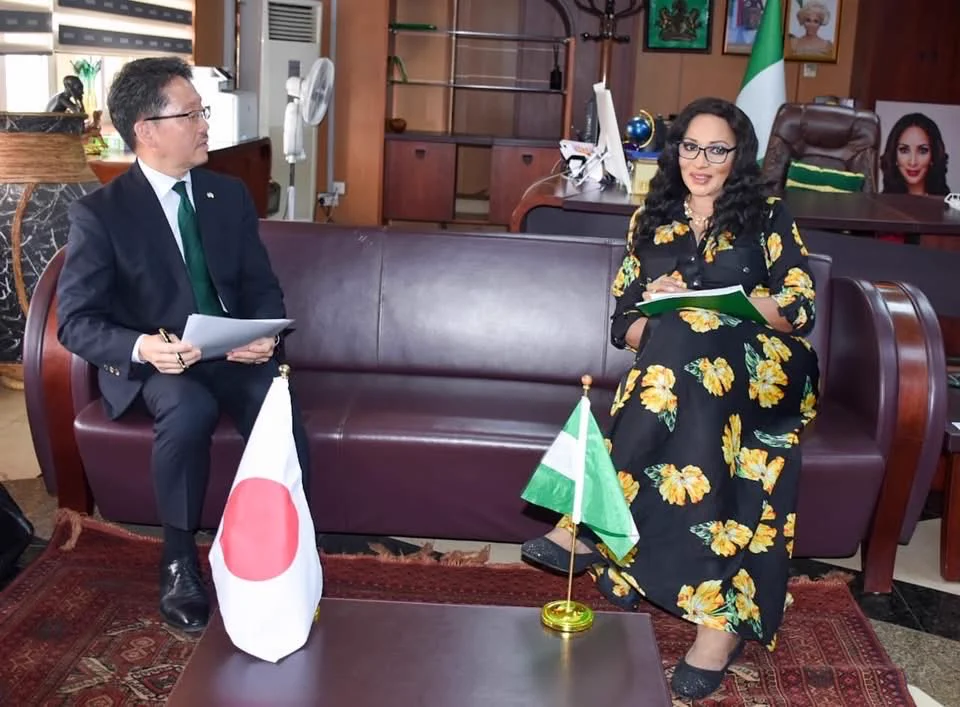
Nigeria and Japan are exploring the creation of a joint industrial and investment hub, as Africa’s most populous country seeks Japanese capital, technology and supply-chain access amid efforts to convert decades of diplomatic ties into measurable economic gains.
Foreign Affairs Minister Bianca Odumegwu-Ojukwu raised the proposal during a meeting in Abuja with Japan’s ambassador to Nigeria, Hideo Suzuki, according to a statement from the minister’s office.
The proposed Nigeria-Japan Industrial and Investment Hub would foster business partnerships, technology transfer, industrial expansion and access to the broader African market.
Odumegwu-Ojukwu urged both governments to implement the outcomes of the 10th Nigeria-Japan Special Partnership Forum, held in Abuja in August, through concrete programs, investment commitments and regular consultations between their foreign ministries.
“The outcomes of the Forum must be translated into concrete programs, investment commitments and measurable development outcomes,” she said.
The minister asked the Japanese Embassy to help develop a practical roadmap for the initiative.
She also called for closer commercial links between companies in both countries, including joint ventures, local-content development, skills transfer and the integration of Nigerian firms into Japanese supply chains.
Energy cooperation featured prominently in the discussions.
Nigeria welcomed Japan’s interest in resilient energy systems and critical-mineral supply chains, and encouraged Japanese investment in solid minerals, natural-gas development, cleaner-energy technologies and industrial decarbonization.
Japan has already expanded its economic footprint in Nigeria through development finance and technical cooperation.
The Japan International Cooperation Agency recently committed $10.4 million to expand Nigeria’s innovation infrastructure, while officials have discussed a $50 million seed-funding facility for startups in partnership with the Nigeria Sovereign Investment Authority.
Odumegwu-Ojukwu also reaffirmed Nigeria’s commitment to regional stability through the African Union (A.U) and the Economic Community of West African States ( ECOWAS), and encouraged continued Japanese backing for African-led peace and development initiatives.
On consular matters, Nigeria sought continued dialogue on visa-related obstacles affecting businesspeople, students, researchers, officials and tourists.
Ambassador Suzuki said Japan wanted to deepen cooperation with Nigeria, which he described as a “strategic African giant,” and pledged that visa issues would be handled expeditiously.
The meeting comes as the two countries mark 66 years of diplomatic relations.
For both governments, the challenge now is to turn a longstanding relationship, and a growing list of agreements, into factories, investments and jobs.
