

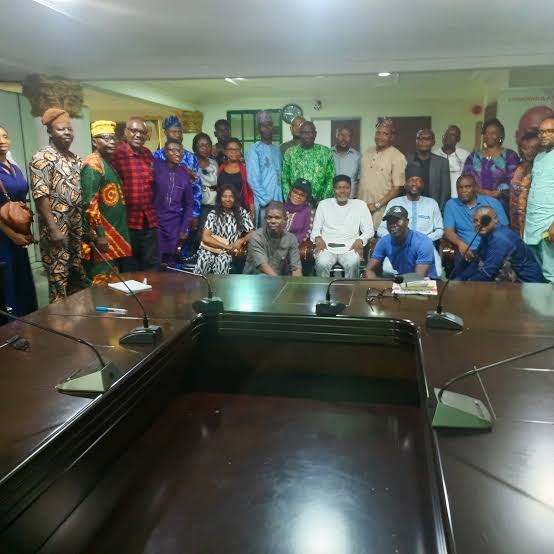
The Association of Nigerian Authors (ANA) has commended President Bola Tinubu and the Nigerian Copyright Commission (NCC) for enforcing the copyright levy and strengthening the protection of authors’ intellectual property rights, saying the move could further strengthen the economic value of the nation’s creative industry.
Speaking at the opening of ANA’s 45th International Convention at the Mamman Vatsa Writers’ Village in Abuja, National President of ANA, Usman Akanbi, praised the government’s activation of a long-unused copyright levy as a potential new source of income for writers, even as piracy and weak distribution systems continue to limit creators’ earnings.
The levy, created under Section 89 of the Copyright Act 2022, compensates rights holders for private, noncommercial copying of protected works, including photocopying and digital scanning.
The levy also applies a 5% charge to selected electronic devices, storage media, printers, photocopiers, phones and cloud services capable of storing or copying copyrighted material.
The Federal Government, to this effect, has released an initial 1.21 billion naira through the Nigerian Copyright Commission, according to ANA.
The payment marks the first operational use of a levy that has existed in Nigerian copyright law for decades but had not previously been implemented.
He said the intervention should help ensure that Nigerian writers receive financial rewards for the use and exploitation of their work, rather than relying solely on recognition for their literary contributions.
The Association also praised the Nigerian Copyright Commission and its Director-General, John Asein, for facilitating the process and advancing protections for authors’ rights.
The policy arrives as authors’ literary works increasingly feed other parts of the creative economy, including film, television, theater, advertising and digital platforms.
Effective copyright administration could broaden legitimate revenue streams, improve returns on creative investment and strengthen incentives for new work.
Asein described writers as foundational contributors to the nation’s creative economy, saying literature supplies source material for industries ranging from music and broadcasting to animation and digital content.
He said copyright provides the legal and economic framework for converting creative talent into assets and sustainable livelihoods.
Piracy remains a central threat to authors and publishers, he added.
Asein said the commission would intensify enforcement against infringement in physical and digital markets and deepen cooperation with authors, publishers, technology platforms and other stakeholders.
“Every pirated book takes something away from the author, the publisher and the creative ecosystem,” he said.
“Protecting copyright is therefore not simply about protecting works; it is about protecting livelihoods, investment and Nigeria’s creative future,” the DG said.
ANA said it would continue pursuing professional-development programs, publishing support for emerging and established writers, and policy engagement with the government.
Akanbi also identified insecurity and economic hardship as constraints on creativity, calling for conditions that allow writers to work, publish and earn from their intellectual investments.
Secretary to the Government of the Federation (SGF) George Akume, represented by Permanent Secretary Bekearedebo Augusta Warrens, called for greater use of literature to address security challenges, strengthen unity and promote social cohesion.
He urged practical steps to expand access to books, support emerging writers and develop the publishing industry.
The convention’s keynote speaker, Pan African School of Economics Vice-Chancellor Mahfouz Adedimeji, advocated greater investment in public and school libraries, stronger institutional support for authors and wider international promotion of Nigerian literature.
The event included awards, the induction of ANA fellows, panel discussions and the commissioning of projects at the writers’ village.
The NCC received ANA’s Award for Excellence for its work on intellectual-property protection, while Asein received a Special Recognition Award for his contributions to Nigerian literature and the creative industry.
