

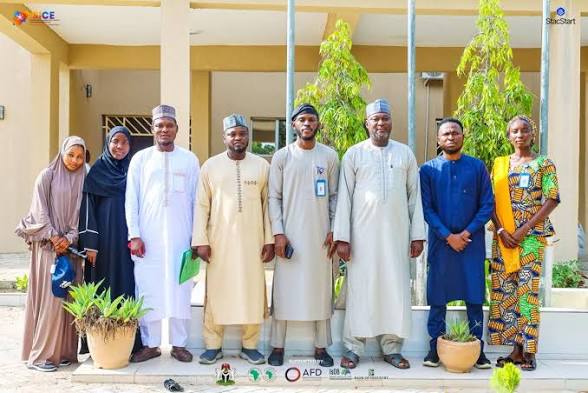
The Federal Government, in partnership with private company Conclase Consulting Limited, has unveiled plans to train 50,000 Nigerian youths in digital and vocational skills as part of efforts to tackle unemployment and equip young people for the emerging global economy.
The 18-week program, which will be implemented by Conclase through its subsidiary, StacStart, cuts across seven states in the North-West region: Kano, Kaduna, Katsina, Kebbi, Jigawa, Sokoto and Zamfara, reaching 186 local government areas, the company said in a statement.
Participants will receive technical instruction alongside employability training, mentorship and certification.
The program also will provide access to internships and job-placement support intended to help graduates find work or start businesses.
According to the statement, applicants will first undergo registration and screening.
Those selected will progress through foundational, intermediate and advanced levels of training.
The curriculum will include artificial intelligence and machine learning, cybersecurity, cloud engineering, software engineering, data analytics, user-interface and user-experience design, 3D animation, content creation, social-media management and graphic design.
Participants also will receive training in fashion design, culinary arts and food production.
The initiative aims for 50% female participation and will include young people who are not in employment, education or training, as well as people with disabilities.
Adeposi Bamiduro, chief executive of Conclase Consulting and StacStart, said the program is intended to link skills training with employment and entrepreneurship.
“Digital skills are only truly valuable when they create opportunities,” Bamiduro said.
“Our focus is not simply to train young people, but to equip them with practical skills, connect them to opportunities, and help them turn what they have learned into sustainable careers and livelihoods,” he said.
Program Director Abudu Damilola said the initiative would emphasize converting training into economic outcomes.
“Our responsibility is not simply to train 50,000 young people, but to build a system that helps them translate those skills into meaningful livelihoods,” Damilola said.
The program forms part of the Federal Government’s Investment in Digital and Creative Enterprises initiative, known as iDICE.
It is coordinated by the Bank of Industry in partnership with the African Development Bank, the Islamic Development Bank and Agence Française de Développement.
The effort is among the government’s attempts to expand digital-skills development and improve young Nigerians’ access to employment.
Its success will depend in part on whether training translates into jobs, internships and viable businesses.
Earlier, Information and National Orientation Minister Mohammed Idris had separately promoted the economic potential of Nigeria’s workforce through the government’s “Hire from Nigeria” initiative.
“Through ‘Hire from Nigeria,’ we are positioning one of our greatest national assets, our people, at the centre of our economic engagement with the world,” the Minister said.
