

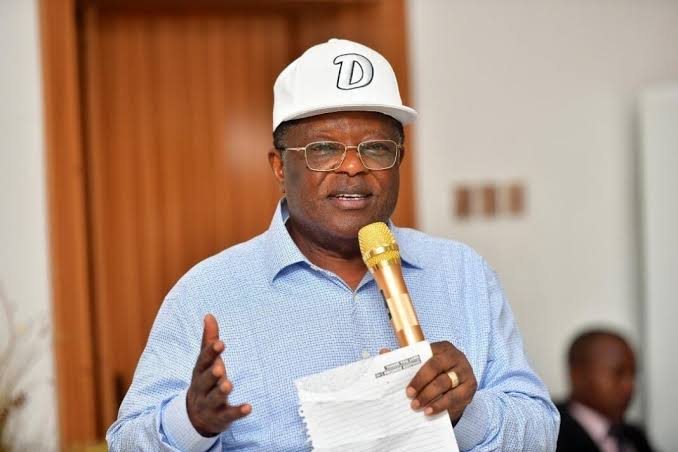
The Minister of Works, Dave Umahi, has admitted that the Lagos-Calabar Coastal Highway project commenced without a single, comprehensive master design, raising fresh concerns over planning and cost for the 750-kilometre superhighway more than two years after construction began.
Umahi, who disclosed this on national television during an interview, said the project is instead being designed, procured and built section by section, with environmental assessments, soil investigations and detailed engineering work carried out for each stretch.
He rejected criticism that the government should calculate the highway’s total cost by applying an average per-kilometre price across all 750 kilometres.
“There is no one single design for the 750 km of Lagos-Calabar Coastal Highway,” Umahi said.
The minister said the route was first conceived in 1955 and gazetted as a concept in 2006, but that he had not found a complete engineering design, subsoil investigation or other detailed technical documentation for the entire corridor in the ministry’s archives.
He argued that the approach reflects standard practice: terrain, bridges, drainage and soil conditions vary along the coastal route, so final designs and costs must be developed separately for each section.
However, design work is ongoing for the Edo, Delta and Bayelsa portions, he said.
The minister defended the cost of the first section, saying a standard two-lane carriageway would cost about $5.5 million per kilometre, or roughly ₦7.3 billion, based on a comparison with a coastal road in neighboring Benin.
He cited a 47.47-kilometre Lagos section with a contract value of about ₦1.06 trillion, and said that when adjusted for its three-carriageway configuration, the equivalent cost was about ₦7.5 billion per kilometre.
The minister dismissed the widely cited ₦15 trillion estimate for the full highway, asking: “Who fixed this N15tn that people are just, you know, brandishing everywhere?”
He said no one had the right to multiply an average cost by 750 kilometres.
The minister’s explanation may clarify the government’s phased engineering method, but it also leaves unresolved how officials will establish a definitive total financial commitment, evaluate the project’s overall value and communicate its final completion cost to the public.
The Federal Government has previously described the coastal highway as a roughly ₦15 trillion, eight-year project intended to link nine coastal states and support trade, tourism and regional integration.
Umahi has said the entire highway would be completed in just over three years, even as design and procurement continue for later sections.
