

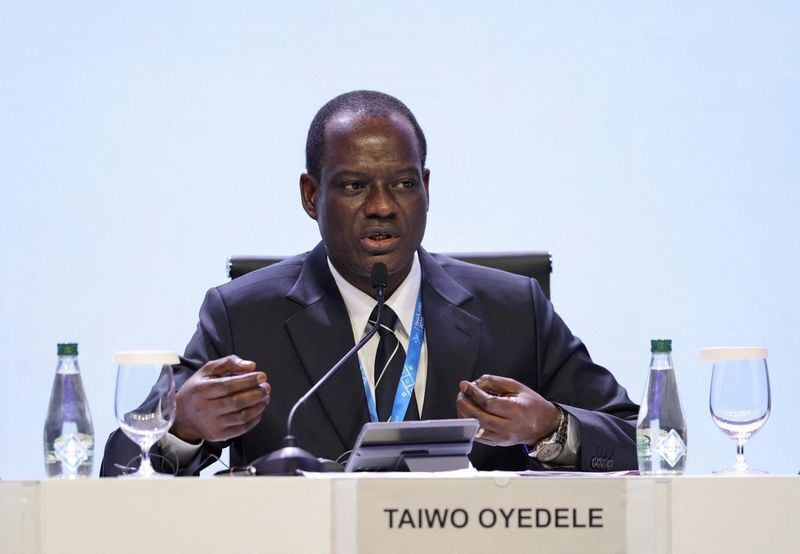
The Federal Government has told Nigerians to forget any return to fuel subsidies and multiple exchange rates, seeking to reassure investors and development partners that its market-oriented reforms remain intact despite pressure over living costs and energy prices.
This was disclosed by the Minister of Finance and Coordinating Minister of the Economy Taiwo Oyedele Saturday at a briefing on the sidelines of the International Monetary Fund (IMF) and World Bank Group Annual Meetings in Bangkok, Thailand.
He said the recent 30-day reduction in petrol retail margins by state oil company Nigerian National Petroleum Corporation (NNPC) was a temporary commercial decision, not a publicly funded subsidy.
“Let me be clear: there will be no return to fuel subsidies or multiple exchange rates,” Oyedele said.
The Minister said questions about whether Nigeria could reverse its reforms came up repeatedly in meetings with credit-rating agencies, investors and multilateral lenders.
He argued that reversing course would jeopardize the country’s recent macroeconomic stabilization and deter foreign capital, insisting that President Bola Tinubu’s economic reforms have come to stay despite the current hardship.
Nigeria’s economy expanded 4.4% in the second quarter of 2026, Oyedele said, while inflation has fallen for four straight months and remains less than half its peak from roughly two years earlier.
Foreign reserves have risen above $35 billion, he added.
The government also pointed to an increase in the tax-to-GDP ratio to 12.5% at the end of 2025, from about 7% three years earlier, and a roughly twentyfold rise in private capital inflows—from about $300 million in 2023 to nearly $6 billion in 2026.
The Minister said Nigeria’s debt burden stood at about 36% of GDP and that the government was shifting toward longer-term, lower-cost borrowing.
He unveiled 65 investment projects valued at $78.5 billion under a “Project Nigeria” initiative spanning energy, transport, agriculture, mining, health and services.
The projects are backed by feasibility studies and designed to attract private participation from domestic and foreign investors.
The Minister said firms from Asia and Europe had already expressed interest.
The World Bank reaffirmed support for Nigeria’s power and infrastructure agenda through guarantees and financing mechanisms, while the IMF committed to technical assistance on fiscal policy, transparency and statistics.
The European Union identified energy and local pharmaceutical manufacturing as priorities under its Global Gateway program.
Oyedele cautioned, however, that such pledges should not be mistaken for immediate funding.
“These are commitments to work together with us, not announcements of money,” he said, adding that Nigeria would report progress only once agreements were signed and results materialized.
