

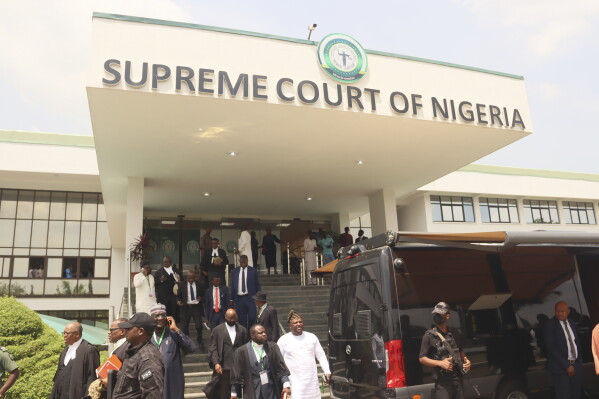
The September 24 Supreme Court ruling has threatened party tickets as the apex court’s interpretation of the Electoral Act and party constitutions means tickets already issued by major political parties could be invalidated if parties fail to comply strictly with the new conditions set by the court.
The Supreme Court’s decision reaffirmed the requirement that political parties submit verified membership registers to the Independent National Electoral Commission (INEC) at least 21 days before a primary, congress or convention.
Only individuals listed on the register submitted to INEC may vote or contest in the relevant party process, according to legal experts.
The ruling does not automatically invalidate candidates already published by INEC, nor does it authorize the commission to remove candidates unilaterally.
However, it gives aggrieved aspirants and rival political interests a potentially powerful basis for challenging nominations that failed to comply with the Electoral Act.
Monday Onyekachi Ubani, a Senior Advocate of Nigeria and former second National Vice President of the Nigerian Bar Association(NBA), said the ruling had settled the question of whether parties could disregard statutory requirements in the name of internal autonomy.
“If you want to run for an election or be a voter, your name must be in the electronic register of the political party,” Ubani said.
The law requires parties to submit the register 21 days before a primary, convention or congress, he said.
A party also cannot rely on a different register after submitting one to INEC, Ubani said.
Section 84(2) of the Electoral Act allows an aspirant to challenge alleged violations of the law or INEC guidelines, while Section 84(6) bars parties from using a register different from the one previously submitted.
The provisions were strengthened by amendments to the Electoral Act, which introduced consequences for parties that fail to submit their membership registers within the prescribed period.
The earlier 2010 law did not contain a comparable penalty, Ubani added.
Responsibility for compiling and maintaining the records rests with political parties, not INEC.
The registers are expected to contain details including members’ names, addresses, gender and state of origin.
Ubani said, however, the Supreme Court’s decision was not self-executing.
INEC could not independently review previously published candidates and remove those whose names might not appear on a properly submitted register, he said.
“INEC, on its own, cannot because that will be an exercise of judicial function,” Ubani said.
“It’s only an aspirant who has locus standi that can go to court,” he stated.
Any challenge would also have to comply with statutory deadlines for pre-election litigation.
In many cases, the 14-day filing period may already have expired, unless a suit was filed within time and remains pending, he said.
That limitation could significantly reduce the immediate effect of the ruling on primaries that have already taken place.
He further added the decision could make it harder for politicians to defect shortly before a primary and secure a nomination on a new party platform.
Kabiru Akingbolu, a Lagos-based human-rights lawyer, on his part, said the ruling effectively closed the door on late moves by politicians seeking to contest the same office under another party.
A prospective candidate whose name was not included in the membership register submitted 21 days before a primary could face a legal challenge, he said.
Arrangements involving placeholder candidates who later withdraw could also become more difficult, even though the Electoral Act permits candidates to withdraw, he stated
Akingbolu said, however, that the ruling might have limited practical effect on the 2026 electoral cycle and the 2027 elections because many party primaries had already been completed and the deadlines for filing pre-election cases had passed.
He also questioned who would have the legal standing to challenge a nomination.
Under the law, an aspirant generally must have participated in the relevant primary to bring a pre-election challenge, raising questions about whether outsiders or nonparticipants could sue, he added.
Abiodun Layonu, another Senior Advocate of Nigeria, cautioned against describing the ruling as a retroactive application of the Electoral Act.
Legislation generally does not operate retrospectively unless it expressly provides for such application, subject to constitutional limitations.
However, the Supreme Court’s ruling, he said, did not create a new law, adding that, it affirmed the validity of provisions that were already part of the Electoral Act.
“The significance of the apex court’s decision was that it had now authoritatively determined that the disputed provisions of the Electoral Act were valid,” Layonu said.
The decision therefore amounted to a judicial confirmation of the law’s existing status, rather than the creation of a new obligation, he said.
Conduct occurring after the law’s enactment could be assessed under the relevant provisions where applicable, he stated
He also warned candidates against assuming that the earlier Court of Appeal judgment would shield them from the consequences of the Supreme Court’s decision.
Ige Asemudara, a human-rights lawyer, said the ruling underscored the need for parties and aspirants to comply strictly with statutory membership and nomination requirements.
He said individuals whose names were not included in a party’s register within the period prescribed by law should not participate in its primary process.
The same principle would apply to aspirants who lost a primary and later moved to another party, he said.
The Supreme Court, Asemudara said, interpreted existing provisions rather than introducing a new legal regime.
The decision’s practical consequences would depend on whether a candidate’s conduct fell within Sections 77 and 84 and whether an eligible challenger filed a timely case, he added.
The ruling has already prompted opposition parties and political strategists to examine party registers submitted to INEC alongside the dates on which politicians defected.
That scrutiny, he said, could produce post-election litigation even where potential challengers failed to bring pre-election suits within the required period.
Under Sections 29, 32 and 88 of the Electoral Act, only an order of the Federal High Court in a valid pre-election case can disqualify a candidate for failing to meet nomination requirements, the human rights lawyer added.
Candidates whose tickets were secured through waivers, including a high-profile governorship candidate in Rivers State, remain listed on the INEC portal for now.
Their longer-term security, however, could depend on whether rival aspirants filed valid claims within the constitutional 14-day window.
The Supreme Court’s ruling has not automatically cancelled party tickets. It has, however, made clear that electoral mandates remain vulnerable when political expediency collides with the procedural requirements of Nigeria’s electoral law.
