

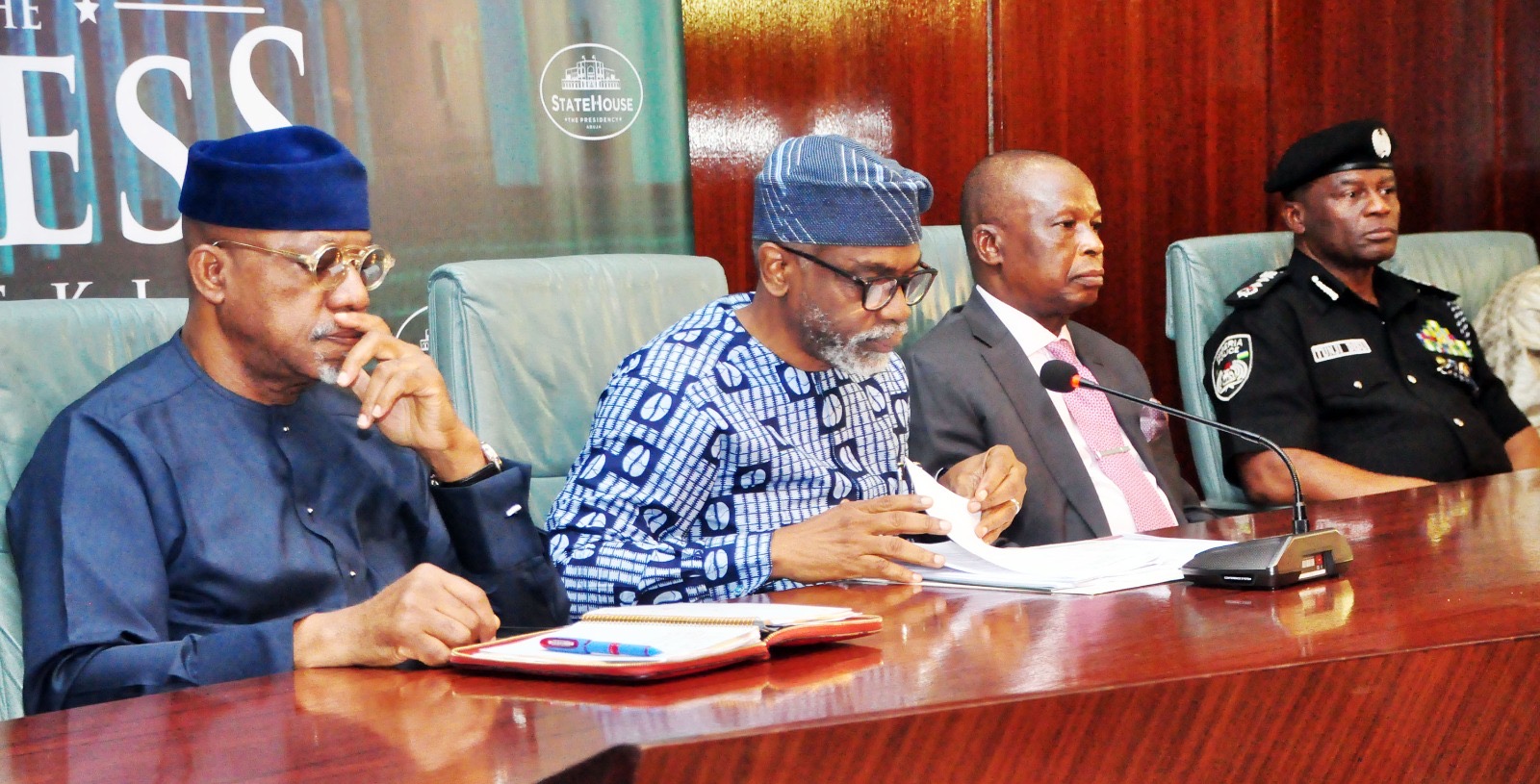
The Presidency on Monday commenced work on the drafting of a broad legal framework needed to implement a new federal‑and‑state policing model for the country.
Chairman of the Presidential Working Group of the National Advisory Committee on State Policing and Chief of Staff to the President Femi Gbajabiamila told State House Correspondents at a press conference that members of public are immediately invited to submit memoranda as inputs for the draft framework aimed at translating legislative advances into a practical plan.
“This is a monumental reform that Nigerians have debated for many years. The central task is to “design a lawful, professional and sustainable federal and state policing system that places greater capability closer to the people while preserving national standards, national security and the rights of every Nigerian,” Gbajabiamila, said.
The Chief of Staff said that the public both home and abroad, professional bodies, civil society and other stakeholders have now until 13th August 2026 to submit memoranda, position papers and proposals.
He said such contributions can be submitted through a dedicated website already launched www.nationalpolicingbill.com.
Submissions he explained will be organized, recorded and considered; and once a draft is ready, national consultations will enable scrutiny of specific clauses, safeguards, funding proposals and transition arrangements.
The Senate passed a constitutional amendment enabling State policing on June 24, and the House of Representatives passed an executive State Police Bill on July 23.
The constitutional change, however, is not yet operative and still requires approval from State Houses of Assembly as set out in the Nigerian Constitution 1999 (as mended). Until those approvals and implementing laws are in place, the Nigeria Police Force remains the sole constitutionally recognized police institution.
According to the Chief of Staff, the amendment provides only the framework for a dual policing model; it does not create the operating rules.
“It does not settle questions on standards, certification, recruitment, training, funding, command, jurisdiction, complaints, data, firearms, pensions, transition or cooperation,” he said.
Those issues, he added, will be addressed in the National Policing Bill and subsidiary instruments.
Gbajabiamila said the working group’s mandate is technical and implementation‑focused: to produce an “implementation‑ready” draft National Policing Bill and an accompanying legislative package.
He explained that the team will audit the Police Act 2020 and related statutes and draft provisions on minimum national policing standards, state readiness and certification, jurisdictional rules, independent oversight bodies, custody and use‑of‑force safeguards, pensions and transfer arrangements, interoperable data systems, firearms control, and funding and federal intervention mechanisms.
He also said the working group’s secretariat, which will also undertake research, legal audit, policy analysis and drafting work has institutions including the Presidency, the Federal Ministry of Justice, the Office of the National Security Adviser, the Nigeria Police Force, the Nigeria Governors’ Forum and the Nigerian Bar Association.
According to him, a national consultation will follow, after which the draft will be revised, prepared, and approved by the President for formal transmission to the National Assembly.
Gbajabiamila noted that President Tinubu has also approved a multidisciplinary Policy Advisory Committee chaired by Hon. Justice Mohammed Abdullahi Liman with members including Judges, academics, security officials, justice‑sector reformers, technology experts and representatives from the National Assembly and subnational governments.
Several State Attorneys‑General are also expected to participate, offering direct regional perspectives.
“State Police cannot mean 36 States militias,” Gbajabiamila said, cautioning against political interference that could turn police institutions into instruments of partisan control. He noted that such interference should be exceptional, evidence‑based, time‑limited and reviewable.
Operational rollout for each of the 36 States, he said, will be contingent on demonstrable readiness—covering recruitment, vetting, training, pay, pensions, equipment, custody facilities, complaints mechanisms, oversight, firearms control and financial sustainability.
While there will be national standards set the baseline, the Chief of Staff said that each State of the Federation as being proposed may be free to adopt higher ones, but no Nigerian is left to receive lower protection wherever they live.
Gbajabiamila acknowledged legitimate concerns about potential political abuse, unequal state capacity, duplication of command structures and funding shortfalls.
“Those concerns are precisely why the constitutional amendment cannot be treated as self‑executing,” he said.
“Safeguards are not obstacles to State Police; they are what make State Police credible, lawful and sustainable.”
He added that law alone cannot solve Nigeria’s security problems: effective leadership, competent officers, reliable intelligence, resources and public trust will be essential.
Joined at the Monday’s briefing were the Inspector General of Police Olatunji Disu, Attorney General and Minister of Justice Lateef Fagbemi, and Ogun State Governor Dapo Abiodun, and the President of the Nigeria Barr Association (NBA) among others.
