

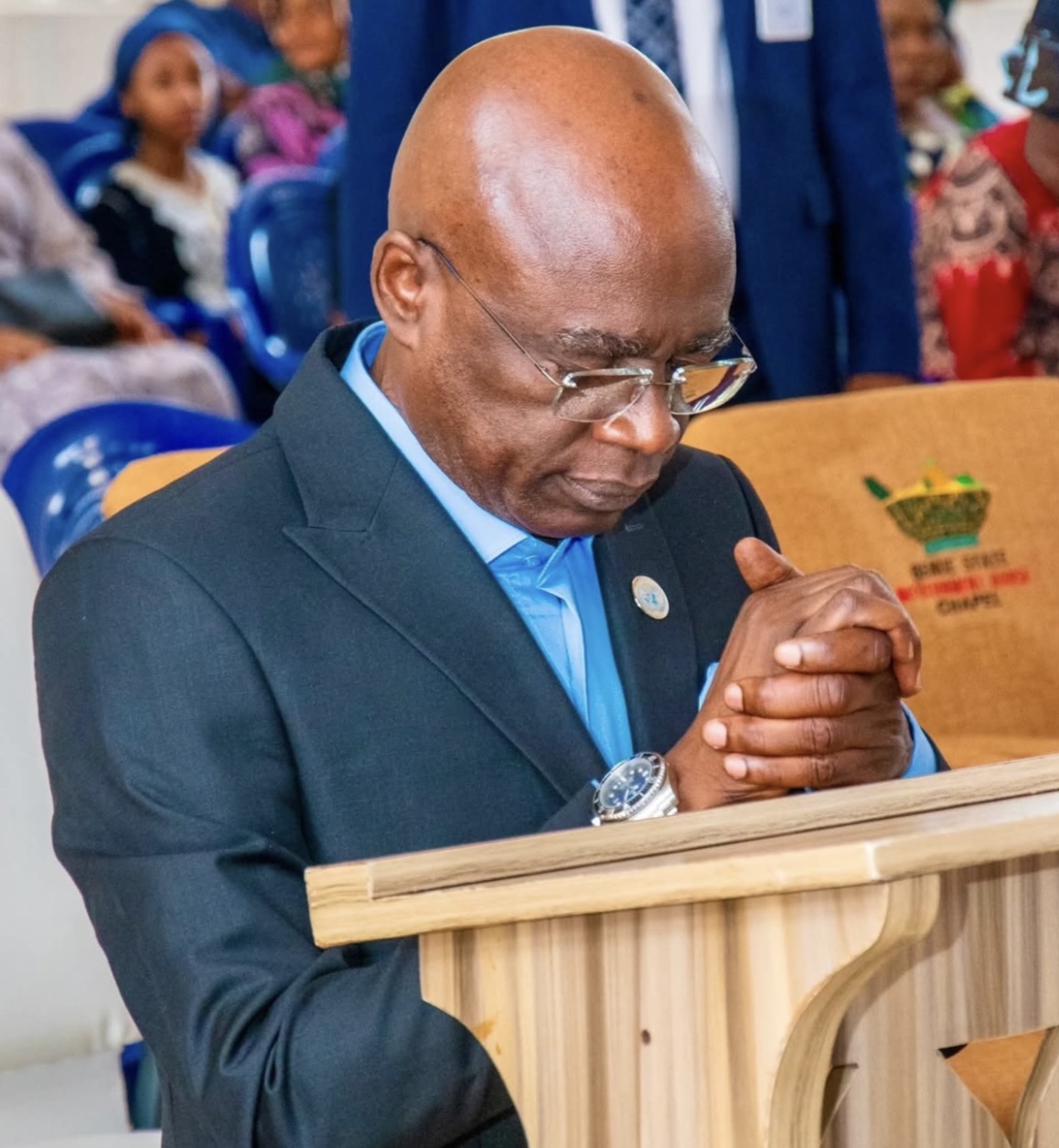
A group of gubernatorial aspirants from Vandeikya Local Government Area in Benue State has petitioned four Catholic Bishops, accusing Governor Hyacinth Alia of using the church space and his position as a priest‑governor to intimidate or threaten perceived political rivals ahead of the 2027 general election.
The complaint, dated 27th February 2026 and signed by prominent figures including lawmakers, professors and a surveyor, have been sent to Bishop William Amove Avenya of Gboko, Bishop Michael Ekwoyi Apochi of Otukpo, Bishop Wilfred Chikpa Anagbe of Makurdi, and Bishop Isaac Bundepuun Dugu of Katsina-Ala.
The petitioners called on the church leaders to intervene amid what they describe as a pattern of politicized intimidation in Catholic gatherings.
At the heart of the grievance is a January 18 thanksgiving Mass at All Saints Catholic Church in Tsenge, an event that was organized to honour Professor Steve Ugba.
The petitioners explained that Governor Alia, a former Catholic priest who took office in 2023, addressed worshipers near the altar, endorsing “brute force” for peace, urging supporters to “bite off the finger” of threats, and vowing to “literally behead” anyone who slapped him.
READ ALSO: The truth about UK based Jupiter Lithium Limited and Nigeria’s Basin Mining Limited
“These statements are utterly incompatible with Christian teaching,” the letter states, arguing they violate the neutrality of liturgical settings,” the petition stressed.
The group also cited an August 2025 incident at St. George Catholic Church in Tyobo, where the governor allegedly threatened the Ter Gboko, a traditional ruler and ex-speaker of the Benue State House of Assembly.
NewsQuest reports that such rhetoric, the aspirants warn, risks alienating congregants, pressuring clergy, and tarnishing the church’s moral authority—especially given fears that worshipers with opposing views may feel unsafe.
Our correspondent confirmed from Professor Terhemba Shija – in a telephone call about the authenticity of the copy of the petition, which is already on some social media platforms.
Among their demands: a pastoral letter upholding church neutrality, guidelines for priests to reject political speeches during services, private talks with the Governor, and coordination with the Christian Association of Nigeria (CAN).
Copies of the petition have been dispatched to the Apostolic Nunciature in Nigeria, Archbishop Ignatius Ayau Kaigama, and other Christian leaders.
The Governorship aspirants who signed the petition include Honourable Joseph Waya, Professor Paul Angya, Professoe r Denis Ityavyar, Professor Terhemba Shija, Rt. Hon. Dominic Ucha, and Surveyor Godwin Ityoachimin.
Read full petition below:
Most Rev. Bishop William Amove Avenya
Catholic Bishop of Gboko.
Most Rev. Bishop Dr Michael Ekwoyi Apochi
Catholic Bishop of Otukpo.
His Lordship, Bishop Wilfred Chikpa Anagbe, CMF
Catholic Bishop of Makurdi.
Most Rev. Bishop Isaac Bundepuun Dugu Catholic Bishop of KatsinaAla.
RE: FORMAL AND URGENT COMPLAINT CONCERNING THE DESECRATION OF CHURCH PLATFORMS THROUGH POLITICAL THREATS, INTIMIDATION, AND ADVOCACY OF VIOLENCE
Your Lordships,
We write on behalf of the Coalition of Gubernatorial Aspirants (From Vandeikya LG) for the Benue State 2027 Elections, and as practising Christians who remain committed to the life, unity, and moral witness of the Church in Benue State. This letter is submitted with deep respect for ecclesiastical authority and with a profound sense of pastoral concern.
We bring to your attention a serious and escalating pattern of conduct involving His Excellency, Governor Hyacinth Alia, whereby sacred church spaces and religious services are repeatedly used as platforms for political intimidation, threats of physical violence, and rhetoric fundamentally incompatible with Christian teaching.
These actions constitute not merely political impropriety, but grave violations of the sanctity of worship, canonical norms governing sacred places, and the pastoral duty owed to the faithful.
1. The Nature and Purpose of Sacred Space in Catholic Teaching
The Catholic Church has consistently taught that churches are not neutral public venues but consecrated spaces set apart exclusively for divine worship.
Canon 1205 of the Code of Canon Law defines sacred places as those designated for worship or burial by dedication or blessing. Canon 1210 further provides that “only those things which serve the exercise or promotion of worship, piety, or religion are permitted in a sacred place; anything not in harmony with the holiness of the place is forbidden.”
Historically and theologically, churches have functioned as sanctuaries of peace, places where the faithful gather without fear, where political, ethnic, and social divisions are subordinated to the unity of the Body of Christ. Even in times of conflict, churches have traditionally been spaces where violence is excluded and human dignity affirmed.
It is against this clear canonical and theological background that the conduct described below must be evaluated.
2. Incident at All Saints Catholic Church, Tsenge (18 January 2026)
On 18 January 2026, during a thanksgiving Mass held at All Saints Catholic Church, Tsenge, Ugba, Logo Local Government Area, in honour of Professor Steve Ugba, Governor Hyacinth Alia addressed the congregation from within the church precincts, in the presence of the VicarGeneral, concelebrating clergy, and the assembled faithful.
During this liturgical gathering, the Governor made statements which included:
i. An endorsement of “brute force” as a prerequisite for achieving peace.
ii. Instructions to supporters that if “anyone points a finger at them, they must bite the finger hard enough to sever it”.
iii. A declaration that anyone who slapped him should not expect Christian forbearance, as he would “literally behead the person”;
iv. A statement implying that reliance on the altar of God for political protection would have led to his destruction.
These remarks were made within a sacred liturgical context, during a Mass, and in proximity to the altar. They were not spontaneous remarks outside worship, but deliberate statements delivered to a congregation gathered for prayer.
3. Canonical and Theological Implications of the Tsenge Incident
The Tsenge incident raises multiple grave concerns:
a. Desecration of Sacred Space
Threats of beheading, mutilation, and physical violence are not merely inappropriate in a church; they are fundamentally opposed to the holiness of sacred space. Canon 1210 is unequivocal on this point. Such language, particularly when uttered in a church during worship, constitutes a moral profanation of the space, even where formal juridical procedures under Canon 1222 have not been initiated.
b. Theological Scandal
The Governor’s explicit rejection of Christ’s teaching on nonretaliation (cf. Matthew 5:39) while standing in a church constitutes a public theological scandal. When such repudiation occurs without correction, it risks conveying to the faithful that the Church tacitly condones violence as a legitimate response to political opposition.
c. Direct Incitement and Instruction
The instruction to supporters to inflict physical injury goes beyond rhetoric. It constitutes advocacy and encouragement of violence, delivered in a space where the faithful are entitled to expect protection, not intimidation.
d. Pastoral Failure and Clergy Vulnerability
The absence of immediate intervention highlights a broader pastoral crisis. Clergy appear constrained by fear, uncertainty, or lack of institutional support, rendering them unable to safeguard the integrity of worship when confronted by politically powerful figures.
4. Further Incidents and Emerging Pattern
The Tsenge incident is not isolated. On 31 August 2025, during a service at St. George Catholic Church, Tyobo, Gboko, the Governor reportedly issued threats against the Ter Gboko and a former Speaker of the Benue State House of Assembly, whom he accused of plotting against him.
Beyond these documented examples, credible reports from multiple parishes across Benue State indicate a recurring pattern:
i. Use of church services for political messaging and intimidation.
ii. Exploitation of the Governor’s former clerical status to gain access to pulpits;
iii. Pressure on clergy who feel unable to refuse speaking opportunities or intervene once speeches commence.
iv. Gradual erosion of church neutrality, with congregations increasingly associating particular parishes with partisan political positions.
5. Impact on the Faithful and Religious Freedom
The consequences for ordinary worshippers are severe and deeply troubling:
i. Congregants with differing political views feel unsafe attending church services where the Governor may appear.
ii. Families of political opponents fear being identified or targeted within their own parishes.
iii. Supporters interpret violent rhetoric as morally sanctioned when delivered in church.
iv. Churches risk becoming spaces of surveillance rather than sanctuary.
This situation undermines religious freedom, which includes the right to worship without fear, intimidation, or political coercion. It also compromises the Church’s mission as a unifying spiritual home for all believers.
6. Canonical Responsibility of Ecclesiastical Authority
Canon 1213 places upon legitimate ecclesiastical authority the duty to ensure that the holiness and dignity of churches are preserved. When sacred spaces are repeatedly used for threats of violence, this duty is directly engaged.
Moreover, the Church’s pastoral responsibility extends to:
i. Protecting clergy who act to uphold canonical norms.
ii. Providing clear guidance on acceptable conduct within sacred spaces.
iii. Ensuring that silence or inaction is not misconstrued as approval.
7. Broader Implications for the Church’s Witness
The continued misuse of church platforms for political intimidation carries farreaching consequences:
i. Erosion of moral authority: The Church’s ability to speak credibly on peace and justice is weakened.
ii. Damage to unity: Political divisions fracture the Body of Christ.
iii. Risk of actual violence: Rhetoric delivered in church may translate into realworld harm.
iv. Compromise of electoral peace: Churches should be agents of calm during electoral periods, not sources of escalation.
8. Requested Pastoral and Canonical Actions
Considering the foregoing, we respectfully request that the Church leadership consider the following measures:
1. Issuance of a pastoral letter reaffirming the sanctity and political neutrality of church spaces and explicitly condemning threats and violent rhetoric within them.
2. Public clarification that the incidents referenced above are incompatible with Christian teaching and canonical norms.
3. Private pastoral engagement with Governor Alia, addressing the scandal caused and setting clear boundaries regarding the use of church platforms.
4. Empowerment and protection of clergy, including written guidelines affirming their authority to intervene or refuse political addresses.
5. Establishment of clear protocols governing any participation of political figures in church gatherings.
6. Ecumenical coordination through the Christian Association of Nigeria to ensure a unified Christian response.
7. Pastoral support for affected congregants, particularly those who feel threatened or marginalised.
8. Appropriate engagement with civil authorities, where necessary, to safeguard worshippers and public peace.
9. Conclusion
Your Lordships, this matter presents a defining moment for the Church in Benue State. The choice before ecclesiastical leadership is not political but pastoral and evangelical: whether sacred spaces will remain houses of prayer and refuge, or whether they will be gradually normalised as venues for intimidation and violence.
We submit this complaint in faith, humility, and concern for the integrity of the Church and the safety of its members. We trust in your wisdom and courage to act decisively in defence of the sanctity of worship and the Gospel of peace.
Yours faithfully in Christ,
Hon. Joseph Waya
Prof. Paul Angya
Prof. Denis Ityavyar
Prof. Terhemba Shija
Rt. Hon. Dominic Ucha
Esv. Godwin Ityoachimin
Cc:
– Apostolic Nunciature, Nigeria
– Archbishop of Abuja
– President, NKST Synod
– Chairman, Christian Association of Nigeria (Benue State).
