

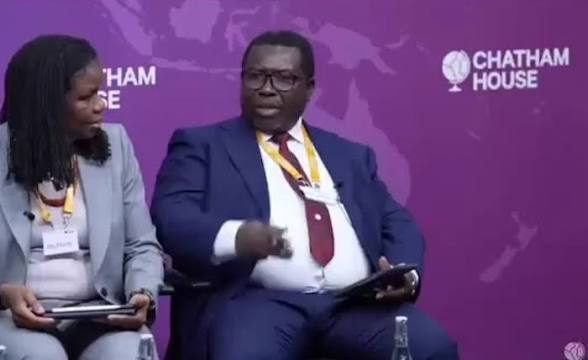
Chairman of the Independent National Electoral Commission Professor Joash Amupitan has rejected allegations that he is politically biased, saying he has never owned or operated a social-media account linked to him and that the claims have been referred to security agencies for investigation.
The comments come as preparations for presidential and legislative elections in January 2027 get underway.
Speaking at a high-level event hosted by Chatham House in London in collaboration with the Kimpact Development Initiative, Amupitan said an independent forensic examination had been conducted into claims that his phone number was associated with a controversial account on X, formerly Twitter.
He said the matter had also been referred to the Department of State Services (DSS) and the Inspector-General of Police (IGP).
Amupitan addressed concerns about his prior involvement in politically sensitive court cases, saying his participation was strictly tied to his professional responsibilities as a lawyer before taking office.
He said those engagements would not affect his impartiality as head of INEC.
“My loyalty is solely to the Constitution of the Federal Republic of Nigeria (FRN) and the Electoral Act,” he said.
“Every constitutional institution, including the Presidency, the National Assembly, and state governors, owes its primary loyalty to the Constitution and the rule of law.”
The INEC Chairman also responded to allegations of irregularities in the national voter register, including reports that registered voters in an Ebonyi State ward had increased by 85 percent.
He said the commission had reviewed the complaint and taken steps to resolve it in line with the law.
Amupitan said the Electoral Act allows Nigerians to raise objections, submit claims and request certified true copies of the voter register.
He described those provisions as part of the commission’s effort to promote transparency and accountability in the electoral process.
Amupitan urged young Nigerians to play a more active role in shaping the country’s political future.
He said responsibility for building a better Nigeria rests partly on the younger generation.
He warned that the spread of false information and digital disinformation could erode public confidence in democratic institutions.
“Misinformation is among the greatest dangers facing our democracy,” he said.
“Citizens should verify information before acting on it or sharing it, and allow our democracy the opportunity to succeed.”
