

The Nigerians in Diaspora Commission (NiDCOM) will hold its 9th Nigeria Diaspora Investment Summit (NDIS) on November 10 and 11, with a target of attracting up to $100 billion in diaspora investment into the Nigerian economy every year.
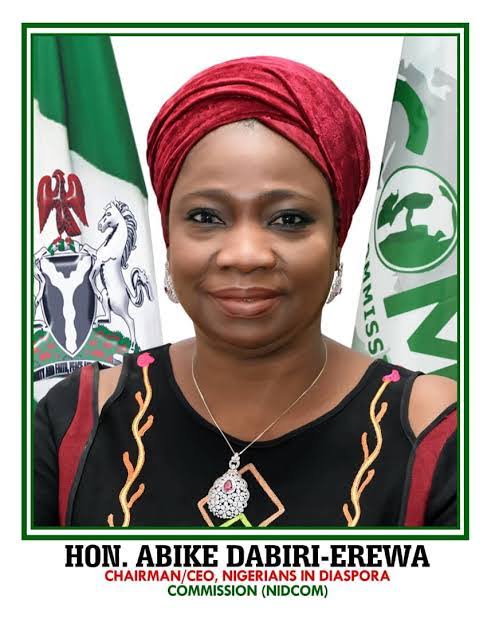
Announcing the summit on Friday in Abuja, NiDCOM Chairman/CEO, Abike Dabiri-Erewa, said the diaspora holds financial, entrepreneurial and intellectual capital far beyond remittances, and if fully harnessed, could help drive the Federal Government’s ambition of building a $1 trillion economy.
She said the summit will focus on closing the trust deficit that often discourages Nigerians abroad from investing at home.
The event is themed “Bridging the Trust Gap: Connecting Diaspora Capital with Credible Home-based Opportunities.”
Dabiri-Erewa said the diaspora represents more than a source of remittances, describing it as a reservoir of financial, entrepreneurial, professional and intellectual capital.
If fully mobilised, she said, it could channel as much as $100 billion into the economy annually.
She argued that Nigeria must treat its diaspora as an economic asset rather than merely a social network.
She, however, acknowledged that converting that potential into investment would require more than marketing investment opportunities.
“Unlocking this potential requires transparency, robust investor protection, credible institutions, reliable information and effective regulatory frameworks,” she said, identifying the issues that often make Nigerians abroad hesitant to commit capital at home.
The summit will be held virtually on Zoom, with limited in-person attendance at the Shehu Musa Yar’Adua Centre in Abuja.
NiDCOM scaled back the physical component because of the approaching national election campaign season.
The first day will open with addresses, goodwill messages and a keynote presentation, followed by a session on Nigeria’s capital markets.
Participants will include the Securities and Exchange Commission ( SEC), Nigerian Exchange Group (NEG), Central Bank of Nigeria (CBN) and Ministry of Finance Incorporated.
The second day will focus on bankable infrastructure projects and public-private partnerships.
The Infrastructure Concession Regulatory Commission (ICRC), Nigerian Sovereign Investment Authority (NSIA), Ministry of Finance Incorporated and Corporate Affairs Commission (CAC) are expected to participate.
A later session will examine regulatory frameworks and investor protection, including business registration, due diligence and anti-fraud safeguards.
The Presidential Enabling Business Environment Council, Nigerian Export Promotion Council (NEPC) and sector regulators are also expected to take part.
The emphasis on investor protection reflects a central challenge for Nigeria: attracting capital requires not only opportunities, but assurances that contracts will be enforced, funds will be secure and regulators will operate predictably.
Dabiri-Erewa commended First Bank of Nigeria and other partners for supporting the summit.
She said this year’s event would lay the groundwork for the 10th anniversary summit in 2027.
NiDCOM invited Nigerians in the diaspora, business groups, professionals, institutional investors, project developers and entrepreneurs to participate in the summit.
